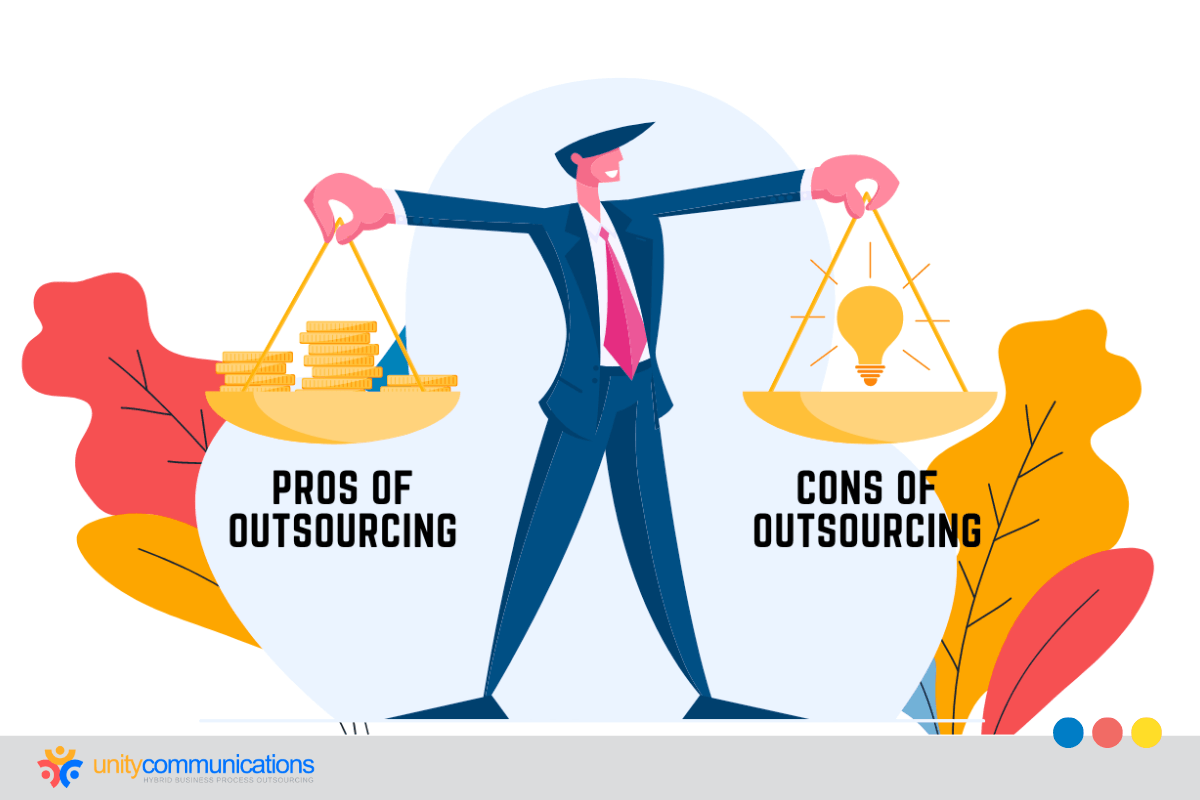


Outsourcing, primarily through BPO services, has become a go-to strategy for companies seeking to reduce costs, access specialized expertise, and maintain competitiveness. However, like any business decision, it has advantages and potential drawbacks.
Understanding the pros and cons of outsourcing is crucial before making a commitment. Making the correct choice depends on how well you weigh the trade-offs against your business goals, resources, and long-term strategy.
In this article, we’ll highlight the real-world benefits and challenges every business leader should consider before making a move.
Key advantages of outsourcing

Outsourcing can transform your business by leveraging external resources that enhance productivity, alleviate pressure on internal teams, and optimize workflows.
The key is understanding when to outsource so you can target the functions that significantly influence your bottom line and growth potential.
1. Cost reduction and efficiency
When considering the pros and cons of outsourcing, cost reduction and efficiency usually top the list of advantages. Outsourcing enables you to operate more cost-effectively without sacrificing quality or performance.
For instance, a company might outsource its customer service to a BPO provider in a lower-cost region, gaining 24/7 support at a fraction of the in-house expense.
Beyond labor savings, outsourcing streamlines processes, eliminates redundancies, and minimizes overhead. The result is a leaner operation that can do more with less.
Outsourcing can reduce costs through the following:
- Access skilled talent in cost-efficient regions to lower labor expenses. This allows businesses to maintain high-quality output without paying premium in-house salaries.
- Reduce infrastructure costs by eliminating the need for additional office space or equipment. BPO providers supply the necessary facilities and tools, saving you from significant capital investments.
- Minimize training expenses with providers who already have trained staff. This eliminates onboarding delays and ensures experienced professionals complete the work from day one.
- Spread operating costs across multiple clients, lowering the per-client expense. Shared resources make services more affordable without compromising the level of support provided.
- Reduce downtime through established workflows and faster turnaround times. Efficient systems keep projects on schedule and prevent costly delays.
With the right BPO partner, you can unlock savings while improving operational performance.
2. Access to specialized expertise and advanced technology
Among the biggest pros of outsourcing is access to specialized knowledge and advanced technology. IT outsourcing enhances your operations, demonstrating the value of external expertise. It connects you with professionals who possess specialized skills and experience that would otherwise require significant time and investment to develop in-house.
For example, a mid-sized retailer might outsource its IT infrastructure management to ensure secure cloud storage and 24/7 technical support without hiring a whole in-house team. Similarly, a startup could partner with a BPO provider to establish cybersecurity protocols and manage software updates, enabling its small staff to focus on growth.
Whether IT security, legal compliance, creative design, or technical support, BPO providers give you immediate access to talent already trained and aligned with industry best practices, making it easier to weigh the pros and cons of outsourcing for your business.
Outsourcing provides access to specialized expertise in the following ways:
- Employ certified professionals with niche, high-demand skills. These experts bring years of hands-on experience, ensuring your business benefits from proven best practices.
- Stay updated on the latest regulations, technologies, and market trends. This proactive approach keeps your operations compliant and ahead of industry shifts.
- Deliver sector-specific knowledge tailored to your industry needs. Such customization aligns strategies and solutions with your market and customer expectations.
- Offer immediate capabilities without long recruitment or training periods. This speeds up project launches and helps you respond quickly to opportunities or challenges.
- Provide access to tools, methods, and insights typically unavailable in-house. These resources can significantly improve quality, efficiency, and decision-making.
With this level of expertise on your side, you can focus on growth while specialists handle complex or technical work.
3. Focus on core business activities
Outsourcing frees your internal teams from routine or time-consuming tasks, allowing them to focus on what truly drives revenue and growth.
Instead of spreading your resources thin across administrative, technical, or support functions, you can channel more energy into strategy, innovation, and customer engagement.
For example, a retail company might outsource its IT helpdesk, allowing in-house staff to concentrate on expanding product lines and enhancing the shopping experience. This focus enhances productivity and ensures your business priorities remain front and center.
Here’s how outsourcing helps maintain focus on core functions:
- Offload repetitive administrative and operational work. This frees up valuable time, allowing your internal team to prioritize higher-value activities.
- Reduce distractions for leadership and high-impact teams. Leaders can direct their energy toward decision-making and innovation instead of routine tasks.
- Allocate more budget and manpower toward strategic projects. This reallocation accelerates growth initiatives and strengthens competitive positioning.
- Manage specialized tasks without constant oversight. It reduces the managerial burden while maintaining quality and accountability.
- Improve overall workflow efficiency across departments. Streamlined processes enhance coordination and speed across your entire organization.
Keeping your team focused on their strengths enables you to move toward long-term business goals more efficiently, while also helping you evaluate the pros and cons of outsourcing for tasks outside your core expertise.
4. Flexibility and scalability
Continuing our discussion of the pros and cons of outsourcing, BPO enables you to scale operations as business demands change. Whether launching a new product, handling seasonal peaks, or managing an unexpected workload surge, outsourcing lets you quickly adjust resources without the hassle of recruitment or layoffs.
For instance, an e-commerce brand can expand its customer support team during the holiday rush and scale back afterward without long-term staffing costs. This agility ensures your company operates at the right capacity for maximum efficiency.
Outsourcing supports flexibility and scalability through the following:
- Rapidly increasing or reducing team size based on demand. This allows your business to handle peak periods or project surges without overstaffing during slower times.
- Accessing a diverse talent pool without lengthy hiring processes. You gain instant access to skilled professionals who are ready to contribute immediately.
- Adapting contract terms to match evolving business priorities. Flexible agreements make scaling services easier as your strategy changes.
- Quickly onboarding specialized skills for short-term or urgent projects. This ensures that critical initiatives stay on track without delays caused by the recruitment and training process.
- Avoiding the financial strain of maintaining unused capacity. Outsourcing allows you to pay only for the necessary resources, thereby improving cost efficiency.
With outsourcing, you can remain nimble and responsive, regardless of how the market shifts.
5. Risk sharing and compliance support
No analysis of the pros and cons of outsourcing is complete without looking at the risks. A 2024 Gartner survey revealed that legal and compliance leaders plan to strengthen their strategic role, improve third-party risk management, and ensure that compliance programs keep pace with rapidly changing regulations.
Outsourcing supports these goals by easing workloads and sharing business risks with providers with the certifications, systems, and expertise to meet regulatory standards.
For example, a healthcare company outsourcing its billing to a partner who complies with the Health Insurance Portability and Accountability Act of 1996 (HIPAA) gains accuracy and legal protection without the expense of building an internal compliance department. The external team helps safeguard the business against costly errors and penalties.
Outsourcing supports risk sharing and compliance by:
- Leveraging providers with proven compliance frameworks (e.g., ISO 27001, SOC 2, the General Data Protection Regulation (GDPR). This ensures your business adheres to industry standards and avoids costly regulatory penalties.
- Maintaining up-to-date security measures and best practices. Regular updates protect sensitive data and reduce vulnerabilities to cyber threats.
- Providing documentation and reports for audits and inspections. Clear records make it easier to demonstrate compliance during regulatory reviews.
- Monitoring processes continuously to detect risks early. Proactive monitoring helps prevent minor issues from escalating into major problems.
- Reducing the impact of potential disruptions through established contingency plans. Having backup procedures ensures operations remain stable even during unexpected events.
Partnering with experts strengthens your compliance posture while minimizing risk exposure, all while giving you a clearer view of the pros and cons of outsourcing in regulated industries..
6. Access to advanced technology
BPO services often provide you with tools and technical capabilities that might otherwise be too expensive or complex to implement in-house. From automation platforms to advanced analytics, outsourcing partners invest heavily in technology to improve efficiency and performance.
For instance, a retail business outsourcing its customer support might gain access to AI-driven chatbots, customer relationship management (CRM) integrations, and real-time reporting dashboards without the upfront development costs. You stay competitive without straining your budget or IT resources.
Outsourcing grants access to advanced technology by:
- Providing automation tools to streamline repetitive tasks. This reduces manual effort, speeds up processes, and frees your team to focus on higher-value work.
- Offering cloud-based platforms for seamless collaboration. Teams can collaborate in real time from anywhere, enhancing efficiency and communication.
- Using AI and machine learning for predictive insights and process optimization. These technologies help anticipate trends, prevent issues, and make operations more proactive.
- Delivering advanced analytics for informed decision-making. Access to actionable data empowers leaders to make smarter, faster, and more strategic choices.
- Continuously upgrading systems to keep pace with industry trends. Staying current with the latest tools keeps your business competitive and agile.
With the right BPO partner, you can leverage cutting-edge tools that drive growth and efficiency, while understanding the pros and cons of outsourcing to meet your business needs.
The disadvantages of outsourcing

While BPO offers numerous pros, it also requires careful planning and execution. Understanding the cons of outsourcing will enable you to make informed decisions and select the most suitable BPO services for your specific needs.
By anticipating potential issues, you can set safeguards to protect your operations and long-term goals.
1. Loss of control
A common disadvantage of outsourcing is the risk of losing control over specific processes. The U.S. outsources approximately 300,000 jobs annually, highlighting the prevalence of businesses that rely on external providers.
However, when an outside team manages certain functions, companies might face reduced oversight, which can affect responsiveness and quality control.
For instance, a business outsourcing its IT help desk might need to follow the provider’s ticketing protocols instead of making immediate adjustments, which could lead to potential delays or misalignment without clear communication.
Here’s how outsourcing can reduce operational control:
- Relying on the provider’s processes instead of your own. Your business might need to adjust internal workflows to align with the vendor’s systems, which can require flexibility and adaptation.
- Having less direct influence over day-to-day decision-making. The outsourcing partner might guide key operational choices, limiting immediate control.
- Needing to adapt to the vendor’s timelines and workflows. The provider’s schedule might determine the project’s pacing, which could affect your internal planning.
- Risking slower response times for urgent issues. Depending on the provider’s availability, urgent matters might not be addressed as quickly as in-house.
- Not meeting performance expectations. Misalignment between your standards and the vendor’s approach can create gaps in outcomes unless managed carefully.
Clear agreements, performance metrics, and regular reviews can help maintain control even when operations are outsourced, ensuring you stay aware of the pros and cons of outsourcing.
2. Communication and cultural barriers
Working with outsourcing partners in different locations can introduce challenges in communication styles, time zones, and cultural expectations. Even slight differences, such as preferred work methods or response times, can lead to misunderstandings if not addressed early.
For instance, a U.S.-based company outsourcing customer support to another country might encounter variations in tone or problem-solving approaches that affect customer satisfaction.
Outsourcing can create communication and cultural gaps in the following ways:
- Time zone differences can delay responses or project progress. Projects might take longer if teams cannot coordinate in real time across regions.
- Language nuances lead to misinterpretation of instructions. Subtle differences in phrasing can result in errors or misaligned expectations.
- Varied approaches to problem-solving or decision-making. Differences in work styles might require additional coordination to ensure consistent results.
- Different holiday schedules affect availability. Planning around regional holidays is essential to avoid unexpected downtime.
- Customer expectations do not align with the service delivery style. Cultural differences in communication or service norms can affect perceived quality and satisfaction.
Establishing clear communication protocols, cultural training, and overlapping work hours can help bridge these gaps effectively.
3. Quality and reliability concerns
Studies show that strong quality management directly boosts sales and profitability, underscoring the importance of aligning with the right BPO partner. However, outsourcing can create uncertainty if a provider’s standards do not match your own, leading to inconsistent results or customer dissatisfaction.
For instance, an e-commerce company outsourcing product descriptions might receive technically correct content, but without the unique brand voice that customers expect.
Outsourcing can lead to quality and reliability issues:
- Varying quality control measures between your team and the provider. Differences in standards might result in inconsistencies unless closely monitored and aligned.
- Inconsistent performance due to staff turnover at the outsourcing company. High turnover can disrupt workflow continuity and require additional oversight.
- Limited oversight. Without direct supervision, small mistakes might go unnoticed until they escalate.
- Over-reliance on templates or generic solutions. This can reduce customization and limit responsiveness to specific business needs.
- Lack of familiarity with your company’s brand or customer preferences. The BPO team might require time to fully understand your values, style, and client expectations.
Regular audits, performance reviews, and clear quality benchmarks can help maintain your expected standards, while also giving you insight into the pros and cons of outsourcing.
4. Data security and confidentiality risks
Data security is often cited as one of the most significant disadvantages in the pros and cons of outsourcing. In 2024, CrowdStrike identified 26 new threat actors, with over half of vulnerabilities tied to initial access attempts.
This highlights the importance of approaching outsourcing carefully. Granting third parties access to sensitive company or customer data can create serious risks if not properly managed.
Without strict safeguards, businesses face potential data breaches, regulatory noncompliance, or misuse of confidential information. For instance, healthcare providers outsourcing medical billing must protect patient records under HIPAA standards.
Outsourcing can lead to data security and confidentiality issues:
- Increased exposure of sensitive data to third parties. Sharing information with external teams raises the potential for accidental leaks or misuse.
- Weak security protocols or outdated systems at the provider’s end. Without robust safeguards, your data could be vulnerable to cyberattacks.
- Insider threats from the outsourcing partner’s staff. Employees with access to sensitive information might intentionally or unintentionally compromise security.
- Insufficient compliance with industry-specific regulations. Noncompliance can lead to fines, legal issues, and reputational damage.
- Delays in detecting and responding to breaches. Slow incident response increases the impact and recovery time of security incidents.
Selecting a provider with robust security certifications and conducting regular security audits can help protect your information assets.
5. Hidden costs and contract complexity
Many U.S. startups turn to outsourcing with providers in developing countries to cut rising labor costs. While this approach seems cost-effective initially, hidden expenses can arise from unclear contracts, shifting scopes, or additional service fees.
For example, a business might face unexpected charges for services they assumed were covered, such as ongoing support or software licensing.
Here’s how outsourcing can create hidden costs and contract issues:
- Ambiguous pricing models that leave room for unexpected charges. Unclear terms can make it difficult to predict total expenses, affecting your budget planning.
- Additional costs for overtime, rush projects, or service upgrades. You might incur extra fees if the project’s demands exceed the agreed-upon scope.
- Fees for early termination or contract amendments. Changing business needs can trigger costly penalties if contracts aren’t flexible.
- Expenses from resolving disputes or renegotiating terms. Time and resources spent on negotiations can erode the cost benefits of outsourcing.
- Overlooked charges for technology, infrastructure, or training. Hidden operational expenses can accumulate, reducing the overall return on investment.
Reviewing contracts, clarifying deliverables, and budgeting for contingencies can help prevent financial surprises while keeping the pros and cons of outsourcing in perspective.
6. Dependency on the outsourcing partner
Relying heavily on a single external provider can create strategic and operational risks for your business. If the partner experiences disruptions, performance issues, or shifts in priorities, it can directly affect your operations.
For example, a retail company that outsources its entire customer service department to one provider could face severe delays and customer dissatisfaction if that vendor experiences a staffing shortage.
Similarly, a software firm relying on a single offshore development team might see project timelines slip if the partner’s priorities shift to other clients.
Dependency can harm your business in the following ways:
- Over-reliance on one vendor for critical functions. This can make your business vulnerable if the provider fails to deliver or faces operational challenges.
- Limited internal capability development. Relying too heavily on outsourced expertise might hinder the growth of in-house skills and knowledge.
- Difficulty switching providers or scaling independently. Transitioning to a new vendor or bringing functions back in-house can be costly and time-consuming.
- Potential misalignment with long-term business goals. The partner’s capabilities, priorities, or contract terms might limit critical decisions.
- Risk of complacency in monitoring performance. Heavy dependence may lead to reduced oversight, thereby increasing the likelihood of errors or inefficiencies.
With careful planning and multiple risk mitigation strategies, you can manage dependency while reaping the benefits of outsourcing, all while weighing the pros and cons of outsourcing for your business.
Is outsourcing right for your business?

The pros and cons of outsourcing necessitate a careful evaluation. By weighing the benefits against the risks, businesses can make informed decisions that align with their goals.
The right approach is to understand how each factor affects your operations, finances, and long-term strategy. With a balanced analysis, outsourcing can become a strategic advantage rather than a gamble.
Tactics to evaluate outsourcing fit
Before committing to a BPO partnership, it is essential to evaluate how outsourcing aligns with your specific business needs. This ensures that you are choosing solutions that support your growth.
A thoughtful evaluation process reduces the chances of unexpected costs, quality issues, or operational disruptions. Key tips for evaluating outsourcing fit include:
- Identify your core priorities. Determine which functions to keep in-house and which to outsource without harming your competitive advantage.
- Calculate total cost impact. Factor in all potential expenses, including hidden fees, transition costs, and ongoing management.
- Assess vendor capabilities. Verify expertise, technology, and track record in your industry.
- Consider scalability. Ensure the provider can adjust resources to match your future growth or seasonal needs.
- Review compliance and security measures. Confirm the vendor meets your industry’s regulatory requirements and data protection standards.
These steps can help you confidently determine whether outsourcing is right for your business.
Importance of clear contracts, due diligence, and strong partnerships
A successful outsourcing arrangement is more than finding the lowest cost. It is also about building a trust, transparency, and accountability partnership.
Clear contracts set expectations, due diligence reduces risks, and ongoing collaboration ensures consistent results. They create a solid foundation for a long-term, mutually beneficial relationship.
The following are best practices to ensure outsourcing success:
- Draft detailed contracts. Define deliverables, timelines, KPIs, payment terms, and dispute resolution processes.
- Conduct thorough due diligence. Research vendor reputation, financial stability, and client references before committing.
- Establish strong communication channels. Set regular check-ins, reporting schedules, and escalation procedures.
- Align goals and expectations. Ensure both parties understand and agree on performance standards and success metrics.
- Foster long-term collaboration. Treat the vendor as a strategic partner, not just a service provider.
To weigh the pros and cons of outsourcing effectively, you must align your BPO strategies with your long-term goals. By prioritizing these measures, you can protect your business interests while building a productive and reliable outsourcing relationship.
What is outsourcing?
Grand View Research projects that the outsourcing market will grow to $525.23 billion by 2030. Outsourcing involves delegating specific tasks or functions to external providers rather than handling them internally. Understanding how outsourcing works helps streamline operations, cut costs, and access specialized expertise.
In particular, business process outsourcing (BPO) focuses on contracting out specific operational tasks to third-party experts. Choosing the business processes to outsource depends on your goals, resources, and the complexity of the work.
Here are examples of business processes to outsource:
- Customer service and call center support
- Payroll processing and HR management
- IT support and software development
- Accounting and bookkeeping
- Marketing and content creation
- Data entry and administrative tasks
- Procurement and supply chain management
Why does outsourcing work for many businesses? When done strategically, it can free up internal resources and help you focus on business growth.
What’s the difference between outsourcing and offshoring?
The history of BPO dates back to the late 20th century, when companies began delegating non-core tasks to specialized service providers to cut costs and improve efficiency.
Understanding the difference between outsourcing and offshoring is essential for making informed business decisions. While both strategies involve leveraging external expertise, they operate in distinct ways.
Key differences include:
- Location. Outsourcing is contracting specific tasks or processes to a third-party provider, which can be located domestically or internationally. Offshoring refers to the relocation of business processes or services to another country, typically to benefit from lower labor costs.
- Scope. Outsourcing focuses on “who” performs the work, while offshoring focuses on “where” the job is done.
- Control. Outsourcing might involve relinquishing some process control, while offshoring can maintain in-house management with overseas execution.
- Primary driver. Expertise and efficiency drive outsourcing, while cost savings and resource availability mainly drive offshoring.
Many top BPO companies offer outsourcing and offshoring solutions, allowing businesses to tailor strategies for maximum impact.