


Outsourcing risks show up in what the contract leaves out, such as the fee no one itemized or the ticket backlog no one flagged. Most leaders find these gaps months into an engagement, after the SLA is signed and the budget is set.
BPO services reduce this exposure only when governance and accountability sit inside the contract from day one. This guide covers the risks that catch leaders off guard, how they play out in practice, and what to review before signing.
What are the leading outsourcing risks in 2026?

Outsourcing risks span control, data, vendor, and cost. Equally significant are communication, compliance, AI, and geopolitical gaps.
Ignoring these risks gets costly fast. Before you sign, it’s worth weighing the risks and drawbacks of BPO: Is outsourcing right for your business? The eight areas below show how these risks play out for real companies and what to check before you commit to a provider.
1. Loss of control (over quality, processes, and service standards)
Loss of control occurs when a provider runs daily operations and your visibility into quality, workflows, and service standards begins to shrink.
Real-world example: An MSP hands ticket resolution to an BPO team. By month three, tickets that once closed in four hours take two days, since the provider works its own queue first. Nobody flags the drift inside the company until clients start complaining on monthly calls.
What it looks like when it goes wrong: Fixes take longer than they used to. Quality checks no longer match your original standards. Your team spends hours chasing status updates instead of closing tickets. Then the clients notice the change before your internal reports do.
Set clear checkpoints and review points in the contract before work begins. Outsourcing risks such as this grow when oversight shrinks as daily work shifts to their team.
2. Data security and privacy risks
Data security risk refers to how a provider stores and protects your information. Weak controls can expose client records and trade secrets.
Real-world example: A logistics company outsources support. The vendor’s team shares logins instead of individual accounts. A former contractor accesses the system months after the contract ends, before anyone notices.
What it looks like when it goes wrong: Passwords get shared among the team instead of assigned to individuals. Permissions never get revoked when contracts end or staff leave. Gaps remain unnoticed until a breach forces you to explain them to clients.
This is one of the risks that extends beyond a single employee’s mistake. According to the 2026 Thales Data Threat Report, human error caused 28% of breaches. Around 63% of organizations put nation-state attackers among their top security concerns. Before signing, review a vendor’s access controls and its incident response time.
3. Vendor dependency and lock-in risk
Vendor dependency and lock-in risk grow as your systems, data, and workflows depend on a single provider, raising switching costs.
Real-world example: A retail company keeps its order system on one provider’s custom platform. A planned switch shows that moving orders, inventory data, product catalogs, and customer records would take eight months and cost more than the original contract.
What it looks like when it goes wrong: Your data sits in formats only the vendor’s tools can read. Staff know one system and no other. Price increases land, and you have no alternative. Exit clauses remain vague or missing, leaving your business with fewer options at contract renewal.
These outsourcing risks shrink your options, so ask for data portability terms and a documented exit plan before you move forward with the contract. Your choices might become harder to expand once renewal begins.
4. Hidden costs
Your original quote can lose value as added fees, scope changes, and add-on charges push outsourcing spend beyond the agreed price.
Real-world example: A manufacturer signs a fixed-price support contract. The provider begins billing after-hours support, extra reports, and system upgrades as separate services. The quarterly invoice exceeds the finance team’s budget by almost twice in the first six months.
What it looks like when it goes wrong: Change requests get billed as extras instead of being covered under scope. Invoices carry line items nobody explained during negotiations. Support tiers that seemed included require an upgrade fee. Finance flags the gap only after several billing cycles pass.
Request a fixed, itemized scope before signing the contract, including clear limits on change requests. List the price for every service tier and add-on, and require written approval for any new charges.
5. Communication and cultural misalignment
Time zones shrink daily overlap, language differences slow clarifications, and different communication norms mean a problem can go unspoken instead of flagged.
Real-world example: A product manager sends specifications to an offshore development team, confident the requirements are clear. The developers spot two ambiguous points but say nothing, since questioning a client feels disrespectful in their office culture. The build ships three weeks late, leaving half the features missing.
What it looks like when it goes wrong: Instructions get read as strict rules or as loose suggestions. A question that takes five minutes in the same office takes two days by email. Meetings are scheduled at times that suit one team and drain the other. Small gaps stack up until the finished work looks little like the brief.
To help both teams align, share work hours, and document key instructions. These habits reduce outsourcing risks tied to communication before they turn into missed deadlines.
6. Compliance and regulatory exposure
Regulatory exposure grows when your provider fails legal, labor, or industry requirements, exposing your business to fines, back pay claims, or enforcement action.
Real-world example: A healthcare company hires a billing provider handling European patient data. The provider claims full GDPR compliance before the contract takes effect. A GDPR audit uncovers missing controls, leaving the client responsible for responding to regulators.
Labor law adds a second layer of exposure. A company that sets an outsourced worker’s hours, assigns daily tasks, or supervises them directly can trigger worker misclassification claims in jurisdictions that test for actual control rather than contract labels.
Outsourcing across borders also means each country’s wage, benefits, and termination rules apply on their own terms. A provider’s compliance in one location does not cover you in another.
What it looks like when it goes wrong: Required compliance records go missing, and audit responses arrive late. Contract terms fail to match regulatory obligations. Misclassification claims appear after a labor authority reviews how outsourced staff are actually managed, not just what the contract says. Your provider fixes issues after violations are found instead of before.
Your legal responsibility stays with your business, even after outsourcing. About €1.2 billion in GDPR fines were issued during 2025, based on DLA Piper’s 2026 GDPR Fines and Data Breach Survey. The report found an average of 443 daily breach notifications. Review compliance evidence, including labor classification practices, before approving the agreement.
7. AI-related risks
Your third-party provider’s use of automated decisions can increase AI governance risk when review and human oversight remain limited.
Real-world example: An insurance company hires a claims processing provider using AI to review supporting documents. The AI overlooks policy exceptions and flags valid claims for rejection. Claims staff approve the recommendations without checking the flagged cases, delaying legitimate claims until customers file complaints.
What it looks like when it goes wrong: Staff cannot explain how AI reached a decision. Similar claims receive different outcomes. No review process exists for disputed results. Human review begins only after customers challenge the decision. Outsourcing risks increase when automated decisions proceed without clear oversight.
Per Deloitte’s 2026 State of AI in the Enterprise, only 21% of organizations have a mature governance model for autonomous AI. Examine your provider’s process for monitoring AI decisions, validating outputs, recording human interventions, and involving employees when automated decisions need another look.
8. Geopolitical and operational continuity risks
Geopolitical events and operational disruptions can interrupt your provider’s services, delaying delivery despite stable internal operations.
Real-world example: One offshore delivery center supports every customer service request. Continuous flooding disrupts transportation and causes outages. It also interrupts internet access. Customer requests are building because no secondary site is ready to take over the workload.
What it looks like when it goes wrong: Service backlogs grow, while contract commitments slip. Customers wait longer for updates. Your provider shifts work after disruptions begin, rather than following a tested continuity plan. The risks of offshore outsourcing become clear when a single location supports your entire operation.
Include your BPO provider’s business continuity and disaster recovery plans in your contract review before approving the outsourcing agreement. Confirm backup sites, recovery targets, staffing coverage, and communication procedures. For more guidance, read offshore BPO: navigating the benefits, risks, and best practices before choosing a third-party contractor.
What has changed in 2026 that raises outsourcing concerns?

Cost used to drive outsourcing choices. AI adoption, data rules, and global instability carry just as much weight for companies in 2026.
AI tools cover ground once left to in-house teams, drafting reports and analyzing data among them. Providers add these tools to their delivery, and the split between internal and outsourced work shifts as a result.
Data sovereignty rules limit where you store and process customer information beyond your home country. Countries add requirements for local hosting, transfer approvals, and audit access, reducing your list of eligible outsourcing locations each year.
Conflict in one region can delay shipments in another, and supply routes change with little notice. These scenarios push you to rethink where you place work and raises outsourcing risks tied to location choice. Leaders must weigh outsourcing benefits and risks together and give governance and long-term operational continuity far more weight.
Why do outsourcing problems happen in the first place?
Outsourcing problems happen because planning and governance gaps exist before you sign, not because the provider alone fails.
- Poor due diligence. Unchecked capabilities lead to mismatches after signing.
- Unrealistic expectations: Savings come slowly, since new teams need time to learn your business.
- Weak governance. Unclear ownership leaves decisions unmade.
- Incomplete contracts. Vague terms mean each side reads the contract differently.
- Lack of communication. Skipped check-ins create gaps that turn into missed deadlines.
- Misaligned incentives. Volume-based pay favors output over quality.
Unchecked, these causes accumulate, and the risks remain hidden until damage occurs.
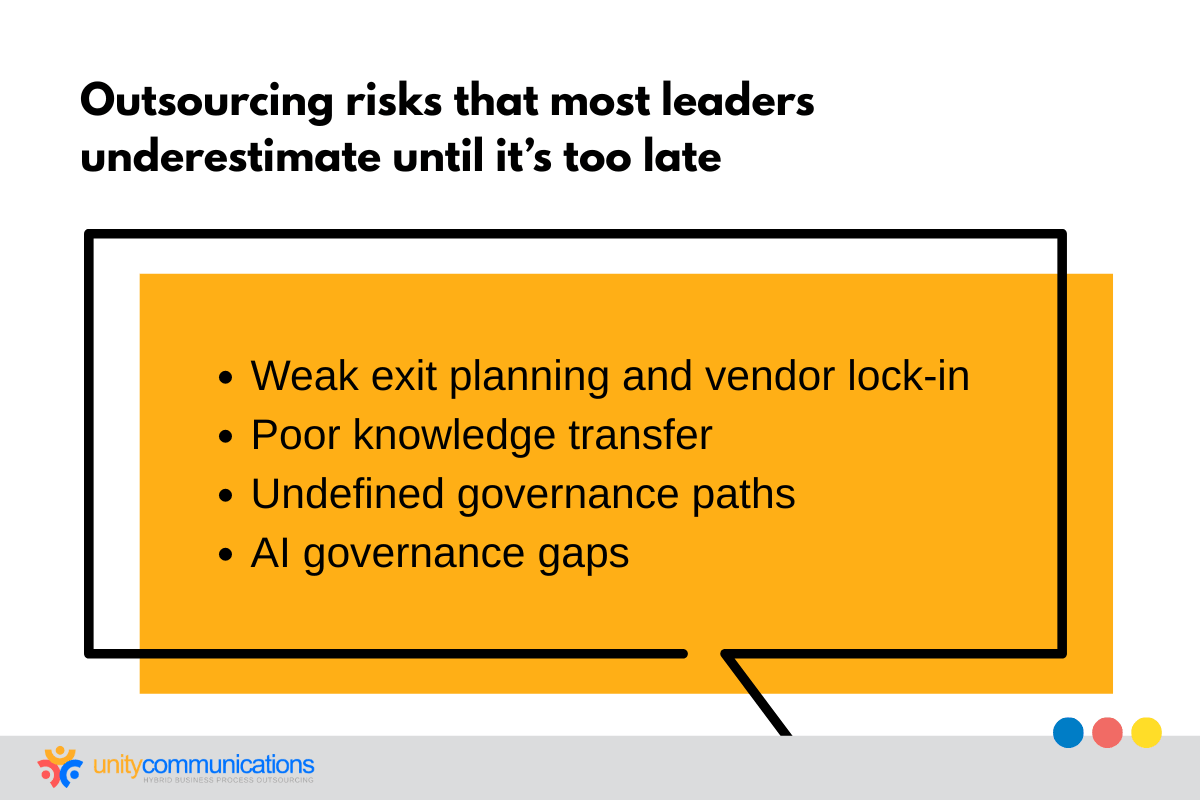
Real engagements show these gaps in action. For outsourcing risks examples grounded in actual outcomes, read outsourcing case studies: lessons learned from successful and failed outsourcing.
Which outsourcing contract terms deserve the closest scrutiny?
SLAs, pricing, data security, compliance, liability, and exit rights deserve the closest scrutiny in any outsourcing contract.
Check these nine clauses before you sign to minimize outsourcing risks:
- SLAs and KPIs. Define measurable targets, or performance stays unverifiable.
- Scope and change requests. Lock scope terms, or costs creep with each request.
- Pricing and hidden costs. List every fee, so invoices carry no surprises.
- Data security and confidentiality. Who has access, and how fast?
- Compliance obligations. Assign regulatory ownership to support outsourcing risk management.
- AI usage and governance. Require disclosure of automated decisions and review steps.
- Liability and indemnification. Cap exposure, since these clauses drive outsourcing contract risks.
- Audit and reporting rights. Secure access to records and performance data.
- Termination and exit. Determine transition timelines and knowledge-transfer responsibilities.
Review BPO risk management framework: navigating key essentials for a complete checklist.
How can you check your outsourcing exposure before signing a contract?
Assess outsourcing exposure by reviewing where your operations, data, vendors, and governance pose the greatest risk before signing.
- Business objectives and scope. Name the issue you’re solving before outsourcing due diligence begins.
- Operational criticality. Rank each function by its daily impact for closer oversight.
- Data sensitivity and compliance requirements. Know what data leaves and the rules involved.
- Internal governance and stakeholder readiness. Identify an owner and set escalation paths before issues arise.
- Vendor capabilities and financial stability. Review financial health as one measure of vendor risk in outsourcing.
- Business continuity and resilience. Confirm backup plans before relying on a single provider.
- Exit readiness. Set portability and transition terms before signing, as delays favor them.
Run this assessment before entering contract talks with a clear view of your exposure, backed by evidence rather than the vendor’s version of your readiness.
How does Unity help businesses manage outsourcing challenges?

Unity Communications handles outsourcing challenges through clear contracts, measurable performance, and steady accountability.
Unity sets clear SLAs, performance metrics, and escalation steps for each specific engagement, agreed upon before work begins. Governance meetings review results against targets, and quality checks catch gaps before they grow, keeping delivery consistent throughout the contract.
Contracts specify accountabilities in plain words. Hence, both parties know who owns each task. When inquiries arise, scheduled check-ins and shared reporting help resolve them before misunderstandings grow, mitigating outsourcing risks.
Governance remains an ongoing practice at Unity. Clients see compliance status, continuity plans, and open issues through regular reviews. Problems get solved as a joint effort.
Outsourcing keeps some risk in place, and no provider can clear it completely. Strong governance and shared accountability help you realize the benefits of outsourcing while exposure remains manageable throughout the contract’s life.