


Compliance outsourcing matters because you operate under specific federal laws and industry regulations. Non-compliance carries severe consequences. These range from regulatory sanctions to reputational damage.
Compliance also benefits you directly. It can reduce cybersecurity risks and improve customer trust.
This article helps you better understand the value of compliance in business process outsourcing (BPO). It also teaches you how to run a compliance audit.
What is compliance in BPO?
Compliance in BPO means adhering to policies, regulatory standards, and procedures set by different stakeholders. These can refer to your company, industry, or government. It covers in-house rules, state and federal laws, and published industry standards.
A BPO compliance program has several benefits:
- Catches regulatory failures at the provider level before they affect you
- Assigns a dedicated team to monitor the provider’s compliance
- Protects your reputation through enforced data protection standards
- Gives you visibility into how the provider handles compliance updates
- Keeps the provider’s teams current on policies that affect your data
- Documents how compliance policies are developed, enforced, and tracked
Compliance programs help you pass regulatory audits and avoid stiff penalties. According to the 2023 Interagency Guidance from the Federal Reserve, FDIC, and OCC, outsourcing does not diminish a company’s compliance obligations.
In other words, your business remains accountable for BPO violations. This is especially true if the issue involves data handling.
When a BPO company understands the laws, your compliance risk drops. Properly trained staff members are also more likely to report illegal or unethical activities.
While compliance matters in every outsourcing relationship, three industries face the highest stakes. These are healthcare, call centers, and finance.
What is outsourcing compliance for healthcare?
A healthcare BPO compliance program is a written plan that sets policies, procedures, and ethical standards for handling protected health information (PHI).
The cost of healthcare regulatory failure is high. According to Ogletree Deakins, civil monetary penalties on individual HIPAA cases range from $25,000 to $3 million. This makes compliance an essential component in any growing business strategy.
Beyond fines, a violation can make it harder to find a trustworthy BPO partner. It might also force you to switch providers mid-contract. You might hesitate to trust BPO teams with a history of violations—and rightly so. Meanwhile, patients might leave or even sue your business.
A healthcare compliance outsourcing plan should address risk areas. These include billing, claims processing, and electronic health records storage.
Healthcare compliance software supports ongoing auditing and monitoring of this plan. The platform helps you track whether your provider is meeting compliance benchmarks in real time.
What does compliance mean in call center outsourcing?
Call center compliance covers how agents handle customer data on every call. The rules that apply depend on what data outsourcing companies touch.
Most call center work sits inside four regulatory frameworks:
- PCI DSS governs credit card data captured by phone.
- TCPA and Do Not Call rules apply to outbound calling in the U.S.
- GDPR and CCPA protect personal data for EU and California residents.
Call recording laws also vary by state and country. Some jurisdictions require all parties to consent before recording.
The operational controls are specific. For instance, DTMF masking allows a customer to type card digits on the keypad. The agent never sees the number. Pause-and-resume recording keeps card data out of your audio archive.
Ask your BPO provider for a documented in-house policy with clear rules and accountabilities. The document must include a checklist that names the most common errors and their consequences. They should also train agents on the legal basis for each rule, so they understand what they are protecting.
What is the compliance program for finance outsourcing?
Compliance in outsourcing finances means adhering to federal and state laws that protect the stability and integrity of financial systems.
Attackers follow the money. Verizon’s 2025 Data Breach Investigations Report recorded 3,336 data security incidents in the finance and insurance sector. Ninety percent of those attacks were financially motivated.
Your provider’s policies and procedures are the starting point for managing this risk and protecting your BPO results. Ask whether your provider has a designated corporate compliance officer (CCO). This role guides adherence to financial rules and leads the response during cyberattacks.
How do you conduct a compliance audit in BPO?
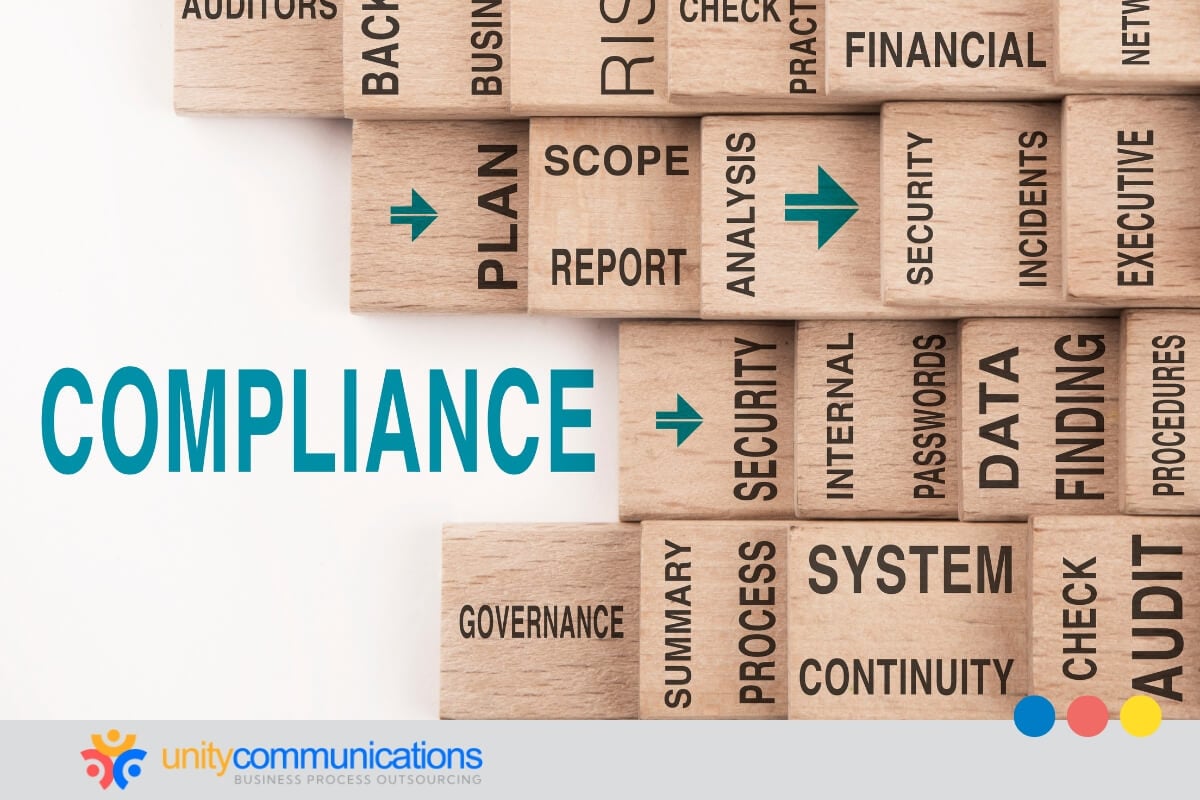
A compliance audit checks whether your BPO partner meets the outsourcing compliance standards that protect your data and customers. You can learn more about the process in our BPO learning center. But to give you an overview, consider these steps:
1. Select a qualified auditor
Choose the person who will run the audit. You can assign your own compliance officer if they understand the outsourced processes. They already know what your company needs to protect.
You can also hire an independent auditor. External auditors bring objectivity and specialized expertise. They are harder for your BPO partner to influence.
2. Align objectives with regulatory standards
List the regulations your BPO partner must follow on your behalf. For instance, GDPR governs the processing of personal data for EU residents. HIPAA covers health information.
Then ask three questions about how your provider operates:
- Where does sensitive data enter their systems?
- Who can access it?
- How long do they retain it?
Review access controls next. Check whether permissions match actual job roles. Flag any gaps between what the regulation requires and what the provider delivers.
Build a concise checklist from those gaps. Each item should name the regulation, the control it requires, and the person responsible for fixing it. This structure gives you a paper trail of what was tested and what was corrected.
3. Define audit scope with stakeholders
Schedule a meeting between your senior stakeholders and the auditor. Use this conversation to align expectations and refine the checklist against operational realities.
Define the audit scope based on your business environment. Where is your regulatory exposure highest? Which processes carry the most risk to your customers? Focus the audit there first.
4. Analyze operations for gaps
The auditor coordinates with your BPO partner’s line managers. The review assesses whether their processes align with your internal policies and external regulations.
The auditor then reports strengths and weaknesses. The findings show where your provider falls short. They also show where your own oversight processes need tightening. Act on both.
5. Use audit tools to streamline the work
Audit management software speeds up the process. The right tools help schedule audits and analyze results. They can also evaluate controls, such as encryption. You get more accurate compliance reports in less time.
Build these audits into your BPO long-term planning strategies. Run them at least quarterly or twice a year.