

Offshoring and outsourcing are often used interchangeably, but they describe distinct strategies.
Outsourcing delegates business functions to a third-party service provider. Offshoring means moving business operations to another country under your own management.
Choosing the wrong model can stall growth or strain resources. This guide covers eight key differences in offshoring vs outsourcing to help you decide. For a closer look, explore our guide on BPO in the Philippines.
Outsourcing vs offshoring: How do they compare?

The core difference between offshoring and outsourcing is ownership. Outsourcing delegates work to a vendor. Offshoring relocates your operations to another country under your direct control.
Outsourcing hires an external service provider to manage specific business functions. You can outsource to the Philippines, Eastern Europe, or a domestic vendor. Outsourcing companies handle the workforce and daily delivery. You no longer manage those functions in-house.
Offshoring builds an operation from the ground up in another country. You own the facility, hire the staff, and run the operation yourself. Common offshoring locations include India and the Philippines, Romania, and Mexico.
According to Grand View Research, the global outsourcing services market reached $4.2 trillion in 2025. It is projected to grow at a CAGR of over 11% through 2030. That scale reflects broad adoption across industries. Understanding offshoring vs outsourcing helps you decide which model fits your goals.
| Outsourcing | Offshoring | |
|---|---|---|
| Definition | Contracting work to an external provider | Moving operations to another country |
| Action | Delegating tasks to a third-party vendor | Relocating operations or jobs overseas |
| Goal | Focus on core operations | Reduce labor and operating costs |
| Workforce | Vendor’s employees | Your own employees |
| Location | Within or outside your country | Outside your country |
Nature of work
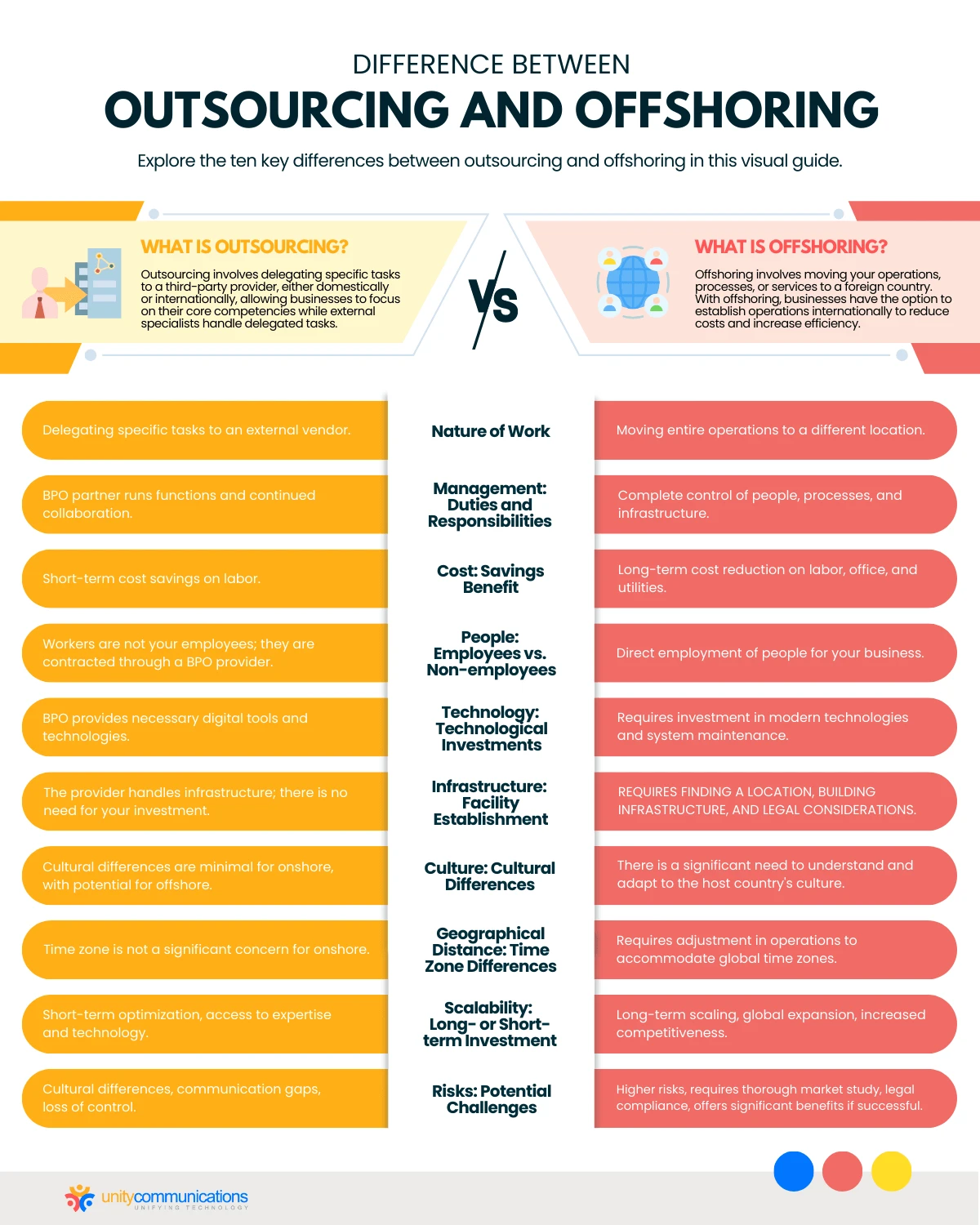
The nature of the work is the clearest distinction. Outsourcing delegates specific tasks to an external vendor. Offshoring moves entire operations to a different country under your direct ownership.
Here are real-world examples:
- Hiring a Philippine BPO team to manage customer support is outsourcing. Software development outsourcing follows the same model. You contract an external development team to build the product.
- Offshore software development works differently. Your own engineers, on your payroll, build from a company office abroad.
The scope of what you control is fundamentally different. So is the level of investment required to get started. Our guide on business process outsourcing in the Philippines covers what to expect when you bring a Philippine BPO team on board.
Management
One primary difference between outsourcing and offshoring is the role of management. Outsourcing keeps management responsibility with your service provider. You set expectations, review outputs, and coordinate with outsourcing teams through shared tools and reporting cycles. Your management overhead stays low.
Offshoring gives you a greater level of control than outsourcing. You manage your in-house team directly, from staff to processes and infrastructure. But it also requires more management bandwidth and budget for local recruiting and payroll setup.
Cost savings
The cost comparison in offshoring vs outsourcing depends on the time horizon and scale. Outsourcing tasks through a cost-effective service provider is often the fastest path to significant cost savings, particularly on labor-intensive functions.
Vendor rates replace domestic headcount costs from day one, with no facility setup or local HR infrastructure required.
Offshoring goes further over time. Offshore labor is often a fraction of the cost of domestic hiring, delivering a lower cost per role at scale. Once your offshoring locations are established, you control labor costs, office overhead, and operational expenses directly. The setup cost is higher, but the long-term return is stronger.
Workforce owner
In outsourcing, a third party employs the workers. They hold contracts with the vendor. You do not manage their compensation or HR. Different outsourcing models offer different levels of workforce involvement and oversight.
Offshore outsourcing, for instance, pairs lower labor costs with full vendor management. But it adds time zones and cultural variables because these providers operate in offshore locations.
With offshoring, you build your own talent pool. You hire directly, set compensation, and build employment relationships. Managing remote teams across time zones adds to the overhead, but the investment pays off when structured well.
Infrastructure
Outsourcing requires no facility investment. Your vendor supplies the office space and equipment. You provide scope, access, and performance standards.
Offshoring means finding a location, building or leasing space, and meeting local legal requirements. This includes compliance with labor laws and data security standards.
In the offshoring vs outsourcing comparison, infrastructure is one of the steepest entry costs for offshoring.
Cultural differences
Culture is a minor concern in domestic outsourcing but a real variable in overseas delivery. Customer service outsourcing in the Philippines, for instance, means working with outsourcing teams in a different time zone.
Time zone differences affect how you schedule syncs, handle escalations, and manage performance reviews. Understanding local holidays and workplace norms is equally important.
Offshoring adds complexity because you have to manage specialists located in another country. Management expectations and organizational culture vary by region. These differences affect team performance when left unaddressed.
Scalability
For short-term scale, outsourcing adapts quickly. The benefits of outsourcing here are clear. You scale capacity without managing headcount changes, which protects productivity. A reliable outsourcing partner handles delivery while you focus on growth.
Each model has unique advantages and disadvantages depending on your timeline. When weighing offshoring vs outsourcing for long-term scale, offshoring provides the stronger foundation. It builds a permanent international presence and opens access to new markets at a lower sustained cost.
Read more about offshoring business operations to see how it supports global expansion.
Risks
We can’t discuss offshoring vs outsourcing without covering risks. Understanding the benefits and drawbacks of each allows you to decide which model fits your needs and when to commit.
A key disadvantage of outsourcing is limited visibility into daily operations. Communication gaps and vendor dependency are also common concerns. Our guide on the pros and cons of outsourcing to the Philippines extensively covers this topic.
The risks associated with offshoring are higher upfront. These include local labor laws, regulatory compliance, currency exposure, and a distributed workforce. But a well-run offshore operation can maintain high-quality output and deliver strong returns over time.
How is AI changing the offshoring vs outsourcing decision?
AI is reshaping the outsourcing decision before it even gets to delivery. Companies that previously outsourced high-volume, repetitive functions now have to ask whether those functions need a human team at all.
Robotic process automation and AI-powered tools handle much of that work internally or through vendor-embedded automation. That changes what is worth outsourcing in the first place.
For functions that still require human judgment, the decision shifts toward talent quality over headcount. Deloitte’s 2024 Global Outsourcing Survey reflects this directly. Improved access to talent is now the top driver for outsourcing, cited by 42% of executives, ahead of cost reduction at 34%. Companies are outsourcing to gain specialized skills and capabilities that their internal teams do not have.
This also raises the bar for vendors. The same survey found that 83% of executives expect third-party providers to incorporate AI capabilities into their service delivery. A vendor without strong AI in call centers or workflows is a harder sell. Outsourcing decisions now weigh a provider’s technology stack alongside their labor cost advantage.
Before choosing to outsource, map which functions AI solutions will handle and which still require skilled human delivery. Outsourcing a function that AI will automate within two years locks you into a contract that loses its value quickly.
To evaluate offshore delivery options in the Philippines, see our offshoring provider guide.