

Outsourcing customer service remains a strategy for growing businesses that want to reduce operating costs without sacrificing key CX metrics that drive customer retention.
Among the countries, the Philippines stands out as a top choice for customer service outsourcing. As a leading offshoring provider, it offers high-quality agents who can connect with customers through their excellent English proficiency, service mindset, and cultural alignment with Western markets.
This article highlights the trends and benefits that make the Philippines a destination for customer service outsourcing.
What are the major trends in Philippines customer service outsourcing?

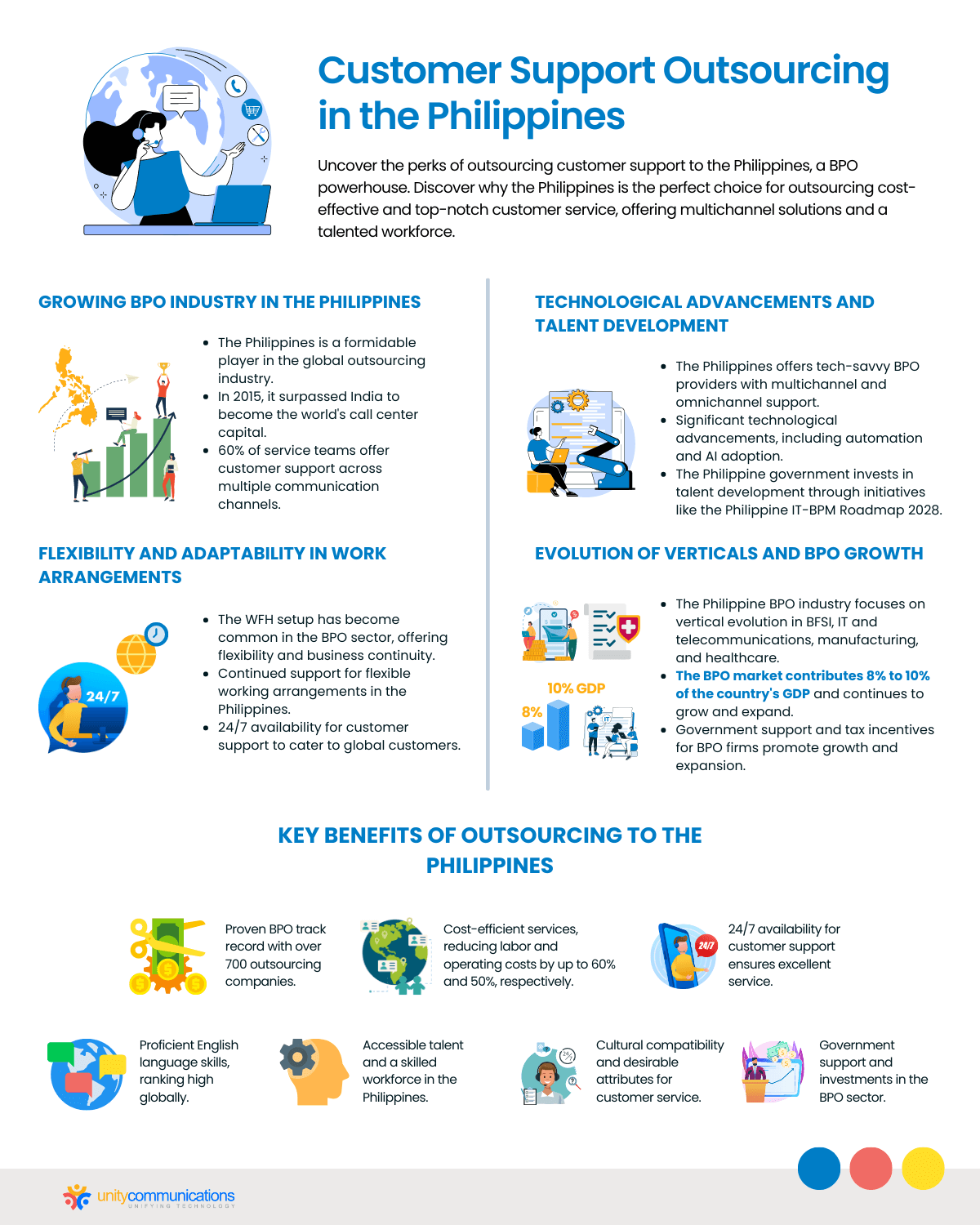
The growth of Philippine business process outsourcing (BPO) is a product of government efforts, deliberate policy design, and decades of infrastructure investment.
The Special Economic Zone Act created the legal framework, while tax incentives attracted multinational firms. Education programs built a pipeline of skilled workers. Today, that combination produces results no competitor can easily replicate.
Further shaping the country as a global outsourcing hub are the different trends that continue to advance its competitive edge. These range from omnichannel solutions to technical adoption and automation.
Multichannel and omnichannel solutions
Customer expectations now demand seamless support across every channel. A customer might start an inquiry via chat, switch to email, and complete it over the phone. The experience must feel continuous.
The Philippine BPO industry has adapted to this reality. Cloud computing and AI enable agents to access full customer histories instantly, regardless of channel. Filipino teams now deliver that seamless experience at scale. The technology also reduces handoffs and wait times, which directly cuts costs.
Contact center as a service (CCaaS) accelerates this shift. Instead of building contact infrastructure in-house, companies rent pre-built platforms from Philippine providers. They gain omnichannel capabilities immediately. They scale up or down without infrastructure risk. This model is reshaping how global companies approach customer service entirely.
Employee upskilling and technical expertise
Beyond technology adoption, the Philippines is making a deliberate bet on people. The Philippine government backs talent development through the IT-BPM Roadmap 2028.
This initiative, managed by IBPAP, aligns education with modern industry needs. New courses, internships, and work immersions are launching. Centralized training and career mapping build talent hubs across the country.
The result shows in hiring. Companies outsourcing to the Philippines find highly skilled agents across data entry, tech support, and customer service. The workforce brings diverse expertise, language proficiency, and industry knowledge, all of which boost customer satisfaction. More importantly, this talent pool grows annually and supports rapid expansion without compromising quality.
Technological adoption and automation
To stay competitive, the Philippine BPO sector is aggressively adopting automation, cloud computing, and AI. These aren’t replacements for human agents—they’re force multipliers. They reshape service delivery and improve how Filipino agents work.
Looking ahead, this trend only accelerates. Case management systems and analytics platforms dramatically boost efficiency. Automation handles routine, repetitive tasks, which frees agents to focus on complex customer interactions that require judgment and empathy. The result maintains service quality while significantly reducing response time.
Permanent work-from-home and flexibility
The pandemic accelerated remote work globally, but the Philippines went further. What started as emergency flexibility became permanent policy. IT-BPM companies now maintain work-from-home setups without losing tax incentives.
Policy changes allow firms to transfer registration from PEZA to the Board of Investments. This flexibility fundamentally supports the country’s BPO growth. Both service providers and their clients can expand the recruitment pool beyond major cities and help attract top talent from across regions.
Vertical specialization and industry focus
As the BPO market matures, specialization is becoming the competitive edge. Verticals—industries offering specialized services—now drive most of the growth.
Banking, financial services, and insurance (BFSI), IT, telecommunications, manufacturing, and healthcare all rely heavily on IT-BPM services. Each vertical evolves at its own pace, with distinct capital requirements and process optimization strategies.
The Philippines is building expertise in each one. Companies gain opportunities to grow, but only if they stay current with how each industry evolves.
Continued market growth and expansion
The Philippine BPO market has continued to grow since its inception, as its fundamentals remain solid. Government support fuels continued expansion. The United States plans to expand investments in the country, a signal of confidence in both the market and the talent pipeline.
According to the Philippine Inquirer, the IT-BPM sector ended 2025 with $40 billion in export revenues and 1.9 million workers. Philstar reports that under the IT-BPM Roadmap, the industry could hit nearly $60 billion in revenue and employ over 2 million by 2028.
What are the top benefits of outsourcing to the Philippines?
Why do so many global companies choose the Philippines? The country offers a unique blend of advantages. One is significant cost savings.
Outsourcing customer service to the Philippines delivers labor cost savings of 50% to 80%. The average hourly rate for BPO services runs $12 to $14, compared to $24 to $28 in the U.S. These translate directly into capital freed up for innovation and growth.
- High-cost commercial real estate leases and office footprints
- Localized employer-side payroll taxes, state unemployment insurance, and workers’ compensation
- Enterprise tech stack provisioning and compliance infrastructure
- Domestic HR administration
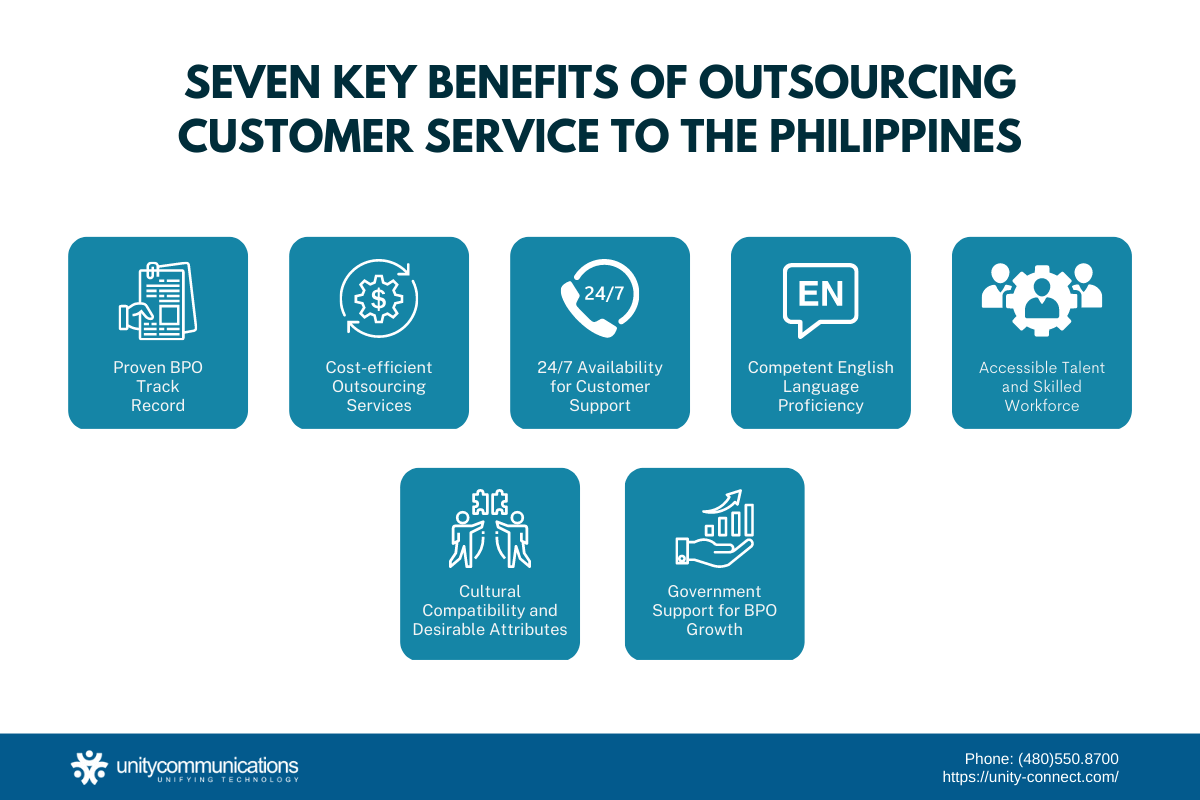
Philippines has become an outsourcing destination for other reasons as well. These include:
- Strong track record and industry leadership. The Philippines remains a top choice for outsourcing, and for good reason. A robust ecosystem of service providers operates nationwide, offering proven expertise across industries. Filipino agents deliver reliable service and customer satisfaction year after year, a track record built over decades.
- 24/7 availability across time zones. Here’s where geography becomes an asset. Filipino teams work shifting schedules around the clock. They serve customers during business hours across Western markets. Night shifts in the Philippines align with day hours in North America and Europe. This time zone advantage means your customers get immediate support at any hour.
- High English proficiency. Most Filipinos speak fluent English. English is the medium of instruction in Philippine schools from elementary through college. According to the EF English Proficiency Index, the Philippines ranked 28th out of 123 countries, placing second in Asia. Strong English skills let agents communicate with clarity and nuance. More importantly, cultural understanding enhances every customer interaction.
- Deep talent pool and scalability. Companies find skilled customer service agents and technical support staff across this massive workforce. When you need to scale fast, that talent pool is ready.
- Cultural alignment with Western markets. This matters more than it appears. The Philippines has a long relationship with the United States. Filipinos understand Western culture, business norms, and customer expectations. This cultural affinity with Western markets creates seamless communication. Agents grasp subtle context and adapt their service mindset accordingly.
- Government backing and growth incentives. The Philippine government invests heavily in it. Tax incentives and regulatory support attract foreign investors. Government agencies coordinate with industry groups to expand infrastructure. This backing drives stable growth and signals long-term commitment. For companies betting on the Philippines, that stability matters.
What are the different outsourcing models in the Philippines?
The Philippines offers multiple outsourcing models, so you can choose the one that best suits your specific needs. Options include:
- Dedicated teams (a fixed group focused solely on your work)
- Shared service centers (flexible access to shared resources)
- Project-based work (for specific initiatives).
Each model delivers cost-effective operations without compromising service quality. For a deeper dive, explore our resource on outsourcing call centers in the Philippines.
What you choose determines your costs and capabilities. For example, contact center outsourcing handles inbound and outbound customer interactions. Technical support outsourcing manages the IT helpdesk and troubleshooting. Meanwhile, data entry outsourcing processes documents and records. All of these leverage the same talent pool of English-proficient, culturally aligned teams.
What should you know before choosing an outsourcing partner?
Several factors matter when selecting an outsourcing provider. Getting them right shapes everything that follows.
First, check the firm’s compliance status in the Philippines. Then, verify their data privacy and security compliance. At a baseline, providers must:
- Comply with local mandates, such as the Philippine Data Privacy Act (DPA).
- Demonstrate global information security standards through active ISO/IEC 27001 certifications or SOC 2 Type II audits.
- Enforce specialized, audited protocols, backed by endpoint monitoring and clean-desk policies to maintain cross-border data integrity.
Check their service delivery record across your industry. Speak to references. Review their technology infrastructure and omnichannel capabilities. Confirm they offer training for your specific use cases.
Dig deeper. Ask about their approach to cultural compatibility with Western markets. Strong cultural affinity becomes clear through conversation. Test their communication and response times early. Understand their staffing models and flexibility for scaling. Review pricing and confirm it includes ongoing training and quality monitoring.
A reliable partner operates as an extension of your team. They invest in employee development and maintain high retention. They stay current with industry trends and technology. Most importantly, they align their service mindset with your brand values.