A single bad quarter can force a hiring freeze, while an overloaded support team can lose a client. To address these challenges, more businesses rely on a business process outsourcing (BPO) company to survive or stay ahead of the competition without overstretching their own resources.
But which BPO model is ideal for your situation? This article breaks down the types of BPO by location, work area, tasks, and supply chain role. It weighs the pros and cons of each to help you pick the right one for your business.
What is BPO?
Before we discuss the BPO models, let’s define BPO. Business process outsourcing (BPO) is the practice of hiring a third-party provider to run specific business functions, such as customer service, finance, or IT support, on a company’s behalf.
Instead of building an internal team from scratch, businesses hand off defined processes to a partner with the staff, tools, and experience to run them.
According to Grand View Research, the BPO market was valued at $328 billion in 2025 and is projected to reach $695 billion by 2033, a sign of how many companies now treat outsourcing as standard practice.
That growth also means more options for buyers, and more room to choose the wrong one. Picking the right BPO model starts with understanding the key types of BPO available.
BPO models based on location
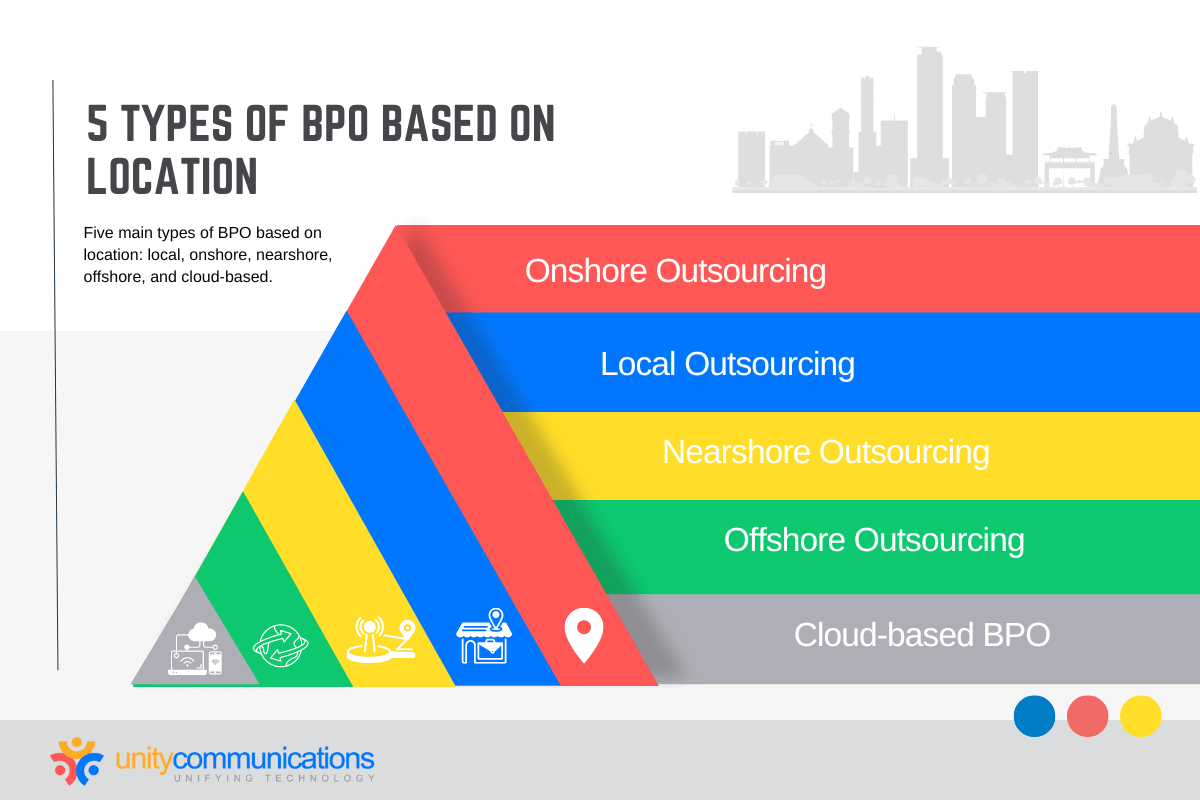
BPO models can vary based on location. These include local, onshore, nearshore, offshore, and cloud-based.
Onshore outsourcing
With onshore outsourcing, you hire a BPO company in the same country where you run the business. For instance, you are running a Florida-based company that employs a Chicago-based service provider. Onshore BPO firms operate in the same time zone as their clients or with a slight, almost negligible time difference.
Pros
|
Cons
|
Local outsourcing
This is when the BPO company is located near your city or within driving distance. With this model, you can meet the third-party team and assess their operations. But this approach is the most expensive option since you cannot leverage economies of scale.
Pros
|
Cons
|
Nearshore outsourcing
Nearshore outsourcing is when a business hires a vendor in a nearby country. A U.S.-based company outsources to a firm in Mexico or Central America where workers speak English as a second language or are already familiar with its culture. Nearshoring is less cost-effective than offshore outsourcing but has minor time zone differences, similar to those of onshore firms.
Pros
|
Cons
|
Offshore outsourcing
Also known as offshoring, offshore outsourcing involves hiring a service provider in a different country. For instance, an e-commerce company in the U.S. outsources customer support to a Philippine-based BPO company.
This is the most common and least expensive type of BPO. Offshore outsourcing can help reduce labor costs by shifting work to countries where wages and operating expenses are lower than in the client’s home market. Some caveats are the differences in culture, time zones, and accents.
Pros
|
Cons
|
Cloud-based BPO
A cloud is a new form of outsourcing that turns BPO into a business process as a service (BPaaS) model and the industry from a service provider to a planner.
One example of a cloud-based BPO is a cloud contact center that uses an internet-based facility to handle customer communications. This facility is suitable for large enterprises requiring multiple communication platforms.
The cloud contact center uses voice-over-Internet Protocol (VoIP) technology for communication. The cloud contact center syncs data with customer relationship management (CRM) systems so agents receive all updates. Working with a cloud contact center means businesses must provide only a stable internet connection, a workstation, and a headset.
Pros
|
Cons
|
Types of BPO based on areas of work
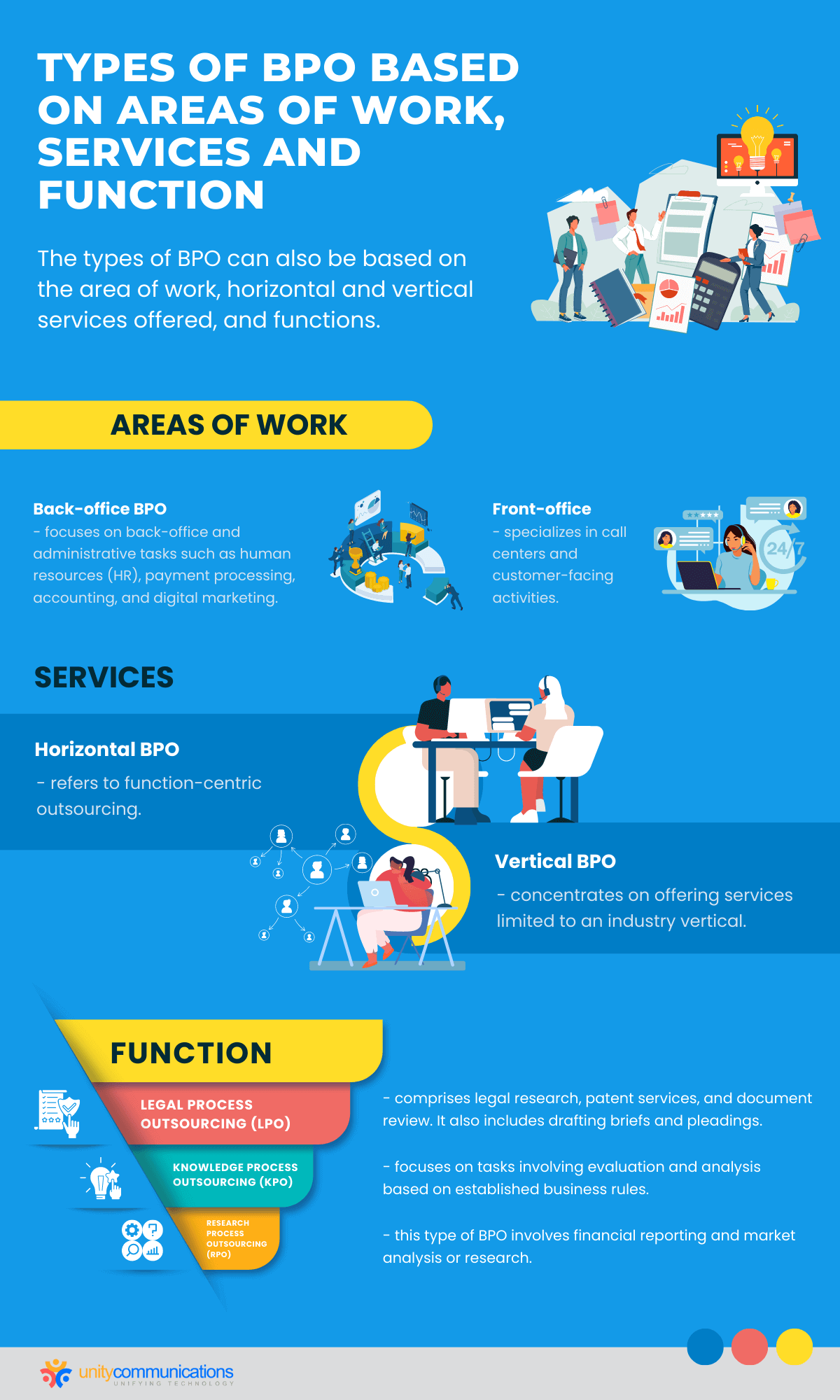
BPO models can also be based on the work area. This can be either back-office or front-office outsourcing.
- Back-office BPO solutions are internal business functions that do not depend on customers. Simply put, customers and back-office workers do not interact. Back-office outsourcing used to involve only administrative activities. Now, it offers human resources (HR), payment processing, accounting, and digital marketing.
- Front-office BPO solutions involve activities that require workers to handle current and prospective clients. Call centers and customer-facing tech support are examples of front-office activities. Front-office workers must possess active listening and effective communication skills to successfully manage client interactions.
Types of BPO based on services
The categories of BPO services encompass both horizontal and vertical services, which can be classified as follows:
- Horizontal BPO refers to function-centric outsourcing. The service provider performs specific work across different industry domains. Examples of horizontal BPO include outsourced HR, payroll processing, facilities management, procurement, and similar functions.
- Vertical BPO focuses on providing specialized functional services within a specific industry vertical or domain. Financial services, retail, manufacturing solutions, and healthcare are examples of vertical business functions.
Here is a table to illustrate how this works:
| Sales | Procurement | Recruitment |
|---|---|---|
| Identify customers | Identify vendors | Identify vacant positions |
| Process orders | Acquire product catalog | Look for candidates |
| Deliver products | Select vendors | Perform interviews |
| Receive payment | Process payment | Pick new hires |
BPO horizontals are function-specific and spread across various industry domains. Processing payments and managing the receipt of payments are examples of horizontal business processes.
The vertical BPO model focuses on services within one industry domain, such as sales, procurement, or recruitment. For example, identifying vacant positions, sourcing candidates, conducting interviews, and selecting new hires fall under the recruitment domain.
Types of BPO based on function
Lastly, BPO models can differ according to function:
- Legal process outsourcing (LPO) comprises legal research, patent services, and document review. It also includes drafting briefs and pleadings. It involves outsourcing low-skill tasks such as legal coding and high-value qualitative activities.
- Knowledge process outsourcing (KPO) is a subcategory of BPO that requires higher levels of skill and expertise. For example, data entry is a BPO service. But when it involves tasks such as evaluation and analysis based on established business rules, the solution becomes part of KPO.
- Research process outsourcing (RPO) is when an external service provider manages a portion or all of the research and development duties of an organization. This type of BPO involves financial reporting and market analysis or research.
AI agent BPO (Hybrid model)
AI agents now handle a growing share of BPO work. These systems plan, decide, and execute across multi-step workflows without constant human input. They differ from older chatbots, which only followed fixed scripts.
Many BPO firms now pair AI agents with human teams instead of replacing one with the other. AI agents handle high-volume, repetitive tasks, such as password resets and billing questions. Human agents step in for complex cases that need judgment or empathy.
That balance matters more than headline layoffs suggest. Gartner projects that by 2027, half of the companies that cut customer service staff due to AI will rehire for similar roles under new titles. Their research found that only 20% of leaders have reduced headcount due to AI, and most report staffing has remained steady even as service volume grows.
Pros
|
Cons
|
How to find the right BPO model for you

Choosing the right BPO model takes more than comparing costs. Here are four practical tips to help you decide.
1. Identify your unique goals and needs
Every outsourcing service comes with its own set of advantages and risks. Your specific goals and needs determine the most suitable outsourcing model. Start by examining what you want to accomplish and whether your plans are short-term or long-term.
For instance, if cost reduction is your primary goal, offshoring and nearshoring are viable options. Each model offers distinct solutions. Although you will experience unavoidable cultural and linguistic differences, offshoring offers access to a larger talent pool and the potential for round-the-clock operations. Nearshoring offers similar advantages while mitigating some of the challenges of offshoring.
If cost savings are not your primary concern and you want to enhance output quality instead, consider onshoring or a hybrid model that pairs AI agents with human oversight. Onshoring is less common due to fewer financial incentives, but AI agents now let companies cut costs on routine tasks without giving up quality on complex ones.
2. Consider your budget
Budget sets the ceiling on which BPO models are even viable. It forces you to weigh costs against other factors, such as quality, speed, control, and access to talent. A tight budget might rule out onshore or local outsourcing entirely, leaving offshore or nearshore as the realistic options. A bigger budget gives you room to prioritize cultural fit or output quality over pure cost savings.
Weigh these factors alongside cost before you commit to a BPO model:
- Compare the total cost of onshore, nearshore, and offshore options, not just hourly rates.
- Factor in hidden costs, such as training, turnover, and quality control.
- Match your budget to your timeline. Cheaper options might take longer to ramp up.
- Set a ceiling for what you’ll spend, then test whether your top BPO candidates fit within it.
- Revisit your budget every year, since labor costs and provider rates shift over time.
While budget is important, a strong outsourcing partnership balances cost with capability. The cheapest BPO model isn’t affordable if it can’t deliver the service quality your business needs.
Deloitte’s 2024 Global Outsourcing Survey found that only 34% of organizations now name cost reduction as their top reason for outsourcing. Talent access, service quality, and agility now weigh equally in the decision.
3. Determine the compromises you are willing to make
Every outsourcing strategy comes with compromises. You might run into BPO challenges no matter which model you pick, so the real question is which sacrifices fit your workflow.
Onshore outsourcing sacrifices budget and flexibility to maintain high output quality. A U.S. company that onshores its legal review, for example, pays more per hour but skips the cultural and legal translation issues that come with an offshore team.
Offshore outsourcing flips that equation. Language and cultural differences can surface early, and clients might hand over some day-to-day control of the function. In exchange, this BPO offers far more value for your money and access to a much bigger talent pool. A retailer offshoring its customer support to the Philippines, for instance, gains 24/7 coverage at a fraction of the cost, and most language or communication gaps close quickly with the right onboarding and training.
Nearshoring splits the difference. It offers cost-efficient services while avoiding the sharper cultural and linguistic problems that come with offshoring, since nearshore workers often share a similar time zone and cultural context with the client.
Before you commit, weigh what matters most to your business: cost, control, or speed. If retaining full day-to-day control is your top priority, onshore or nearshore might be a better fit, even at a higher price. If your priority is stretching your budget as far as possible while still getting quality output, offshore outsourcing delivers the strongest return once you partner with an experienced provider.
4. Optimize your workflow
Once you’ve settled on a model, the next step is fine-tuning your workflow to get the most value from outsourcing. Different types of BPO models call for different adjustments, since what works for onshore rarely works the same way for offshore.
If you choose an onshore partner, keep communication channels open to fully leverage language and cultural alignment. If you go offshore, structure your workflow to run around the clock, since time zone differences let you hand off work at the end of your day and pick it back up the next morning already finished.
Whichever model you pick, document your processes clearly before handoff. A detailed playbook reduces onboarding time and cuts back-and-forth that eats into productivity gains, especially when your provider works in a different time zone or language.