

Every support leader is asking some version of the same question: “How much of our workflows should be automated, and how much still needs a person?”
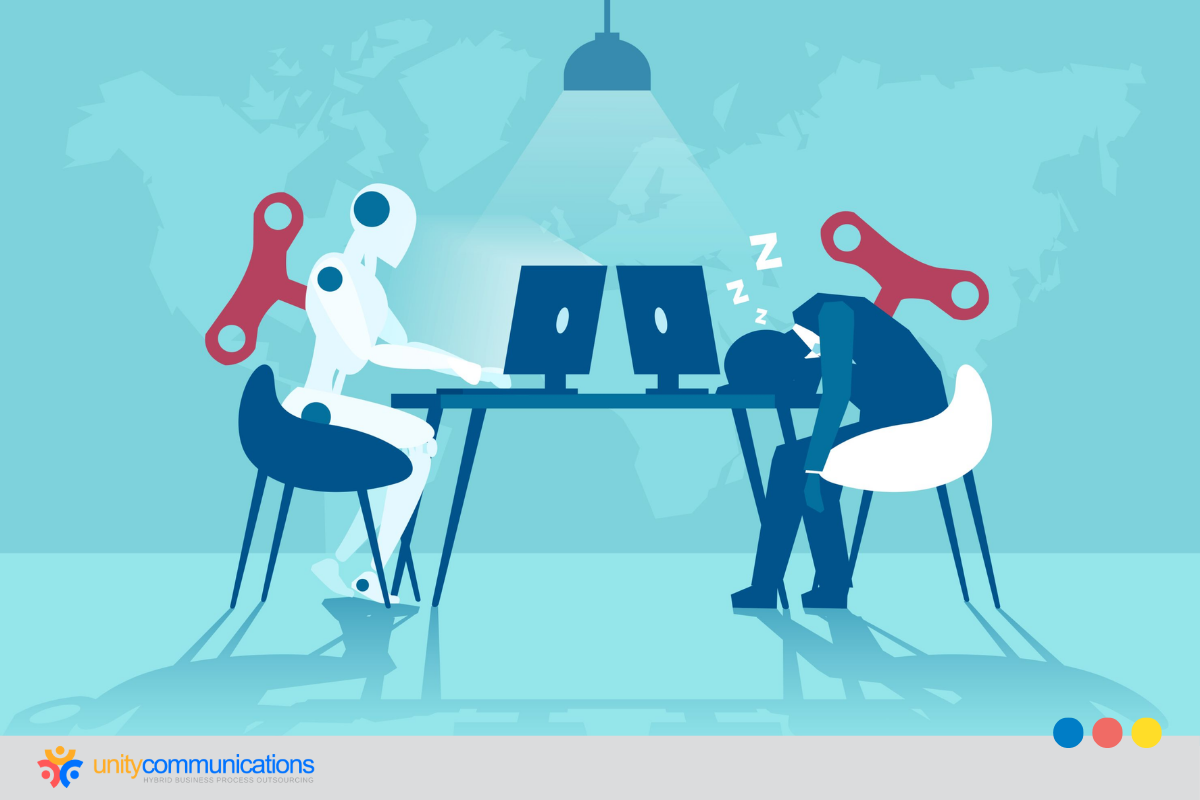
The data keeps pointing to the same answer, which is not “all AI” and not “all human.” The businesses getting this right are building hybrid AI agent solutions, where each side does what it’s actually good at, and the balance is designed on purpose rather than found by accident.
What is a hybrid AI agent solution?
A hybrid AI agent solution is a support model in which AI and human agents work together as a single system rather than as two separate channels.
- AI handles the interactions it’s built for, which are high-volume, repetitive, time-sensitive requests that don’t require judgment calls.
- Human agents handle everything else. This includes escalations, emotionally charged conversations, and account issues that carry real financial or relationship risk.
Hybrid AI agent solutions differ from a chatbot integrated into a support queue. In a true hybrid model, the AI and the human agents share context, follow the same escalation rules, and are measured against the same outcomes. AI tools do not—and should not—keep customers from interacting with a human. AI is the first line of defense in a system to get every customer to the right resolution, whether that comes from a machine or a person.
After deploying AI agents, customer service organizations report customer satisfaction as the most improved metric, ahead of productivity, handle time, and retention, according to Salesforce research, but that gain only holds when AI knows its limits.
Many businesses have tried the fully automated version and watched it backfire. Customers hit a wall, and the bot loops through the same three answers. By the time a human steps in, the customer is already frustrated. A hybrid model exists specifically to prevent that failure mode.
Where artificial intelligence agents excel
Most organizations are still testing AI rather than deploying it at scale. According to McKinsey’s State of AI report, nearly two-thirds haven’t moved past the pilot phase. That hesitation usually comes down to uncertainty about where AI actually delivers.
AI agent solutions are not a lesser version of human support. In specific categories of work, they consistently outperform human-only teams:
- High-volume, repetitive requests. Password resets, order-status checks, appointment scheduling, and basic account questions make up a large share of most support queues. AI agents resolve these in seconds, without the wait time a human queue requires.
- 24/7 availability. Zendesk reports that 74% of consumers now expect round-the-clock support, and AI agents make meeting that expectation realistic. Customers don’t stop needing help at 6 p.m., and AI delivers the same quality of response at 3 a.m. as at noon, without overtime costs or staffing gaps across time zones.
- Consistent FAQ resolution. Artificial intelligence agents don’t have off days. They apply the same answer to the same question, ensuring autonomous task execution every time and reducing variability caused by training gaps or agent fatigue.
- Multilingual self-service. Agentic AI is trained using large language models (LLMs) to handle multiple languages natively, giving businesses coverage they’d otherwise need to hire and staff separately.
- Real-time data retrieval. When a request depends on pulling account details, order history, or inventory status, AI agents can access and surface that information instantly, without putting a customer on hold while an agent searches a system.
These are the interaction types where speed and consistency matter more than nuance. Trying to force a human team to handle all of them at scale is expensive and, in most cases, doesn’t yield better outcomes. It just produces a slower one.
Where human agents are essential

In a SurveyMonkey report, most customers (63%) don’t believe AI will ever fully replace human agents in customer service, and the data backs up that instinct. The scenarios in which AI reliably falls short are just as clear as those in which it excels.
- Complex, multi-step problem resolution. When an issue requires connecting several pieces of information, weighing exceptions to policy, or making a judgment call that isn’t covered by a script, a human agent’s reasoning outperforms rule-based automation.
- Emotionally charged interactions. An angry, anxious, or service-failure-affected customer needs to feel heard. AI can simulate empathy in language, but it can’t adapt the way a trained agent can when a conversation needs to shift tone, slow down, or acknowledge frustration before moving toward resolution.
- High-value customer relationships. Enterprise accounts, long-tenured customers, and high-spend relationships often need a level of personal attention that protects the relationship, not just the transaction.
- Compliance-sensitive conversations. In regulated industries such as healthcare and financial services, some interactions carry legal or regulatory weight that requires human accountability. A misstep here can lead to a poor customer experience and a liability.
- Situational judgment. Real support interactions rarely follow the script exactly. Humans are still better at interpreting situations that don’t fit into any of the categories a system was trained on and deciding what to do next.
This is the part of the hybrid conversation that many AI-first sales pitches skip: the AI and human support balance. AI systems don’t get better at judgment by getting bigger. They get more accurate within the categories they’re already good at. Trained humans still solve judgment, accountability, and emotional intelligence.
How the hybrid workflow works in practice
A well-built hybrid customer support outsourcing model isn’t AI and humans working side by side. Hybrid AI agent solutions are structured handoff systems that route each interaction to the right resource without friction.
- AI as first contact. Most interactions start with an AI agent. Smarter AI handles what it can resolve directly and gathers context on anything it can’t.
- Escalation triggers. A well-designed hybrid system clearly defines when a conversation is handed off to a human. Examples include after a set number of failed resolution attempts, when a customer explicitly asks for a person, when sentiment analysis flags frustration, or when the request falls into a category the AI isn’t authorized to resolve (refunds above a threshold, account closures, compliance-related requests).
- Context transfer. In a good hybrid model, the human agent receives the full conversation history, the customer’s account details, and a summary of what’s already been tried. The customer never has to repeat themselves.
- Resolution ownership. Once a case is escalated, ownership needs to be clear. The human agent resolves it end-to-end, rather than bouncing the customer back into the automated queue.
An AI agent human handoff isn’t a minor technical detail. It spells the difference between a successful hybrid model and an infuriating customer experience. It’s the single biggest factor that determines whether a hybrid model earns customer trust or erodes it.
Why hybrid agents outperform both extremes
AI’s rapid progress is pushing companies to rethink client care strategy. Hybrid AI agent solutions show measurable results in the numbers businesses track today.
The following are the benefits of hybrid AI agents:
- Faster AI resolution times. Routine issues are resolved instantly by AI, without waiting in a queue, while complex issues reach a human faster because they’re pre-qualified and routed with context.
- Lower cost per interaction. AI handles the volume that would otherwise require a much larger human team, without forcing a business to compromise on the quality of interactions that need a person.
- Higher CSAT. Customers get speed and empathy where they matter, instead of a one-size-fits-all approach that’s wrong for a portion of every queue.
- Reduced agent burnout. Human agents stop spending their day on repetitive password resets and status checks. Their time is spent on the harder, more engaging work that actually uses their training, thereby improving retention and reducing turnover.
- Scalability without proportional headcount growth. A business can absorb a spike in volume, seasonal or otherwise, without needing to hire and train a proportional number of new agents.
Fully automated models streamline workflows. It saves money but loses trust the moment a customer hits a problem it can’t handle. A fully human model preserves quality but can’t scale without a linear increase in cost. Hybrid AI agent solutions capture the upside of both without inheriting the downside of either.
What does overautomation look like in practice?
Overautomation happens when a business pushes AI beyond its strengths to cut costs faster than the technology can support.
Common signs include:
- Customers get looped through the same automated responses without a clear path to a human.
- Escalation triggers are set too high, so frustrated customers stay in the AI channel too long.
- The handoff to a human loses context, forcing the customer to explain their issue from scratch.
Each of these erodes trust in a way that’s hard to rebuild. Customers don’t just get annoyed by a bad automated interaction. They either start avoiding the support channel altogether or escalate through public channels such as social media or reviews.
The goal of a hybrid model is to avoid this entirely by defining, in advance, exactly where AI’s authority ends and a human’s begins.
Outsourcing the hybrid model vs. building it in-house
Once a business decides that hybrid AI agent solutions are the right direction, the next question is how to get there. Building from scratch means constructing the AI infrastructure, training it on your specific use cases, hiring and training human agents for escalation work, and building the governance layer that manages the handoff between the two.
That’s a significant investment in time, technology, and specialized talent, and it must be continuously maintained and optimized as customer needs shift.
Hybrid BPO outsourcing to a company that has already built this infrastructure changes the equation. Instead of spending months building and testing a handoff system from scratch, a business gets access to a model that’s already been deployed, refined, and governed across other client operations.
Unity Communications fits into the picture. We operate a hybrid model that pairs AI technologies, which handle volume and speed, with trained human specialists who manage escalations and relationship-sensitive interactions, all within a structured BPO delivery framework. Businesses get a hybrid contact center solution that’s already built, tested, and continuously optimized, without the in-house trial-and-error period.
A decision framework: Where does your support operation sit today?
Before deciding what to change, it helps to know where the current operation actually stands. A few questions clarify that quickly:
- Where is your support team spending the most time? If a large share of an agent’s time goes to repetitive, low-complexity tickets, that’s the clearest sign that AI could absorb volume without affecting quality.
- How long does it take a frustrated customer to reach a human? If the answer is “too long,” the issue isn’t a lack of AI but an escalation trigger set too conservatively.
- What happens to context during a handoff today? If human agents start conversations from scratch after an automated interaction, that’s a governance gap, not a technology gap.
- Where is turnover or burnout highest on your team? If agents are leaving because they’re stuck on repetitive work rather than complex problem-solving, that’s a signal that AI could take pressure off retention efforts.
- What’s actually driving cost today? If the cost per interaction is high because a human team is absorbing volume that doesn’t require human judgment, that’s where hybrid delivers the fastest ROI.
The answers to these questions usually point to a clear starting point: which part of the operation should adopt AI first, and where human agents need to stay firmly in place.