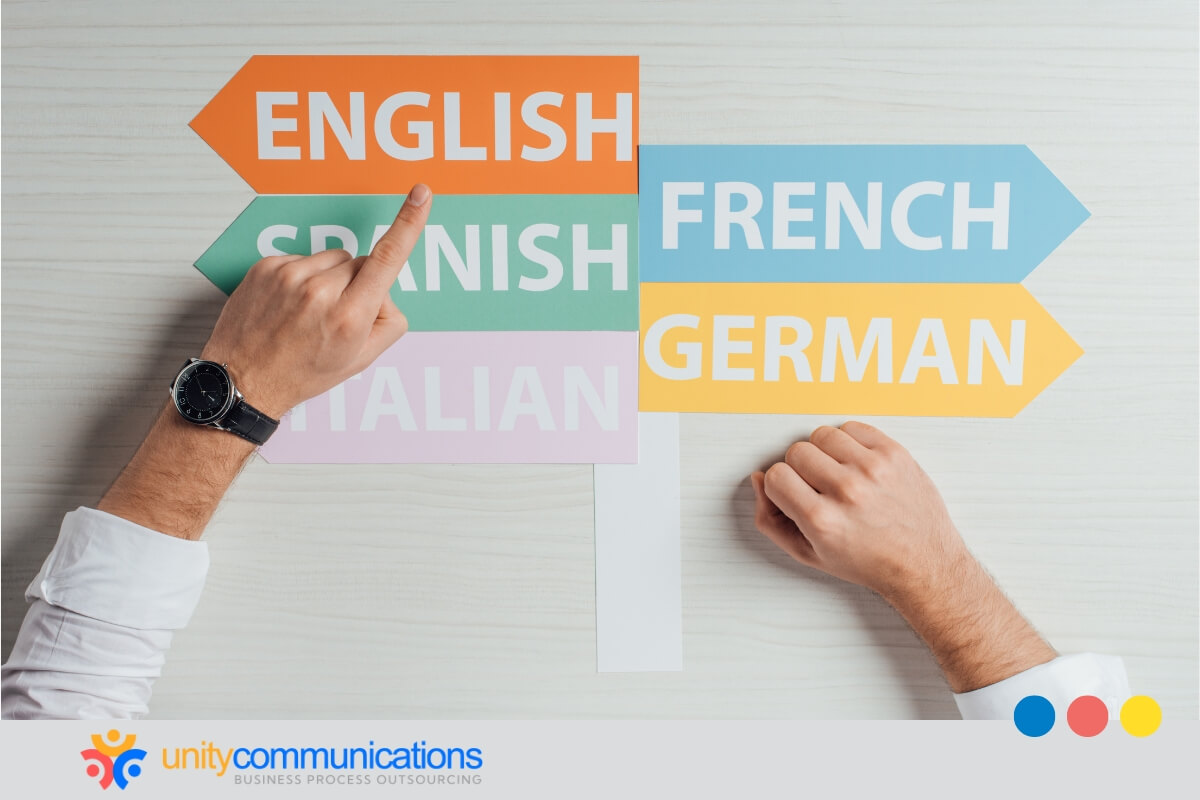


Your customers do not all speak the same language, and they should not have to switch languages to get help. As businesses continue to expand across borders, serving people in their own language has moved from a nice extra to a basic requirement for growth.
That shift is driving interest in multilingual BPO services. Business process outsourcing (BPO) gives companies access to trained multilingual agents who resolve issues, close sales, and build loyalty in customers’ preferred languages. Those agents now work alongside AI tools that translate, route, and analyze conversations in real time.
This guide explains what these services include, why demand continues to rise, how AI is changing the model, and what to look for in a partner to support your business as it grows.
What are multilingual BPO services, and how do they work?
Multilingual BPO services are outsourced support teams, such as customer service and tech support, staffed by agents fluent in several languages.
A company signs an agreement with an outside provider to recruit, train, and manage agents who speak the languages its customers use. Those agents handle messaging across channels on the company’s behalf, following its policies, tone, and product knowledge.
Most of this work is based in delivery centers in countries with deep language talent pools. Common multilingual hubs include the Philippines, Mexico, Colombia, Poland, and Portugal, where many workers speak English plus one or more additional languages.
The provider supplies the people, facilities, technology, and quality control. The client sets service standards, shares product training, and defines the performance targets the team must meet.
Functions a multilingual call center typically covers
- Inbound customer service, such as order status, billing questions, and returns
- Technical support and troubleshooting for software, devices, and telecom services
- Sales, upselling, retention, and collections
- Back office work, such as data entry, content moderation, and email handling for different regions
How agents and technology share the work
Routing software reads the language and topic of each inquiry and sends it to an agent who speaks that language. Translation tools help agents cover less common languages, while CRM platforms keep customer history in one place. This setup lets a single support team serve customers across several languages and time zones.
Why is the demand for multilingual customer support growing?

Demand for multilingual talent is rising across industries. Forbes reports that the U.S. Department of Labor has estimated a 42% increase in demand for interpreters. About 56% of employers surveyed expect demand for bilingual and multilingual speakers to soar over the next five years. Employers rely most on these skills when they expand into new markets, which is where multilingual BPO services can help a business staff up quickly.
Customer support is where this demand becomes most visible. Every customer conversation depends on both parties understanding each other, so a company that cannot serve customers in their own language risks losing them at the moment they need help. Multilingual BPO services give businesses access to trained agents who can meet that need without having to build language teams from scratch in each market.
In addition, the U.S. Census Bureau’s 2025 language use data shows that 22% of people age 5 and older in the United States spoke a language other than English at home between 2017 and 2021. About 61% of that group spoke Spanish. Many brands already serve a multilingual audience in their home market.
Demand is strongest in sectors where a misunderstanding is costly. Examples include healthcare, e-commerce, travel, telecom, and financial services. A misread instruction in a billing dispute or a medical intake call creates real risk, not just a poor customer experience. For growing brands, support in multiple languages is now part of competing in a global market.
Strategic advantages of outsourcing multilingual support
Companies outsource language coverage for more reasons than cost. These are the benefits that matter most.
1. Higher customer satisfaction and loyalty
Customers who receive service in their native language explain problems faster and leave with less frustration. When providers deliver high-quality, culturally aware conversations, the result is higher customer satisfaction and stronger customer loyalty, which drives repeat purchases and referrals.
2. Faster entry into new markets
A provider lets you launch support in a new country without hiring and training a local team first. You can test demand, extend your global reach, and add languages as volume grows.
3. Lower cost per interaction
Building internal language teams means recruiting scarce talent, paying premium salaries, and covering overhead in each location. With multilingual BPO services, you share those costs with the provider and pay only for the capacity you use. This is one of the core advantages of outsourcing, helping companies reduce costs without cutting coverage.
4. Consistent quality in every language
A strong provider applies the same training, scripts, and QA scorecards across all language queues. A customer in Monterrey gets the same quality of service as one in Manila or Montreal. Working with a BPO vendor that offers this level of consistency also sets you apart from competitors who route everyone to English.
5. Cultural and linguistic fit
Translation alone does not build trust. Agents who understand local idioms, etiquette, and holidays offer personalized service that feels local. That linguistic and cultural fit improves customer engagement and cuts repeat contacts.
6. Round-the-clock coverage
Providers of multilingual BPO services with centers across multiple time zones can offer 24/7 global customer service without incurring overtime or night-shift premiums at headquarters.
7. Easier compliance with local rules
Many markets have rules on language access, consumer disclosures, and data privacy, such as the GDPR in Europe. Experienced providers build these requirements into scripts and workflows, which lowers regulatory risk.
Can AI replace human agents in multilingual customer service?
No. AI handles routine requests and live translation well, but human agents are still needed for complex, emotional, or high-risk conversations.
AI now covers a large share of simple, repetitive work. Chatbots and virtual assistants answer common questions, reset passwords, and track orders in dozens of languages. Real-time translation can convert an agent’s reply into the customer’s language during a chat or call. Natural language processing detects intent so each request reaches the right queue.
But these systems have limits. Translation engines can miss idioms, sarcasm, slang, and industry terms. Those errors carry more weight in healthcare, legal, insurance, and billing conversations, where one wrong word can change the meaning of an instruction. Customers who are upset or confused also tend to ask to speak with a person.
Where AI fits best
- High-volume, low-complexity questions such as order status and store hours
- After-hours coverage and first-line triage
- Drafting replies and translating messages for agents to review
- Scoring calls and chats for quality and compliance
Where people still lead
- Complaints, cancellations, and emotionally charged situations
- Regulated topics in healthcare, finance, and insurance
- Complex technical troubleshooting with many steps
- Conversations where tone, culture, or relationship building matters
Common language support challenges and how BPO providers solve them
Language gaps and cultural misreads lead to longer calls, repeat contacts, and unhappy customers. Poorly handled conversations can also damage a brand in markets it is trying to win. Zendesk’s guide to supporting customers in several languages outlines many of these hurdles. Here is how an experienced partner addresses the most common ones.
Finding fluent agents at scale
Hiring native speakers for every language you need is slow and expensive, especially for less common languages. This is where multilingual call center services help. Providers maintain established recruiting pipelines and language testing, so they can staff new queues in weeks rather than months.
Keeping service quality consistent
Your Spanish- and Mandarin-speaking customers expect the same service as your English-speaking customers. Matching tone, accuracy, and empathy across languages takes structured training and ongoing QA reviews. Providers of multilingual BPO services run calibration sessions and native-language quality audits to ensure service quality remains consistent across all queues.
Supporting technical and specialized products
Complex products need agents who understand both the language and the product. Providers train agents on troubleshooting steps, product features, and escalation rules. Many also recruit agents with industry backgrounds for specialized queues.
Controlling cost
Recruiting, training, and retaining an internal multilingual team adds up quickly. Outsourcing partners operate in regions with lower labor costs and spread technology and management overhead across many clients. That lets companies invest more in product development and growth.
Scaling with demand
Volumes rarely stay flat. When demand for customer support spikes during launches, holidays, or outages, a provider can quickly add trained agents and scale back once the peak passes, without long-term hiring commitments.
Trends in multilingual BPO shaping the future of customer service
The role of multilingual call centers is changing fast. Technology now handles more of the volume, while people focus on the work that needs judgment. These are the trends to watch.
AI-powered translation tools in multilingual BPO services
Live voice and chat translation lets one agent help customers in a language they do not speak fluently for simple, low-risk requests. Providers use AI-powered translation tools to extend coverage to less common languages, while keeping native speakers on high-volume and sensitive queues. The AI customer service agents now used in many operations follow the same pattern.
Predictive analytics and sentiment analysis
AI and machine learning models can now review every conversation instead of a small sample. Sentiment analysis flags frustrated customers in any language, and predictive analytics forecast volume by language and channel so managers can staff correctly. These tools give leaders insights into customer behavior that help enhance customer experience across regions.
Hybrid human and AI models
Advancements in AI have not removed people from contact center operations. Gartner predicts that no Fortune 500 company will fully eliminate human service agents by 2028. For the global BPO industry, that points to a blended model for multilingual BPO services, where automation handles volume and people handle complexity.
Customer effort as the main measure
More service leaders now track customer effort alongside handle time. The goal is customer communication that feels easy in any language and on any channel. Reducing effort is what turns routine support into exceptional customer experiences.
How to manage an outsourced multilingual team effectively
The partner you choose matters, but so does how you work with them. These practices keep customer service operations aligned across languages and locations.
1. Build shared training programs
Create training with your provider that covers product knowledge, language standards, and cultural expectations for each market. Update it whenever policies, products, or customer needs change.
2. Leverage technology for collaboration
Give agents and internal teams the same knowledge base, CRM access, and messaging tools. Shared translation features and video calls help teams in several countries work as one unit.
3. Standardize processes
Document every workflow and translate the documentation for each language team. Clear procedures reduce errors and keep service delivery consistent, whether a ticket is handled in the Philippines or Mexico.
4. Lead with cultural awareness
Team leads should understand the norms of the people they manage. Regular one-on-one meetings, feedback sessions, and an open-door policy keep communication honest across cultures.
Monitor BPO performance by language
Track the same customer service KPIs, such as CSAT, first contact resolution, and handle time, for every language queue. Comparing results by language shows where training or staffing needs attention.
Recognize and support the team
Celebrate wins, offer language and career development, and give agents access to wellbeing resources. Teams that feel valued stay longer, which protects both operational efficiency and customer satisfaction.