

What’s the difference between BPO and call centers? A call center handles phone-based customer support and sales calls. Business process outsourcing (BPO) involves handing over a wider range of business processes, such as accounting, HR, and data entry, to a third-party provider.
For a scaling business, the choice matters. Growth means adding capacity without letting costs climb as fast, and the wrong model can mean juggling vendors or paying for services you don’t need.
This article compares BPO and call center outsourcing across five categories, from business goals to costs. Understanding these differences helps you decide when a call center is enough and when a BPO partner is a better fit.
Are call center and BPO the same?
No. A call center handles phone-based customer support, while BPO outsources many business functions to a third-party provider.
Call centers and BPO firms are two related but distinct models:
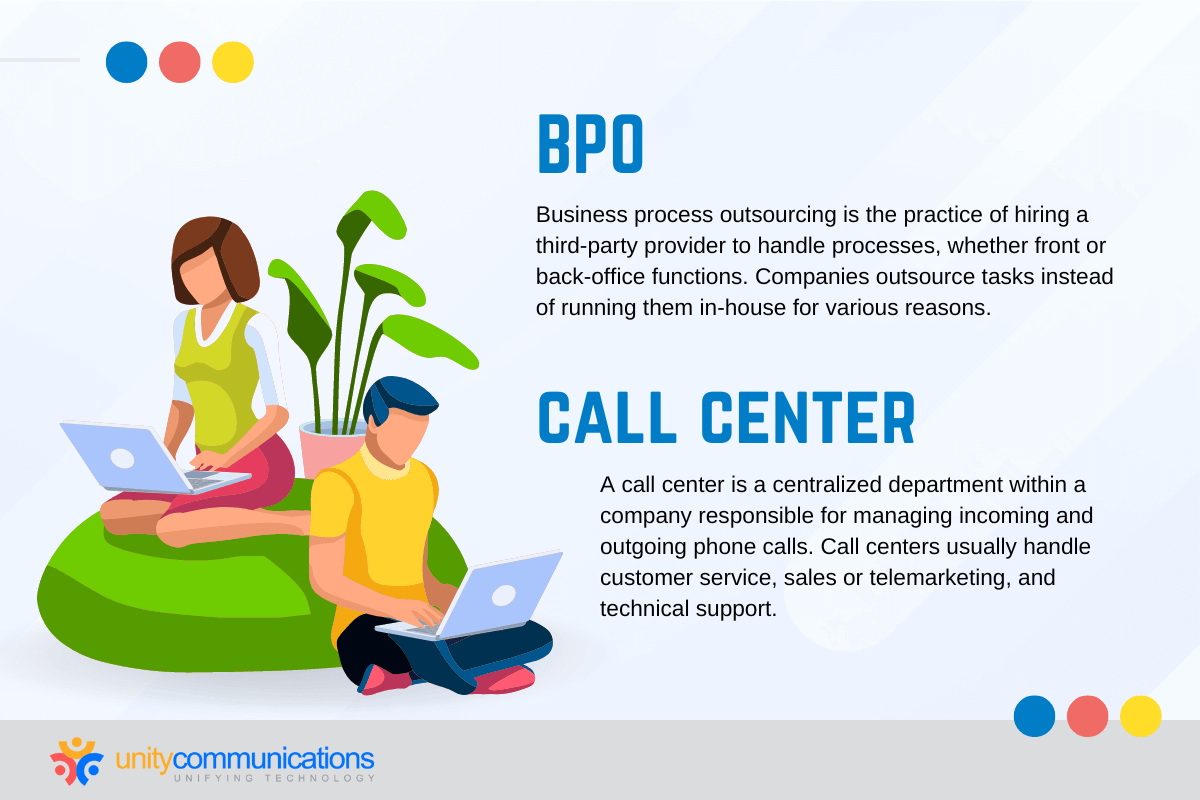
- Call center. It is an operation that manages customer interactions over the phone, including customer service, sales, and technical support. Some now call themselves contact centers because they also handle email and chat. In some regions, the spelling is “call centre.”
- Business process outsourcing (BPO). BPO means hiring a third-party provider to run business processes, from customer support to accounting, HR, IT, and data entry. BPO companies cover both front- and back-office work.
The overlap causes most of the confusion. A call center can run in-house, or a business can outsource it. An outsourced call center is a BPO call center, a provider that handles phone-based work such as customer service, sales, and help desk calls. In this case, the call center is one type of BPO, a subset of the wider BPO industry.
Many BPO companies sell call center services next to back-office work such as data entry. Even so, not every BPO service involves a phone call. Payroll, accounting, and inventory management never do. Keeping the two terms apart helps when you compare providers, service scope, and pricing.
Key differences between BPO and call centers
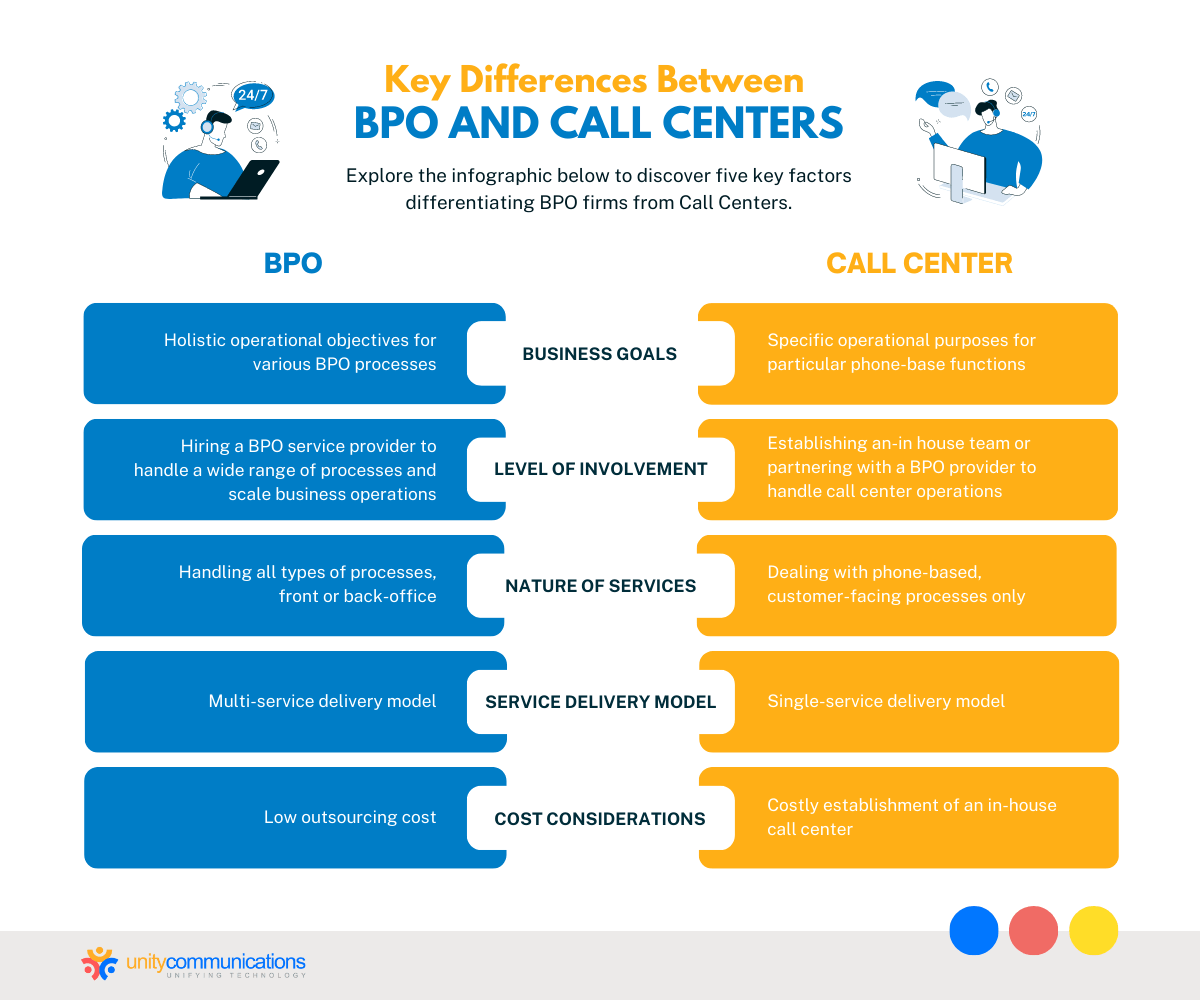
BPO and call centers differ in their business goals, level of involvement, nature of services, service delivery models, and costs.
To further separate the two ideas, here are important points to remember:
- The definition of BPO concerns who does the work, which is a third-party service provider.
- A call center is defined by its work: customer calls.
Many call centers now operate within larger BPO organization. Providers that run phone-based processes such as customer service and help desk are BPO call centers. That is why the differences between the two models can blur, and why one BPO call center might handle both your call center operations and back-office work.
If you’re weighing BPO and call center solutions, the table below compares them side by side. Each category gets its own section after it.
| Category | BPO | Call Center |
|---|---|---|
| Business goals | Broad goals across departments: cost, efficiency, quality, growth | Function-specific goals: CSAT, sales, collections |
| Level of involvement | Always a partnership with a third-party provider | In-house or outsourced |
| Nature of services | Front- and back-office work, including support, accounting, HR, IT, and data entry | Phone-based, customer-facing calls, inbound and outbound |
| Service delivery model | Multiple services under one contract | One service |
| Cost considerations | Cost tracked across every outsourced function | Cost tracked per call and CSAT |
1. Business goals
BPO goals span the entire business, including focusing on core work, building expertise, and growing. Call center goals focus on a single function, such as increasing customer satisfaction, closing sales, or collecting payments.
The main difference between BPO and call centers lies in scope. A business outsources to a BPO to change how it runs across departments. It sets up a call center, in-house or outsourced, to improve one customer-facing function.
BPO goals: Change how the business runs
Businesses that outsource to a BPO usually want to:
- Focus on core work. A third-party provider takes on non-core processes such as payroll and IT support. The in-house team can then focus on customer needs and its core business.
- Gain access to expertise. BPO teams bring trained people and technology that would take months to build in-house. Deloitte’s 2024 Global Outsourcing Survey found that access to talent is now the top driver for outsourcing, cited by 42% of respondents.
- Improve efficiency and quality. A BPO partner can add a quality assurance (QA) team and standard workflows across the processes it takes over.
- Reduce costs. Cost still matters, but it no longer leads. In the same survey, 34% of leaders named cost reduction a primary driver.
- Grow over the long term. BPO teams can scale up or down with demand, and new functions can be added as the business grows.
Call center goals: Improve one function
A call center has narrower goals, each tied to a single function and a single metric:
- Raise customer satisfaction. A service team works to resolve calls faster and lift customer satisfaction (CSAT) and the overall customer experience.
- Extend reach and revenue. A sales team makes outbound calls to prospects and follows up on leads.
- Collect more payments. A billing and collections team contacts customers about overdue balances to protect cash flow.
If a goal names a metric, such as CSAT or payments collected, it’s a call center goal. If it describes how the company operates, such as focus, expertise, or growth, it’s a BPO goal.
2. Level of Involvement
With BPO, you always work with a third-party provider. With a call center, you choose between running it in-house and outsourcing it. So the level of involvement in a BPO and call center setup depends on who runs the work each day.
Here’s how outsourcing works:
- You hand processes to a service provider, whether front-office or back-office, and both parties work toward shared goals.
- The provider runs the work under a contract and a service-level agreement (SLA).
- Both sides review reporting and performance together.
- Your team sets direction and checks results. The provider handles hiring, training, and daily management.
BPO doesn’t have an in-house version. Work kept within the company is handled by a shared service or an internal team. But the model is well established, and BPO providers operate at scale. In the Philippines alone, IT-BPM revenue reached $40.3 billion in 2025, according to IBPAP’s 2026 industry overview.
3. Nature of services
BPO covers front-office and back-office services. A call center covers customer calls only. In a BPO and call center comparison, the nature of services is where the two differ most. One handles a range of business processes, and the other handles customer conversations.
BPO services fall into two groups:
- Front-office work. Customer-facing tasks such as customer support, sales, and technical support. A BPO delivers them by phone, as well as by email and live chat.
- Back-office work. Internal tasks such as accounting and finance, HR, payroll, IT support, data entry, and inventory management for e-commerce.
One provider can run both groups. Deloitte’s 2024 Global Outsourcing Survey found that back-office outsourcing remains common and that 56% of organizations now outsource front-office functions such as sales, marketing, and customer service. That is about 10% more than in 2022.
Call center: customer calls only
Call centers specialize in one channel: the telephone. A call center entails managing inbound and outbound customer calls, and nothing else. Call centers usually handle two kinds of calls:
- Inbound calls. Agents answer customers, resolve issues, and process requests. Customer service operations and technical support are typical examples.
- Outbound calls. Agents contact leads and customers. Sales, telemarketing, and collections are typical examples.
Many call centers now call themselves a contact center and add email and chat. Regardless, the scope stays customer-facing. Call centers typically don’t run payroll or enter data.
Call center example: Inbound and sales calls for an e-commerce brand
One e-commerce brand gave its inbound customer calls and its sales calls to a dedicated phone team. The team tracked average handle time (AHT), CSAT, and first call resolution. After 90 days, Unity Communications reported a 95% net satisfaction score, and the team beat its goal of 18 sales a day. This e-commerce customer support and sales case study stayed on the phone the whole time, first with support and then with sales. That is a call center service.
4. Service delivery models
A BPO organization serves many clients across many accounts and departments. A business can move several functions to a single firm, such as its call center and administrative work. BPO providers often bundle call center services with back-office support, such as data entry and payroll. One BPO team and one set of reports can then cover a wide range of activities.
A call center focuses on one channel and one job. A call center vendor can handle customer service, and sometimes sales and technical support, but the work remains phone-based. If you also need payroll or data entry, you add another vendor or move to a BPO. Even when a BPO runs the call center, it remains one service inside a broader BPO offering.
BPO example: One provider for a brand’s support, shipping, and fraud checks
An Amazon brand needed help with customer messages, shipping issues, review monitoring, data capture, and fraud protection. It worked with one provider instead of hiring a vendor for each task. In this e-commerce outsourcing case study, Unity Communications built a support team, wrote standard operating procedures (SOPs), and cross-trained agents so coverage didn’t rest on one person. Unity reports that the brand boosted its margins and beat its growth targets.
5. Cost considerations
Call centers tend to track cost per call and customer satisfaction. Both numbers describe one channel. Meanwhile, an in-house call center adds up-front costs (e.g., infrastructure, telecom systems, recruitment, and training). An outsourced call center moves most of those to the provider, and you pay for the service instead.
A BPO organization tracks cost across every outsourced function, such as support and data entry. One contract provides a single view of spend, so you can compare the total cost of a function with the cost of running it in-house. A BPO vendor also carries the infrastructure, technology, and hiring. You don’t have to build them. In other words, both models can reduce costs, but they show it in different ways.
Note: The in-house versus outsourced question applies only to call centers, because BPO is never in-house. A BPO vs. call center cost comparison can be misleading when one side is in-house, and the other is outsourced. A fair comparison places an outsourced call center alongside a BPO, or an in-house call center alongside an outsourced one.
Should you choose BPO or call center solutions?
Choose a call center if you only need phone support. Choose BPO if you want multiple business functions handled by a single partner.
The right choice between BPO and call center solutions depends on how much of the business you want to hand off. Match the model to the gap you have today.
Choose a call center when
- Phone support is the only gap. You need an inbound help line, outbound sales calls, or collections calls, and nothing else.
- One metric defines success. CSAT, sales per day, or payments collected tell you whether it works.
- You want the smaller commitment. An outsourced call center adds one service. An in-house call center gives you full control.
Use BPO when
- Several functions need an owner. Customer support, data entry, and payroll all need help.
- You’d rather manage one partner. Moving to one BPO partner replaces a separate vendor for each task with a single relationship.
- Needs will grow. A BPO asks for more coordination up front. It scales more easily as you add functions.
You don’t have to decide everything at once. If you’re weighing a call center or BPO, Unity can build engagements around pilots. You can have a core team of three to five people that grows as the work proves out.
People come first on our teams, and AI and automation support proven workflows in the background. If phone support works and other gaps show up, we can extend the same relationship as your BPO partner.