

Raw materials become finished products through dozens of coordinated steps, and any weak link can slow the entire supply chain. Companies that manage various supply chain functions internally often face inventory shortages, shipping delays, and rising labor costs.
Outsourcing your supply chain addresses these problems by shifting procurement, warehouse management, and logistics to a specialized outsourcing provider. Business process outsourcing (BPO) helps businesses reduce overhead costs without building an internal team from scratch.
This guide covers the benefits of outsourcing in supply chain management and what to expect from the right partner.
What is outsourcing in supply chain management?
Supply chain management outsourcing means hiring a third-party provider to run key supply chain functions instead of your team. Providers handle procurement, warehouse management, inventory, and logistics so your business can focus on its core competencies.
Supply chain management itself covers the entire supply network, from sourcing raw materials to delivering finished goods to customers. An outsourcing partner possesses the expertise and resources that most companies cannot build in-house.
Many providers specialize in a single function, such as warehousing or freight. Others manage an entire global supply chain end-to-end. Small and mid-sized businesses use this model most often, since building an internal logistics team diverts time and resources from product development.
For a fuller breakdown of how this model works, read our guide on what business process outsourcing means.
What are the benefits of outsourcing in supply chain management?
Outsourcing in supply chain management lowers costs, improves productivity. It also gives companies access to advanced technologies they cannot easily develop on their own.
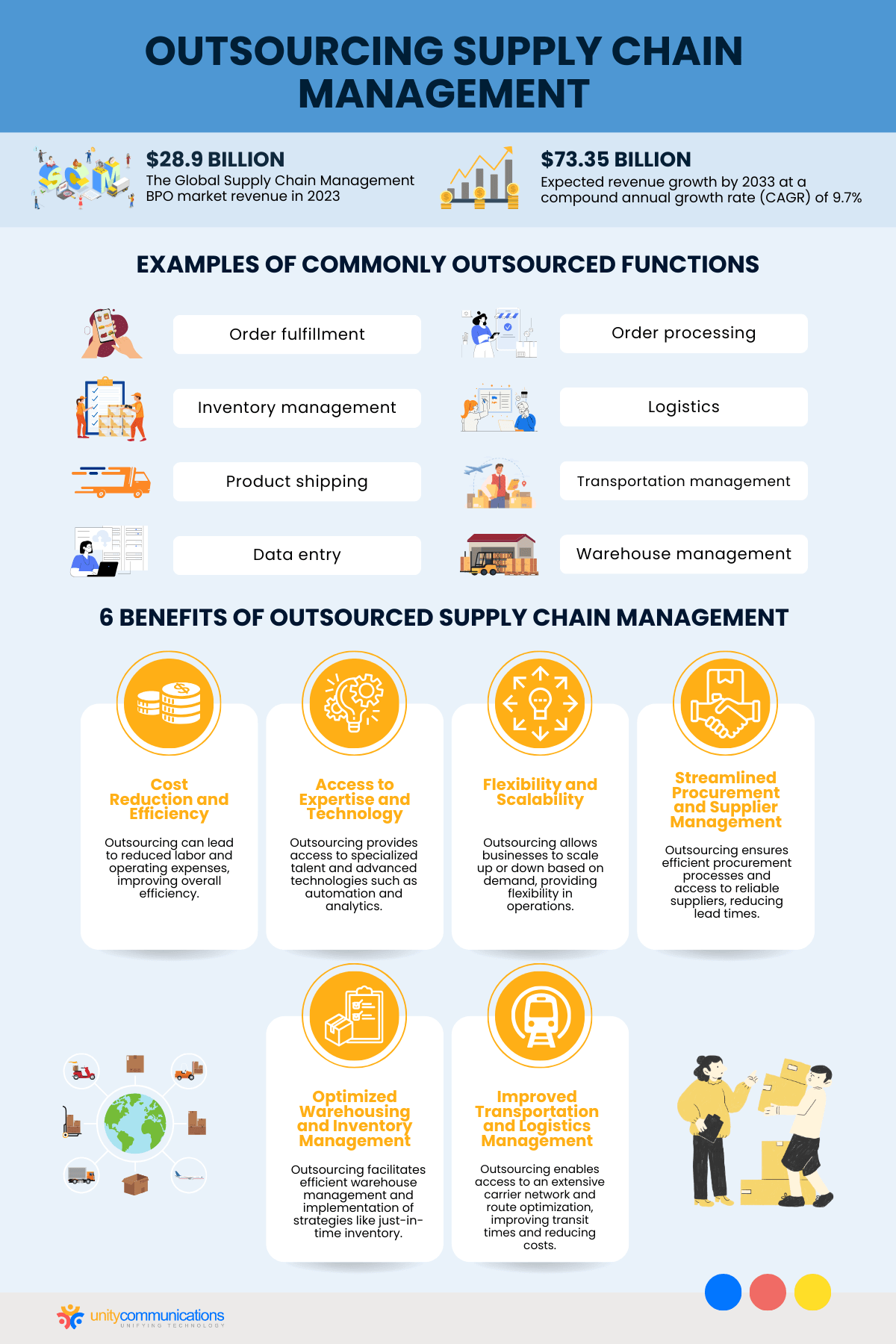
The benefits of supply chain outsourcing span five specific areas worth reviewing before choosing a provider:
Cost savings and operational efficiency
Supply chain outsourcing lowers costs because a provider spreads its infrastructure, staff, and technology across many clients. Your business pays a share of that cost instead of building the same setup alone. This turns fixed costs, such as warehouse leases and full-time payroll, into variable costs tied to actual volume.
A business scaling up during peak season pays more for that period. A business scaling down pays less, without layoffs or idle warehouse space.
The savings go beyond payroll. Providers already run automation tools, hold freight contracts, and train staff for supply chain work. Building the same setup internally means new hires and months of setup time. An outsourcing partner skips that step. This is why more companies now treat BPO as a business strategy rather than a short-term cost fix.
Access to specialized expertise and advanced technologies
A reliable outsourcing provider gives you access to specialized expertise in data management, order fulfillment, and logistics. Providers also leverage advanced tools such as automation, analytics, and cloud-based platforms to support growth.
This access to advanced technologies lets your growing business scale without hiring and training an entire internal team. These platforms also integrate with existing systems, so you gain visibility without replacing tools you already use.
Choosing the right partner means leveraging expertise and resources specifically built for supply chain operations. Learn more about how cloud tools support this kind of growth in cloud-based outsourcing for business growth.
Streamlined procurement and supplier management
Efficient procurement depends on strong supplier relationships and consistent access to raw materials. BPO providers often bring established relationships with multiple suppliers built over years of work.
Partnering with the right outsourcing provider improves negotiation power, contract management, and lead times. This structure helps you avoid the shortages and delays common in unmanaged supply chain operations.
Optimized warehousing and inventory management
Warehouse management and inventory tracking directly affect a company’s bottom line, especially during demand fluctuations. Outsourcing becomes especially valuable once a company outgrows its internal warehousing capacity.
An outsourcing partner provides dedicated warehouse facilities and trained staff to accurately track goods. Providers can also implement strategies such as just-in-time inventory and demand forecasting to optimize supply chain operations. This lowers the risk of stockouts and overstock, which are common issues in in-house management.
Improved transportation and logistics management
Getting products to customers on time requires route planning, carrier relationships, and real-time tracking. Third-party logistics (3PLs) give companies access to established carrier networks and better shipping rates.
Outsourcing eliminates the need to own trucks and warehouses outright, cutting fixed costs. Providers handle the routing itself, adjusting paths in response to traffic or carrier delays without input from your team. This helps companies improve efficiency and respond quickly to delays.
The result is fewer disruptions, lower freight costs, and stronger overall delivery performance.
How do you build a strong outsourcing relationship?
Building a strong outsourcing relationship starts with a clear service-level agreement (SLA) that defines scope, metrics, and responsibilities. The SLA should include operational objectives, industry best practices, and terms for handling a contract breach. Companies should also set key performance indicators for supply chain operations. Examples include cost savings, inventory turnover, and lead time.
Here are some tips to further improve your relationship:
- Evaluate potential providers’ management systems and ERP integration before signing.
- Confirm their track record with similar-sized companies.
- Ask how the provider handles scalability.
- Prioritize real-time visibility and request defined points of contact to prevent a loss of control once the relationship begins.
- Perform regular check-ins for performance reviews to keep both sides aligned as the partnership matures and scales.
For a full walkthrough of this process, read our business process outsourcing guide. For SLA and contract specifics, see our breakdown of the business process outsourcing agreement.
How is AI changing outsourcing in supply chain management?
Outsourcing in supply chain management is shifting from manual processes to AI-assisted, proactive operations. Outsourcing providers now use AI agents to handle procurement, demand forecasting, and supplier risk mitigation with less human input.
These agents typically handle three tasks:
- Flag anomalies in supplier data before problems spread across the entire supply chain.
- Forecast demand shifts before shortages affect inventory levels or warehouse management.
- Route compliance issues to the right team quickly, cutting the lag between a flagged issue and a fix.
According to McKinsey’s 2024 Global Supply Chain Leader Survey, supply chain footprints are evolving as companies pursue strategic resilience projects they began implementing over the past three years. About 73% of surveyed companies report progress on dual-sourcing strategies, and 60% are regionalizing their supply chains.
Future Market Insights projects the supply chain BPO market to grow from $85.5 billion in 2026 to $166.7 billion by 2036. Providers are driving this growth, in part, by adopting agentic AI to optimize supply chain operations across procurement and logistics.
Large outsourcing providers now build these capabilities into standard service packages rather than selling them as paid add-ons. A company evaluating a new outsourcing partner in 2026 gets AI-assisted monitoring by default, not as a future upgrade.
AI also changes how companies respond to supply chain challenges in real time. Older systems flagged a stockout after it happened. Agentic tools flag the pattern that leads to a stockout days in advance and adjust orders before a human reviews the alert.
Businesses that choose an outsourcing provider using these tools gain earlier warnings of disruption and faster response times. Manual tracking alone cannot match that speed, and the gap will keep widening as adoption grows.
What to ask before choosing an AI-enabled provider
Companies evaluating a new outsourcing partner in 2026 should ask a few specific questions:
- Which AI capabilities has the provider deployed across procurement, forecasting, and compliance?
- How do those tools integrate with existing ERP systems?
- What happens when an AI agent flags an issue? Does a person review it, or does the system act on its own?
- How does the provider measure the accuracy of its AI forecasts over time?
- What data does the provider’s AI system access, and how is that data secured?
- How much input does the provider’s team have over the AI agent’s decisions?
- What happens to affected orders or contracts if the AI system fails or goes offline?
- Can the provider show results from a current client using the same AI tools?
A provider without clear answers to these questions will likely leave you exposed during the next disruption.