


When a device fails or a login locks someone out, people want a knowledgeable person who can fix the problem fast. That is why technical support call centers remain a core part of customer and employee service. Trained specialists troubleshoot or escalate the issue until it is resolved.
But not every outsourced technical support provider is the right fit. The best technical support call centers combine technical expertise, SLA discipline, omnichannel tools, and regular audits. Many deliver them at a lower cost through offshore and nearshore teams. This article explains how to choose.
What is a technical support call center?

A technical support call center helps users fix problems with technology, products, or services, usually by phone, through trained specialists.
Because technical support serves technology users, companies commonly outsource it to a business process outsourcing (BPO) provider. IT-BPO firms are a frequent choice for this work because of their technical expertise. In practice, that means partnering with an outsourced IT provider, a third-party vendor that delivers IT support services, including technical support.
Here is a typical scenario. An employee can’t get into the company’s customer relationship management (CRM) tool and calls the tech support line. A BPO specialist provides the username and resets the password so the employee can get back to work.
Contact centers remain a dependable channel for customer-facing functions such as technical support, even as automation spreads. A 2026 Gartner survey of 3,566 B2B and B2C customers found that 87% say companies using generative AI for service must give them a way to reach a human agent.
Different types of call center for technical support
Technical support call centers operate in two main ways: inbound and outbound. Each type of call center handles different types of calls, and most programs start with inbound and add outbound as they mature. Matching the model to your customer needs keeps service quality steady as call volume rises.
Inbound call center service
Inbound teams answer customer questions and troubleshoot requests as they come in. This is the most common call center setup for technical support because users call when a device malfunctions or software crashes. Agents troubleshoot customer issues live and escalate complex problems through the tier structure.
A strong inbound call center service depends on support tools that give agents full context. Features such as call history and knowledge base search shorten each interaction, support first-call resolution, and improve the customer’s perception of the outcome. This setup anchors many customer support programs.
Outbound call center solutions
Outbound call center solutions enable technical support agents to initiate conversations rather than waiting for calls. They use outbound calls to confirm ticket resolution and walk users through software updates after a release. This proactive approach helps meet customer expectations and gives the call center team a chance to catch problems early.
In-house teams vs. an outsourced call center provider
An in-house team gives you direct control over training and call center operations. It also carries the full cost of hiring staff and maintaining support systems. An outsourced call center provider brings trained agents and established quality processes from day one.
Many companies split the work. They keep Tier 3 engineering in-house while a partner handles Tier 1 and Tier 2 contact center service. Nearshore teams in Mexico align with U.S. business hours, and offshore teams in the Philippines extend coverage overnight.
How BPO companies handle a technical support call center
Technical support is typically organized into tiers, and a BPO call center covers some of them:
- Tier 0 (self-service). Users rely on self-help resources and don’t yet need a specialist. This level usually sits outside the contact center.
- Tier 1 (basic support). Specialists handle common technical issues and typically fix them almost immediately. This level covers basic help desk and service desk work.
- Tier 2 (in-depth support). Specialists handle more complex problems. They raise a ticket and take more time to resolve it.
- Tier 3 (expert support). Agents escalate complex issues to a dedicated team. Although the team is usually in-house because of the complexity of the technical problems, a BPO company can still support it by resolving Tier 1 and Tier 2 issues first, so only the most complex cases reach your engineers.
- Tier 4 (external support). Specialists refer users to partnered vendors for problems your company can’t handle. This level also usually sits outside the contact center.
In short, a BPO call center typically handles Tiers 1 and 2, resolving common issues and more complex tickets, while your engineers focus on Tier 3. Because BPO covers both front- and back-office functions, you can also pair technical support with back-office outsourcing as your needs grow.
Factors to consider when choosing a technical support call center
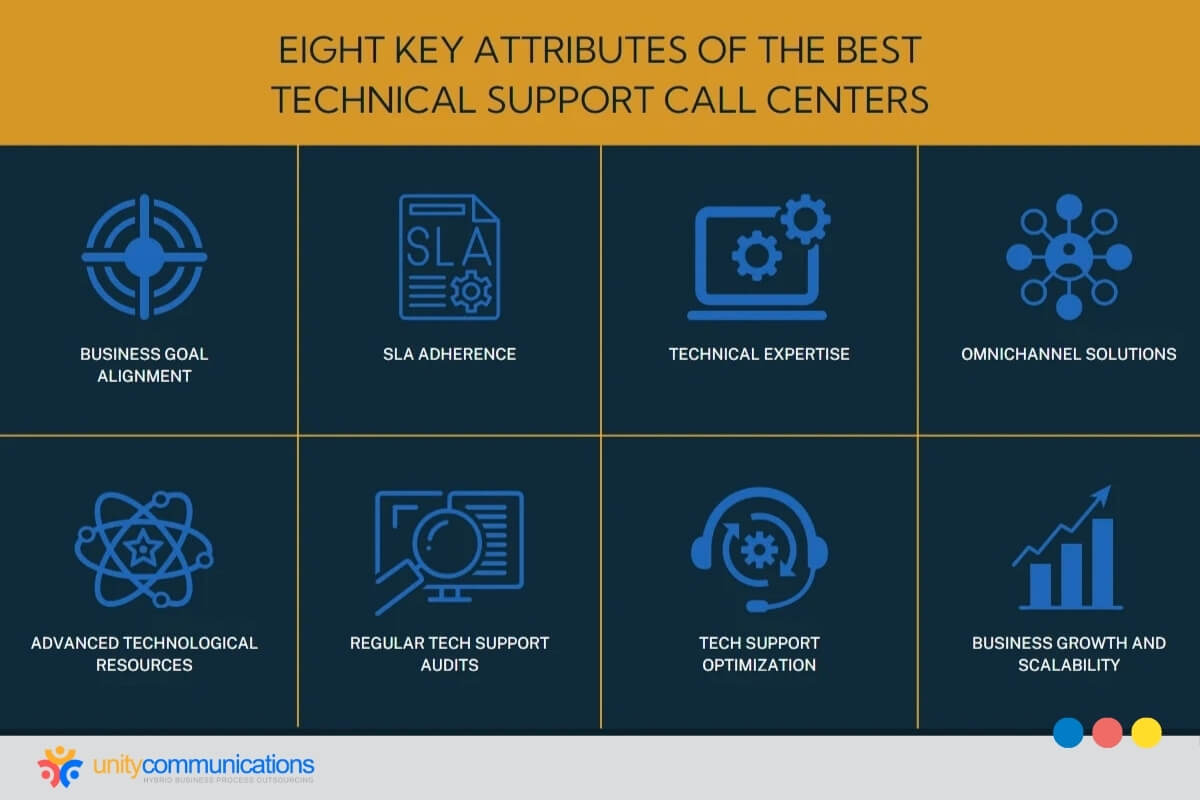
Not every provider delivers the same quality of service, so choosing one calls for a structured comparison. The best technical support call centers combine clear goals, technical expertise, the right technology, and regular quality audits. They also scale as your business grows.
Use the eight factors below to compare your options.
1. Business goal alignment
Whether outsourcing data entry services or tech support, the provider’s work should serve your business goals. These might be faster resolutions, lower costs, or higher customer satisfaction. They shape how the work gets done and how success is measured.
The best technical support call centers align their practices with their clients’ objectives. They treat your goals as the standard for their operation, not just their own internal targets. When a provider works toward the same outcomes you do, the partnership stays focused, and results are easy to measure.
2. SLA adherence
In outsourcing, clients and their BPO provider set a service-level agreement (SLA) to define their relationship. It covers the scope of work, contractors’ duties and responsibilities, and key metrics. It also includes benefits for meeting metrics and penalties for failing to meet the SLA.
The best technical support call centers strictly adhere to SLAs, such as first-contact resolution and customer satisfaction targets.
3. Technical expertise
Technical support takes more than soft skills such as communication, negotiation, and problem-solving. Specialists also need hard skills and real product knowledge, whether they are troubleshooting a computer network or fixing a mobile phone. Process training builds that proficiency.
The best technical support call centers hire selectively and bring in people with industry experience. They also train new agents to build technical expertise before they take live calls. That groundwork gives specialists the depth to resolve issues on the call.
4. Omnichannel solutions
Customers rarely stay in one channel. A 2024 Gartner survey of 5,728 customers found that 73% use self-service at some point in their service journey, yet only 14% of issues are fully resolved there. That gap is why connected support channels matter.
The best technical support call centers go beyond voice. Alongside the phone line, they offer live chat and email support. Some offer self-help options for Tier 0, while others address more complex issues via social media.
5. Advanced technology
Technology shapes how quickly and how well a support team resolves issues. The right tools give agents full context and help quality teams spot problems early, and companies can no longer afford to overlook them.
The best technical support call centers run on modern platforms. Automatic call distribution and call routing send each caller to the agent best equipped for the issue. A CRM integrated with the call center software provides agents with customer information and ticket history on every call.
Call recording and speech analytics enable quality teams to review interactions and identify recurring problems, while cloud-based systems and automation eliminate manual work from daily operations.
6. Regular tech support audits
BPO operations need constant monitoring, whether the work is front-office or back-office. Providers must track performance to keep improving the entire operation, and technical support is no exception. For the back office, these outsourcing tips are a useful companion.
The best call center conducts regular audits. A team of quality analysts (QAs) monitors calls to ensure quality service and business compliance. These reviews show where the operation can improve and keep service consistent over time.
7. Tech support optimization
The best BPO service providers continually improve their business. They boost processes and refine operations so customers get consistent service as call volume, products, and expectations change. That holds whether you outsource data entry or technical support.
In technical support call centers, optimization often includes:
- Providing regular training and updates
- Upskilling and cross-skilling tech support specialists
- Streamlining tech support workflows
- Automating processes and removing manual work
- Using omnichannel solutions (contact center, live chat, email support, social media, and self-service options)
- Using the latest technologies (AI, RPA, cloud computing, PWA, etc.)
- Tracking and assessing business performance
- Adjusting business strategies whenever necessary
8. Business growth and scalability
A technical support operation has to keep up as the business grows. More users and more channels shouldn’t mean slower resolutions or a weaker experience. That makes scalability one of the clearest measures of a reliable BPO provider.
The best technical support call centers do more than optimize a single outsourced function. They help improve customer service as volume rises and scale alongside their clients, so growth doesn’t strain support quality.
For example, Unity supported AT&T’s technical support for business customers in Arizona, helping increase its wireless market share by 4% and secure 15% of the local market.
How do you choose the right call center and outsource to them?

Assess your needs, compare vendors, sign an SLA, launch with support, then track metrics and optimize so your BPO partner meets your goals.
1. Study your industry
Before outsourcing, the initial step is to study your niche. Understand the BPO trends in your sector and the needs of your target market. See how tech support can affect your business. From there, you can make informed BPO decisions.
2. Identify your problems and needs
Audit your tech support operation to see what needs fixing. Consider outsourcing if you lack resources, carry ticket backlogs, or face a high volume of complaints and customer service inquiries. Notice how the customer feels after each contact. Long waits and repeat calls point to gaps worth addressing.
When Wireless Watchdogs’ helpdesk and technical support team became stretched thin, pushing overtime limits and relying on temporary staff, Unity built a custom SLA and a 24/7 offline team. Repetitive tasks were moved to that team within a week, and within four months, the client exceeded its SLA. It ended its need for temporary workers and avoided overtime.
3. Perform a vendor search
Compare technical support call centers on business reputation, BPO credentials, and services offered, along with skills, technical expertise, and industry experience. A modern call center should also have the infrastructure and resources to support your users, including contact center software with features like call routing and recording. Ask how each provider protects customer data.
4. Hire a BPO service provider
After research and due diligence, seal the contract and create an SLA. It should detail what each party is responsible for, the metrics to hit, and what consistent service quality means in practice. Both sides should be clear on every term before signing.
5. Start your tech support operation
Let your BPO partner begin and execute with its own business strategies, but give it the support and information it needs at the outset. A strong start helps ensure every customer interaction reflects your standards. After all, BPO is a partnership.
6. Track your BPO progress
Monitor whether your provider meets its metrics and SLA, including how it uses tools to manage customer interactions. If it falls short, offer help and suggest adjustments to its practices and strategies. Tracking is also how you confirm great customer service and consistent service across every channel.
7. Optimize your tech support operation
Optimization is a long-term effort. Let your provider improve your processes and scale your operation. Well-run technical support call centers invest in the latest technologies, such as automation, AI, cloud computing, and omnichannel solutions, to help your business grow and succeed.
8. Celebrate your BPO success
When your tech support operation succeeds, give your BPO partner the credit. Recognize their role with incentives or profit sharing, since they were instrumental to your outsourcing success.
The cost of outsourcing technical support to a call center
Outsourcing can cost less than staffing in-house, but the cost depends heavily on where your agents are based. Hourly rates for technical support call centers can differ by three times or more from one region to another.
The table below shows typical 2026 ranges for English-language voice support, followed by what the differences mean for your budget.
| Region | Typical Hourly Rate | What to Expect |
| Onshore (U.S. and Canada) | $25–$45 | Highest cost, with the strongest language fluency, cultural fit, and ease of oversight |
| Nearshore (e.g., Mexico) | $12–$23 | About half the onshore rate, with U.S.-aligned time zones and bilingual English-Spanish agents |
| Offshore (e.g., Philippines) | $8–$16 | Among the lowest rates for English-language support, plus overnight coverage for U.S. hours |
| Offshore: Eastern Europe | $14–$22 | Mid-range, with multilingual European coverage and time-zone fit with Europe |
| Western Europe | $28– $45 | Priced close to onshore U.S. rates |
Onshore agents cost the most, but you get proximity, language competency, and cultural affinity. Nearshore teams cost about half as much as midpoints and share your business hours. Offshore teams in the Philippines are cheaper still, roughly two-thirds below onshore at the midpoints, and they extend coverage overnight.
Eastern European providers charge about 50% more than Philippine rates at the midpoint ($18 versus $12 per hour). They make the most sense when you need European time zones, languages, or easier travel. Western European rates sit close to onshore U.S. pricing, so they rarely save money on their own. For English-language support, the Philippines remains the cost leader.
These ranges reflect standard voice work. Technical support often prices toward the top of its range, or above it, because agents need product training and hard skills.
Unity provides support from both onshore U.S. locations and offshore teams in the Philippines, so you don’t have to choose a single region for everything. A hybrid model lets you keep complex, time-sensitive, or compliance-heavy work onshore while routing high-volume Tier 1 and Tier 2 support and overnight coverage offshore. Your blended rate lands between the two.
Different pricing models for BPO call centers
Hourly rates are only part of the cost picture. The pricing model you choose affects how predictable your spend is, who bears the risk, and how well the provider’s incentives align with yours.
Here are seven common models for outsourced tech support. Match one to your call volume, budget, and goals:
- The fixed-price model has a standard rate set by the BPO firm. You must pay the service provider monthly, quarterly, or yearly, as agreed.
- The time and materials (T&M) model involves paying a BPO firm based on the service duration. In addition to the billed time, it includes the materials and resources used.
- The staffing model is a pricing structure for tapping into a BPO firm to provide you with a workforce. You pay for employee services and resources used.
- The consumption-based model bills you for the actual consumption used in a given period. A perfect example is paying monthly for cloud services to store and access data.
- The cost-reimbursable model allows a BPO firm to set an expense limit. Once they exceed this limit, you’ll pay an additional percentage.
- The incentive-based model obligates you to set an incentive program. Usually, you include this in the contract agreement to motivate your service provider.
- The profit-sharing model requires you to share a part of your business profit with your BPO partner. After all, they perform the day-to-day operation of your tech support, for instance.
Get multiple quotes if you outsource your technical support to a call center. From there, compare BPO pricing and settle for the best deal. Also, learn their pricing models and see which apply to your company. With all this in mind, you can make informed BPO decisions.