

Managing customer support gets harder as client demands shift, but customer experience still decides whether a business grows or stalls.
Customers trust businesses whose customer service agents reflect the brand’s values and meet rising customer expectations. That trust is exactly what customer service outsourcing companies are built to deliver, including specialized e-commerce customer service outsourcing teams for online sellers with high ticket volume.
This guide helps you decide whether outsourcing is right for your business. You’ll learn what third-party providers do, how they price their customer support services, and where the tradeoffs lie.
What is customer service outsourcing?

Also known as customer support outsourcing, customer service outsourcing involves delegating voice and non-voice customer service operations to a third-party provider, such as a business process outsourcing (BPO) team.
As a business, you can use this strategy to scale your customer support teams, especially during peak seasons like the holidays. In this case, you can handle high-volume calls with more people without adding permanent headcount or significantly increasing operating costs.
Many businesses, particularly e-commerce, also outsource entire customer support operations. The third-party agents are now completely responsible for interacting with every customer, answering inquiries, and resolving issues.
Regardless of your approach, outsourcing customer support can improve your company’s response rate. You can provide 24/7 coverage without compromising quality service.
This and other factors, such as rising customer expectations and digital transformation, fuel the growth of the industry. According to Research and Markets, the global customer service BPO market could achieve a compound annual growth rate (CAGR) of 8% to 16% from 2025 to 2030.
Outsourced customer service roles
You can outsource many functions to customer service outsourcing companies. These include the following:
1. Inbound calls
Inbound call center agents answer customer questions, complaints, and concerns 24/7. They also handle recurring requests and assist new customers in becoming acquainted with a product or service.
This role satisfies customer demands. Agents are busy addressing client problems and providing alternative solutions as quickly as possible without sacrificing quality or reputation.
2. Outbound calls
Outbound call center agents place calls and develop strategies to turn leads into paying customers. This role calls potential customers, introduces them to new products or services, and informs them about the latest bonuses and promotions.
Listening to clients’ suggestions or concerns and making them feel understood and cared for is part of the job. Another aspect of the task is placing calls regarding payment collections, billing due dates, system modifications, or recent changes.
3. Help desk
A help desk offers instant assistance and resolution to common customer complaints and issues. The next-level agent will immediately take over if a help desk representative cannot address the problem.
Put simply, a help desk agent receives customer calls, provides solutions, or relays them to the next appropriate level of assistance. Like inbound call center representatives, help desk agents serve as the first point of contact for clients. The difference is that a help desk focuses on resolving problems with the business’s products or services.
4. Non-voice
Non-voice customer service also helps address customer issues and provide support, but the core function does not include answering or placing calls. Typically, this role uses live chat, social media, and email to connect with customers and handle their concerns.
These customer service agents must determine the client’s emotions through textual cues before sending any reaction or feedback. Outsourced email support and live chat offer cost-effective solutions while ensuring high-quality service.
5. Data entry
Data entry specialists prepare and organize source information for encoding into a computer. They prioritize error-free encoding, which means that they must review all data for deficiencies. Encoders follow a strict standard procedure to resolve data inaccuracies.
If a data entry specialist is not authorized to correct the error, they can pass the document to the team leader, who is permitted to do so. Data entry includes encoding account and customer data into the business database.
Companies can outsource data entry services for faster encoding and information accuracy.
6. Account management
Account management is about developing, building, and maintaining warm relationships with your customers. Account managers serve as the bridge between clients, upper management, and other company stakeholders. Additionally, account managers ensure that all agents work together to resolve a client’s demand promptly and successfully.
Account managers must be proficient in their current accounts, serving as the primary point of contact between your brand and clients. This role also identifies potential leads and opportunities to build new relationships. Primarily, account managers identify key accounts and establish strong client-advisor relationships.
7. Client relations management
Like account managers, client relations specialists also establish and maintain close relationships with your customers. They also assist in-house teams in guaranteeing successful issue resolution.
The difference is the focus. Client relations managers concentrate on a predetermined portfolio of primary clients and aim to build long-lasting relationships with them. Lastly, client relations managers examine the competition to find new ways to retain existing customers.
8. Research
A customer support research specialist analyzes your company’s service department and identifies easy ways to enhance it. They conduct comprehensive research on optimal ways to improve the customer experience and make recommendations to boost internal productivity.
They can also perform customer satisfaction surveys and interpret and report results to upper management. In conjunction with developing strategies, research specialists also assist in executing plans.
Other functions include inventory management outsourcing, online concierge, lead generation, and sales. Companies can outsource one or all these functions, depending on operational needs.
Channels that customer service outsourcing companies use
Customer service outsourcing companies use various channels to achieve better results and provide a more pleasant client experience. These customer support platforms include:
- Live chat. With live chat, customers click a button to begin a conversation with a representative, often an AI assistant first. This support builds customers’ confidence that they can get help immediately. Most AI chat tools now hand off to a human agent when a question becomes complex.
- Email support. Email remains a primary channel for shoppers to interact with businesses. AI now drafts and prioritizes replies before an agent sends them, cutting response time on routine questions. Customer service outsourcing providers use email support to maintain consistent response speed and personal tone.
- Phone support. Live phone support is a powerful channel for a remarkable customer experience because it provides real-time solutions to customer concerns, especially for older customers and complex issues that chat can’t resolve. Customer support outsourcing companies pair trained voice agents with AI tools that surface customer history mid-call, so agents solve problems faster.
- Social media support. This is a crucial part of customer support because many consumers browse and shop directly through social platforms. Companies now expect social replies to meet the same account history and response-time standards as any other channel, not a slower, separate track.
- Mobile apps. Clients find it easy to interact with you if you give them a direct way to message you without leaving your mobile app. In 2026, that channel often includes AI support that pulls order and account details automatically, so hiring customer support outsourcing teams to staff the human side of that conversation still matters.
Industries and companies that outsource customer support
Certain industries depend on constant, high-volume customer interaction, which makes outsourcing a practical fit. Below are a few examples:
Telecommunications
The telecom sector is a major user of outsourced call center services. Common services that this industry needs include customer and technical support. Payment concerns, subscription upgrades, tech assistance, and tech issues are some of the tasks call centers manage.
Examples
- Verizon
- Telstra
- AT&T
- Vodafone
- Comcast
- Telefonica
Banking
Companies in the financial and banking industry deal with many customers every day. Direct interaction requires strong customer support, whether in person or via communication platforms.
Examples
- Bank of America
- Wells Fargo & Co.
- JPMorgan Chase
- Citi
- Capital One
- America Express
- Axa
E-commerce and retail
E-commerce and retail companies deal with customers 24/7. Expect customer calls asking for updates on their orders, payments, or delivery status. Customer support outsourcing companies help manage client inquiries and calls after office hours and even during the holidays.
Examples
- Amazon
- Target
- eBay
Is customer service outsourcing a good idea for your business?

Yes, if it cuts costs, adds scalability, and improves service, but weigh control tradeoffs before you commit to a provider.
Customer service outsourcing is an excellent alternative to building an in-house support department. It is a cost-effective and beneficial solution, especially for small and medium businesses (SMBs) and startups.
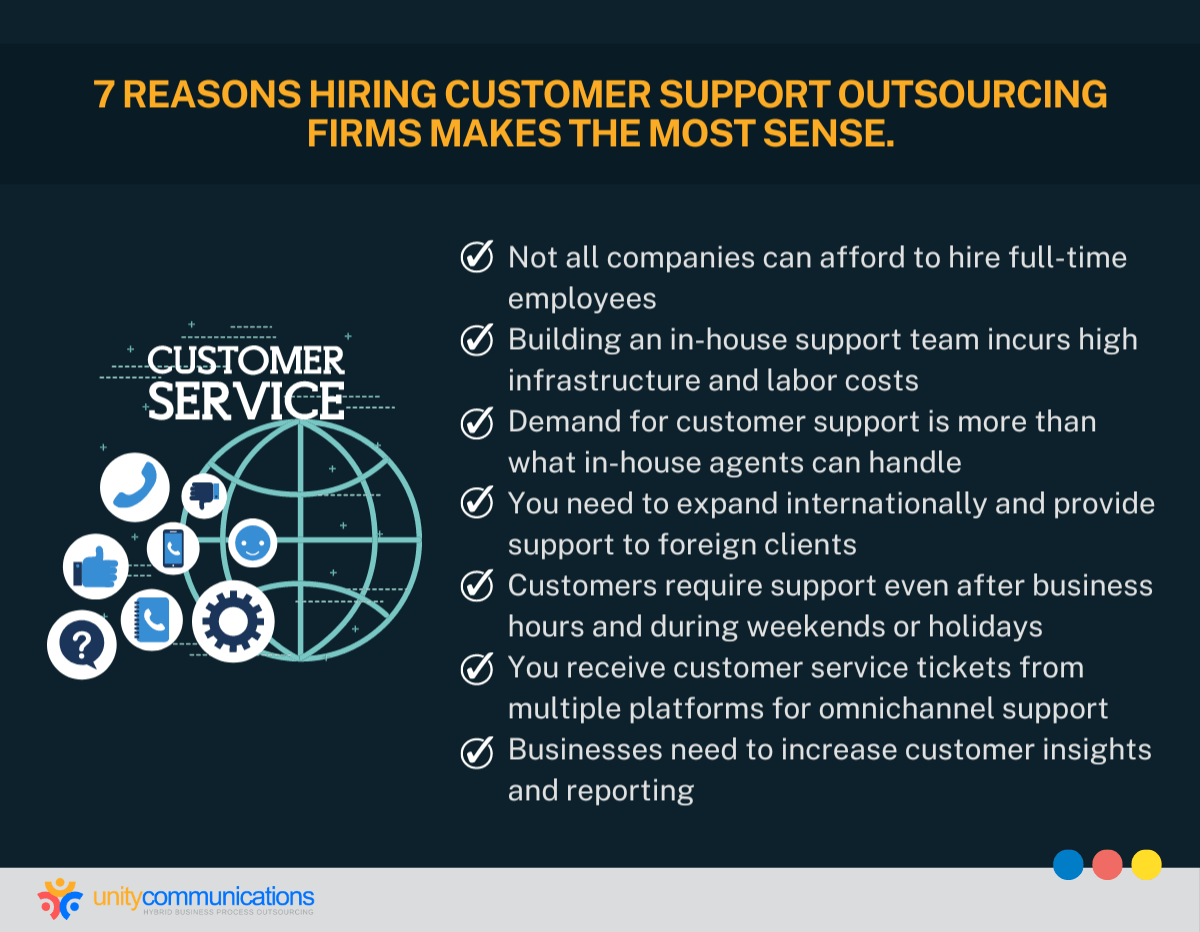
Outsourcing customer service is ideal in the following scenarios:
- You cannot afford to hire full-time employees.
- Building an in-house support team incurs high infrastructure and labor costs.
- Demand for customer support exceeds what in-house agents can handle.
- You need to expand internationally and provide support to foreign clients.
- Customers require support 24/7.
- You receive customer service tickets from multiple platforms for omnichannel support.
- Businesses need to increase customer insights and reporting.
The following sections further explain the advantages of customer service outsourcing:
1. Cost-effectiveness
Outsourcing customer service generates significant savings for your business, from lower payroll taxes to reduced office overhead. That’s perhaps the biggest advantage of outsourcing. Your company avoids the cost of hiring in-house agents, paying full-time salaries and bonuses, and running a training program.
While cost savings are an inherent advantage of outsourcing customer service, it shouldn’t be the only driving force. First, focus on delivering a top-of-the-line customer experience. That means hiring a reputable BPO should be the top priority.
2. Omnichannel support
Companies that manage customer support internally tend to have limited omnichannel support. Outsourcing helps you interact and serve your clients across multiple platforms.
Working with customer service outsourcing companies means providing your clients with access to all available channels, from email to live chat, phone, social media, and even short message service (SMS). Your customers can reach out to you on their preferred messaging platform, and a support representative will be available to handle their concerns.
3. Round-the-clock availability
Companies operating in the global market must stay available 24/7. Outsourcing lets your customers reach your business at any hour, any day.
E-commerce stores need this most, since shoppers browse and buy across every time zone with no fixed business hours. Running that coverage in-house means paying for night shifts, holiday staffing, and backup coverage when someone calls in sick. Outsourcing to a provider built for round-the-clock work solves that without the added payroll.
4. Access to talent
Outsourcing customer support gives your company access to a team of versatile experts. A single provider can cover inbound support, a help desk, data entry, and customer relationship management, so you avoid hiring separately for each function.
Offshore outsourcing widens that talent pool, giving you access to workers with diverse experience and skill sets across regions. Deloitte’s 2024 Global Outsourcing Survey found that improved access to talent is now the top driver for outsourcing, cited by 42% of executives, ahead of cost alone.
5. Scalability
Outsourcing works on an as-needed basis. It allows you to quickly scale up with trained staff to manage the increased call traffic during peak season. Depending on your customer service needs, you can add up to 100 representatives within days or weeks.
Conversely, scaling down with fewer call center agents when peak season ends is equally easy. Customer service outsourcing companies can quickly provide temporary support when needed.
6. Agility
One benefit of outsourcing is access to current technology without buying it yourself. AI-powered chat tools, sentiment analysis, and CRM integrations now update continuously. A typical small business might not be able to justify the cost of licensing and maintaining these tools in-house.
Outsourcing makes your company more agile because you skip that capital expense entirely. The BPO company already runs the software and tech stack your support team needs. The only training required is getting agents familiar with your products and brand voice.
What to look for when considering outsourcing
The only way to achieve the benefits of customer service outsourcing is when you choose the right partner. In this process, the basis goes beyond price.
Other factors to consider when selecting a customer service outsourcing company include:
1. Industry experience
The outsourcing company should understand your specific industry, not just customer support in general. A provider with healthcare experience understands compliance requirements, while one with e-commerce experience knows returns, shipping, and order disputes. Their staff’s level of expertise matters most, since they’re the ones managing your customers directly.
2. Technical expertise
The success of customer support outsourcing depends on the provider’s ability to run current technology. This includes CRM systems, ticketing platforms, and AI-assisted tools that keep pace with how customers expect to be served. A provider stuck on outdated software slows down every interaction your customers have.
3. Track record
The best customer support provider has a proven history of handling critical issues and withstanding market pressure. They know how to adapt during service outages, complaint spikes, or other high-pressure situations without losing service quality.
4. Data security
A reliable outsourcing agency adheres to current security protocols and regularly updates its privacy measures. This includes certifications such as SOC 2 or ISO 27001, along with a clear plan for breach response and disaster recovery. Regular updates to these protocols prevent data leakage and protect both your business and your customers.
5. Strategic alliances
Most customer support providers maintain partnerships with specialized firms, including fraud detection services and disaster recovery agencies. These alliances give you access to expertise beyond basic customer support, without the cost of hiring for each function separately.
6. Staff training and development
The vendor’s employees represent your brand directly, so their training matters as much as your own team’s. A strong provider runs structured onboarding along with ongoing coaching, not a one-time orientation, so agents stay sharp as your account and product line grow.
7. Quality assurance
A dependable provider has clear procedures for delivering error-free service, backed by regular quality control reviews. This includes consistent monitoring of calls and chats, along with updated security protocols that maintain both service quality and data protection.
Tips for outsourcing customer support
Outsourcing offers many benefits to your company and helps you concentrate on your core activities, but giving up control comes with risks. Follow these tips for outsourcing customer service to make your partnership with customer service outsourcing companies work.
- Prepare carefully. Set a clear scope before you sign anything, including response-time targets, escalation rules, and data-handling procedures. Put these terms in a service-level agreement and a non-disclosure agreement, not just a verbal understanding.
- Put time and effort into the relationship. Schedule regular check-ins, weekly or biweekly, to review performance metrics and flag issues early. Use shared tools such as Slack or a joint dashboard so both teams see the same data in real time.
- Commit for the long term. Give a new provider at least three to six months to reach full performance, since ramp-up time affects early metrics. Switching vendors resets that learning curve and disrupts the customer experience you’ve already built.
- Be flexible. Build a contract review clause that allows you to adjust staffing levels, hours of coverage, or the channel mix every 6 or 12 months. This keeps the agreement useful as your business grows, rather than locking you into terms that no longer fit.
- Track the right metrics. Agree on specific key performance indicators (KPIs) upfront, such as first-response time, resolution rate, and customer satisfaction score. Review these numbers against your baseline every month so you catch problems before they affect your customers.