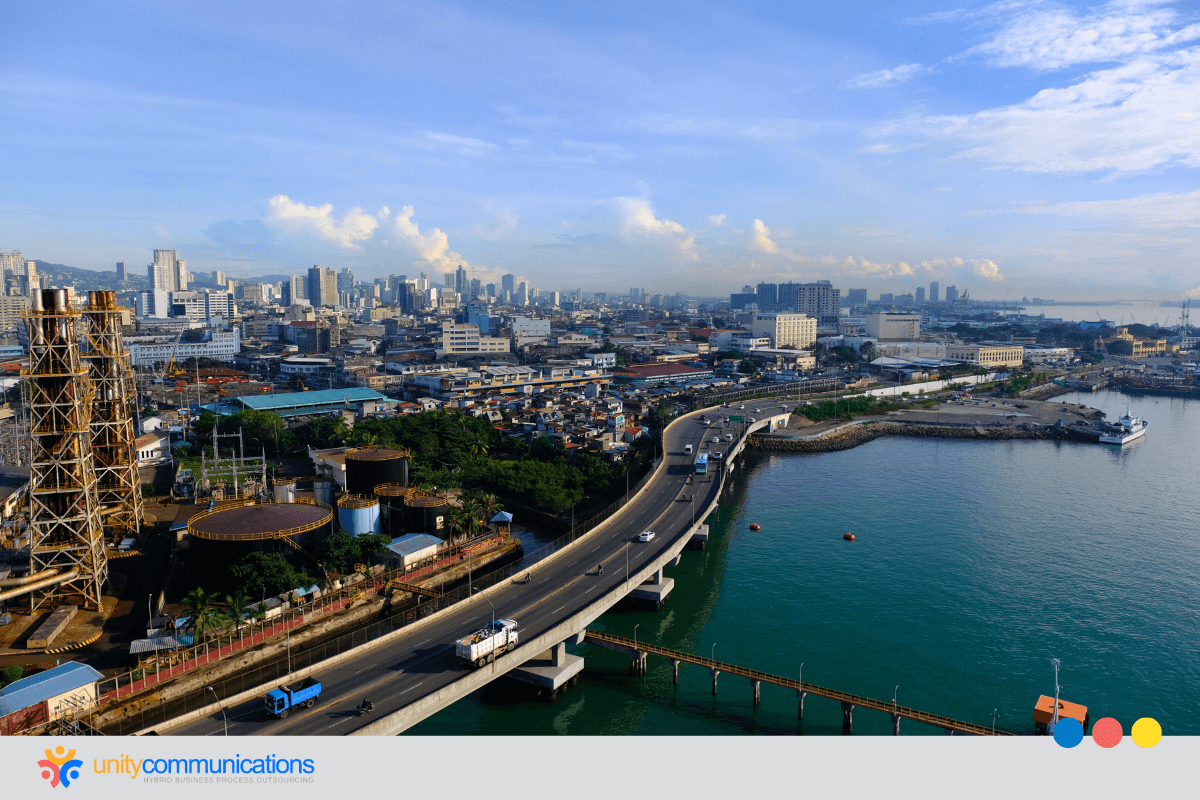


Business process outsourcing (BPO) gives companies dozens of options, and the Philippines sits at the top of most shortlists for its workforce and cost structure. But the destination is only half the decision. Not every provider there delivers the same result, and not every support model fits the Philippines equally well.
This Philippines tech support call center guide sets out the real tradeoffs: what the workforce, cost structure, and infrastructure actually offer, where the risks sit, and how to evaluate a partner before signing, not after. The goal is a decision built on evidence, which good technical support outsourcing should always deliver.
Why do U.S. companies choose a Philippines tech support call center?
U.S. companies choose Philippines tech support call centers for the workforce’s English fluency, cultural alignment, and technical training.
Agents trained on U.S. idioms, tone, and customer expectations handle calls as if working from the same office, not another continent. That familiarity shortens the trust-building period with each customer, and ticket resolution speed per shift reflects it.
Government investment adds further stability. Decades of BPO development have given the country reliable infrastructure and a steady graduate pipeline for technical talent. For more on why this pattern holds across the industry, see why more businesses are outsourcing BPO and call centers to the Philippines.
This maturity is documented at scale. See a total look at the Philippines call center outsourcing industry for how the sector developed into a dependable base for technical support work over several decades.
Cost remains a factor, but it operates alongside scalability. Tech support outsourcing Philippines arrangements let headcount adjust as demand shifts without sacrificing quality, keeping the country near the top of most technical support shortlists.
What can a Philippine tech support call center handle?
A Philippines tech support call center covers Tier 1 help desk requests, Tier 2 troubleshooting, software fixes, and hardware escalations.
Each tier handles a different layer of complexity, but BPO teams cover most of what a U.S. business needs from outsourced technical support. The list below reflects how work actually gets divided and routed once a ticket enters the system:
- Tier 1 help desk for password resets, access issues
- Tier 2 troubleshooting for recurring software errors and configuration problems
- Application support for common business software tools
- Hardware issues routed through structured escalation
- Remote diagnosis without an on-site visit
- Incident tracking through defined ticket workflows
- Knowledge base use for faster repeat fixes
- Omnichannel service using phone, email, quick messages, and self-service portals
Large-volume, standard issues fall to Tier 1 agents, freeing your own team to focus on more complex work. Tier 2 agents step in once a problem needs deeper diagnostic skill tied to specific software or systems. What technical support in a call center is depends on this tier structure, since each level carries distinct responsibilities.
A help desk logs and routes requests, while tech support resolves the root issue behind each customer ticket. The collaboration of technical support and help desk call center services explains why help desk outsourcing Philippines providers that pair both functions under one team shorten resolution time and keep customers informed.
What are the pros and cons of outsourcing to the Philippines?

The Philippines offers strong technical talent and scalability. But attrition, provider quality gaps, and time zone friction still matter.
Advantages of outsourcing tech support to the Philippines
Call center Philippines advantages go beyond English fluency and cost. They rest on workforce depth built over decades of BPO growth and steady training investment:
- Workforce maturity spanning technical and customer-facing roles
- Communication shaped by years of U.S. business exposure
- Scalability that supports fast growth without long ramp-up time
- Continuity practices common among established providers
- Philippines BPO cost savings that free budget for other priorities
The data backs this up at a national level. The Philippines ranked fifth among 25 outsourcing destinations in Ataraxis’s 2026 Global Outsourcing AI Readiness Index, as reported by BusinessWorld Online. It scored 69.05 against India’s 84.55 and Brazil’s 76.1. For your business, that ranking means the talent pool is already adapting to AI-assisted tools.
Disadvantages of outsourcing tech support to the Philippines
Strong Philippines tech support call center advantages come with real tradeoffs. Attrition, provider quality gaps, and time zone friction all deserve a place in the decision:
- Industry-wide attrition that can disrupt agent continuity
- Provider quality variance among smaller, less established vendors
- Time zone gaps of up to 15 hours for U.S. West Coast teams, requiring live-coverage planning that East Coast companies need less of
A provider with structured retention practices, defined tier escalation, and disciplined quality assurance narrows the attrition and quality gaps that hurt weaker vendors, well before time zone planning even becomes a factor. Unity Communications is one example of a provider built around that structure.
The table below sets these points side by side.
| Factor | Strength | Consideration |
| Workforce | Deep technical talent, strong training pipelines | Attrition varies by employer. |
| Cost | Real savings versus U.S. staffing | Cost alone should not decide it. |
| Operations | Scalable and continuity-focused | Time zone needs planning ahead. |
| Communication | Years of U.S. business and cultural exposure | Quality of training still varies by employer. |
A Philippines tech support call center delivers valuwhenen you weigrequiresh sides, since the skills provider narrows most gaps through structure and steady oversight.
When does 24/7 Philippines tech support work well?
A 24/7 model works best when your customers need continuous coverage. It depends on structured staffing, not extended hours alone.
The difference between an effective and a costly 24/7 model comes down to shift structure. The elements below distinguish a genuinely continuous operation from a schedule that simply staffs someone through the overnight hours:
- Dedicated shifts covering morning, evening, and overnight windows
- Documented handoffs so context is carried between shifts without gaps
- Tier-based escalation that routes issues to the right shift fast
- Live monitoring for incidents that happen outside standard business hours
Philippines tech support call center teams built for continuous coverage depend on structured shift design, not headcount alone. Shared tickets and handoff notes give each team the customer context needed when shift responsibility changes.
This model delivers the clearest value for SaaS platforms, healthcare applications, e-commerce retailers, and managed service providers. Their customers submit requests at varying times across multiple time zones. A single internal point of contact keeps that handoff coordinated on your side too, so tickets don’t get overlooked between shifts.
Philippines IT support outsourcing built around 24/7 coverage works when staffing, escalation, and communication stay tight. Friction shows up when any of those pieces are missing. For example, a live overnight shift with no manager empowered to approve escalations just delays the same tickets until morning.
For a business with low overnight ticket volume, staffing a full shift can also cost more than the support it delivers. Standard business-hours support still serves smaller, regional customer bases well, without the added coordination costs.
When is the Philippines not the right outsourcing choice?
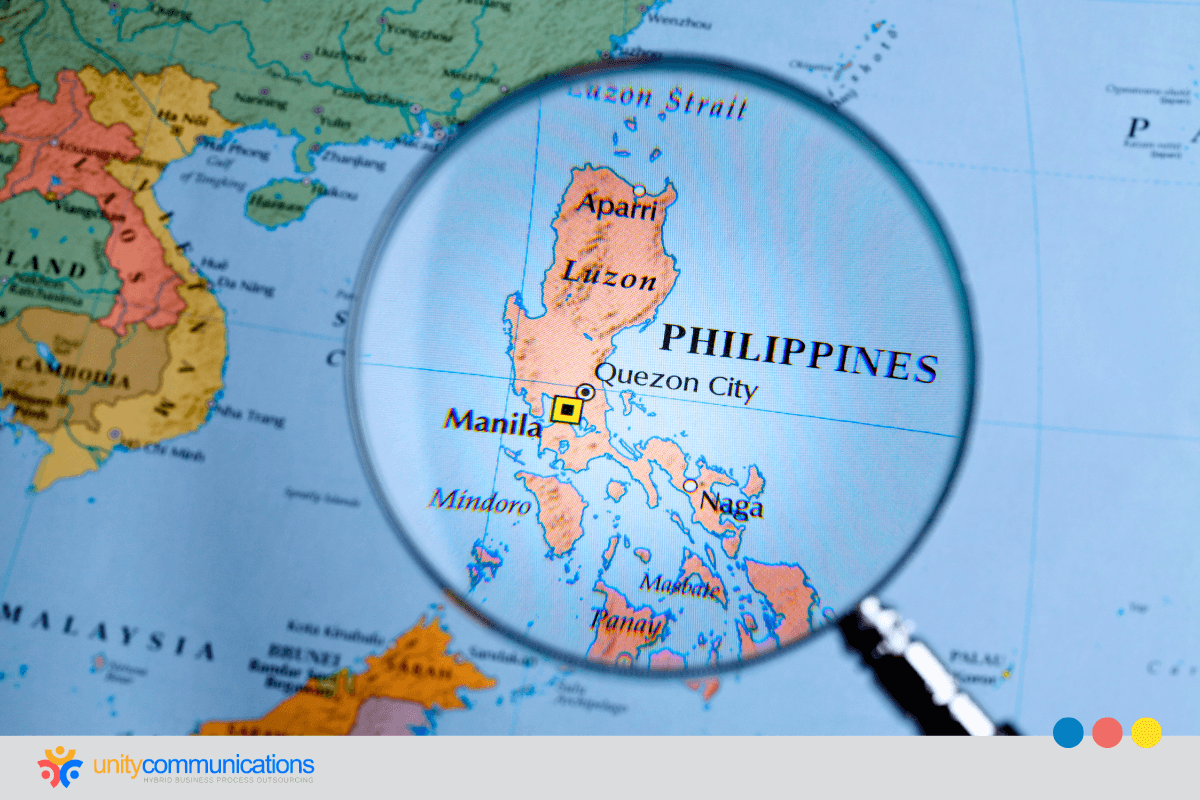
The Philippines fits most support needs well. But it is not the right match for every operation, regulatory setup, or language mix.
Some situations stand out:
- Extensive on-site hardware repair or physical equipment handling
- Support agents handling several non-English languages in one queue
- Data must stay within a specific country, or your industry has its own compliance rules
- Frequent in-person collaboration with your support team
- Ultra-low-latency engineering work tied to a single physical location
Region-specific slang or regulatory language pushes some businesses toward a delivery model closer to that local market. A specialized technical environment tied to a physical location often requires a hybrid setup as well.
If you plan to outsource tech support to the Philippines, start with your actual requirements and build the delivery model around them. Regulatory load, language mix, and real in-person needs carry the most weight in that decision.
How do you choose the right Philippines tech support partner?
To choose the right partner, evaluate operational maturity, governance, and security.
Start with this short-listed vendor checklist:
- Technical depth in tier 1 and tier 2 support
- Escalation management with clear ownership at each step
- Quality assurance backed by measurable performance
- SLA reporting that shows real numbers, not summaries
- Verifiable client references tied to a similar account size
- Agent retention rates and workforce stability over time
- Onboarding methodology and knowledge transfer
- Security and disaster recovery practices
- AI-assisted support tools paired with human oversight
- A governance cadence with a fixed update schedule
The Business Times reported that Philippine BPO companies invest close to PHP1.4 billion, or $24 million, in yearly training, to address talent shortage and rising AI use in the sector. That level of investment indicates that many Philippine BPO call center providers treat quality as an ongoing practice.
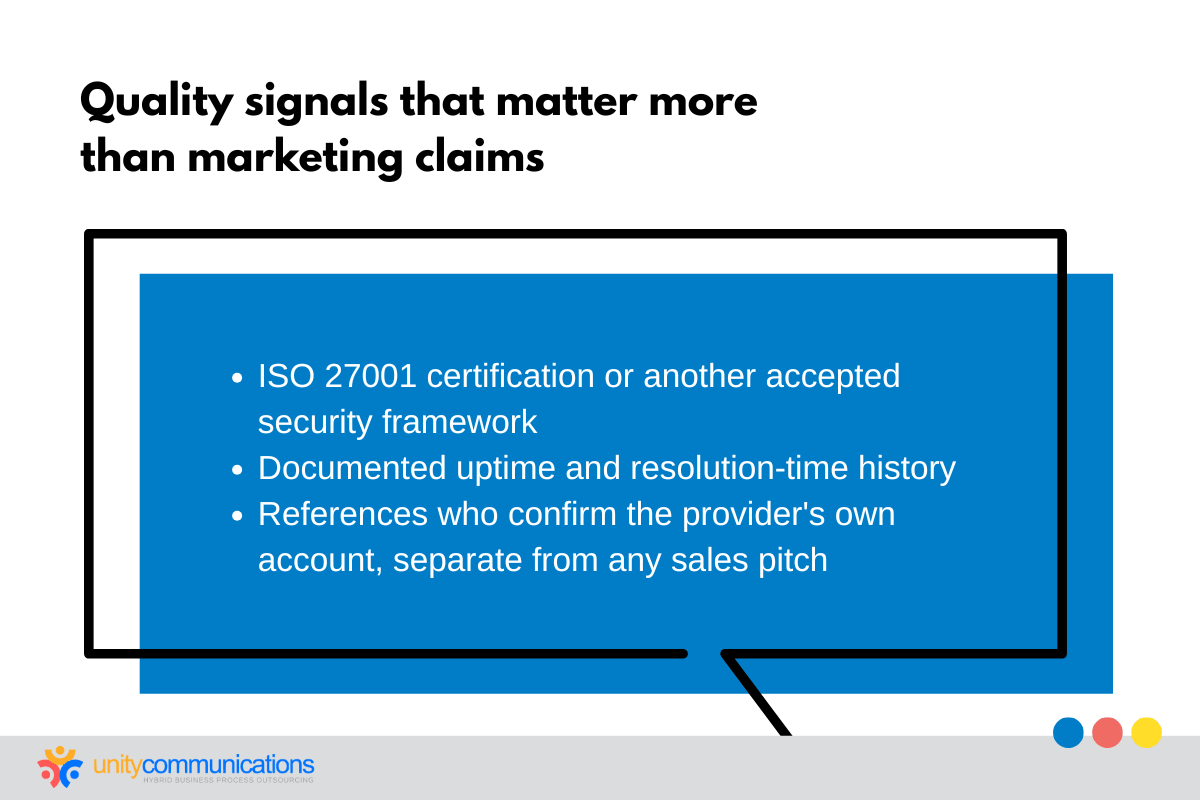
A Philippines tech support call center worth choosing shows the signals above without you having to ask for them. Certification alone doesn’t confirm capability, so look for uptime history and independent references before committing to a partner. That’s ultimately what separates real Philippines call center quality from a certificate on a website.
How does Unity Communications apply these best practices?
Unity Communications applies these standards by running structured Tier 1 and Tier 2 escalation paths under clear governance and oversight.
Delivery sits on a Philippines-based infrastructure built for continuity, not a single office reacting case by case. Escalation paths route issues to the right specialist, and reporting stays visible to clients instead of being buried in internal notes.
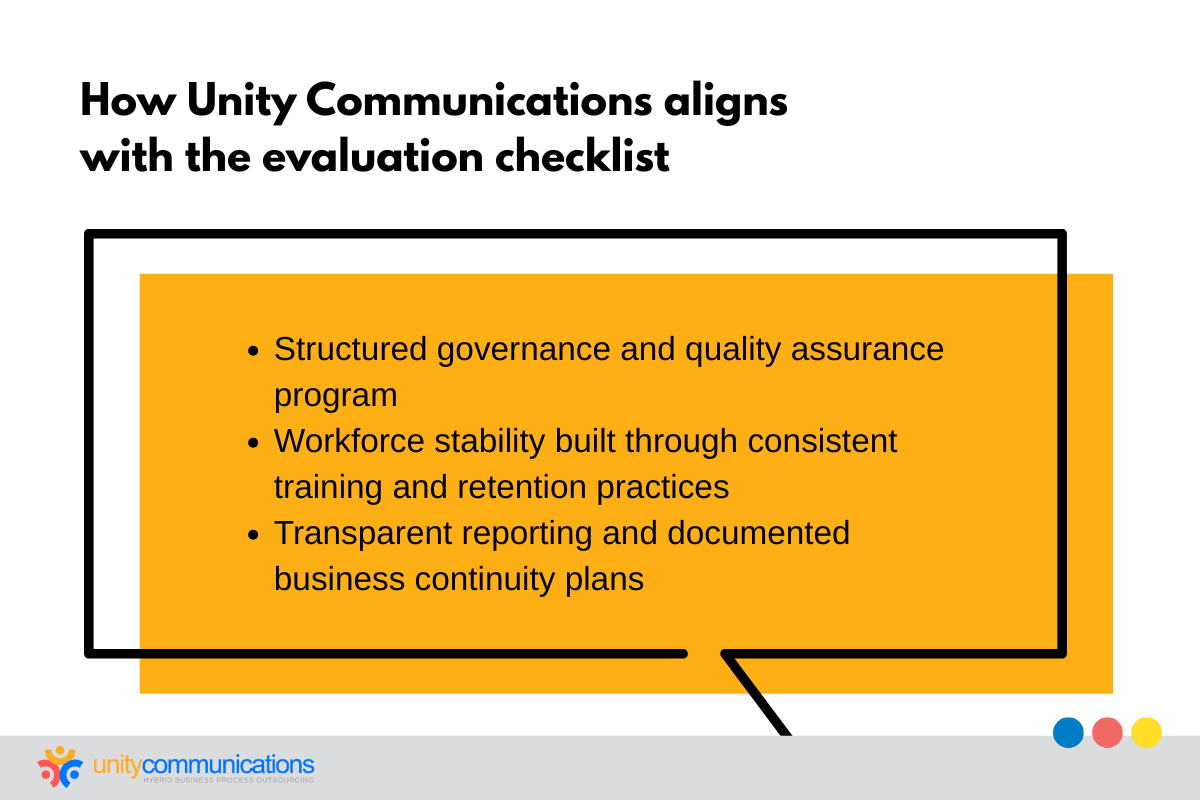
Knowledge management keeps agents current as tools and client needs shift, and workforce stability comes from steady training investment. Security practices and continuity planning stay part of daily delivery, built in from the start.
This kind of BPO tech support Philippines delivery model rewards buyers who value consistency and accountability over the lowest quote.