Streamline your supply chain with business process outsourcing (BPO). Discover how outsourcing enhances supplier coordination, boosts efficiency, manages risks, and scales with your business. Learn how it sharpens your competitive edge and transforms operations for sustainable growth.
Successful vendor coordination can transform a cumbersome supply chain into a streamlined powerhouse. In this article, we discuss the top 5 benefits of using business process outsourcing (BPO) to strengthen supplier relationships and optimize operations.
The advantages of outsourcing supplier coordination are compelling, from boosting efficiency to managing risks more effectively. As you explore further, you’ll understand how BPO scales with your business and sharpens your competitive edge.
Are you ready to reshape your supply chain strategy? Continue reading!
BPO and its role in supply chain coordination

First, what is BPO? It’s the practice of hiring external service providers to manage non-core business activities. Through outsourcing, companies can focus on core competencies.
BPO goes beyond traditional functions such as customer service or information technology (IT) support. It also involves comprehensive supply chain management, where efficiency and strategic coordination are critical.
The recent pandemic showed the importance of flexible and adaptable supply chain strategies. It emphasized how businesses must respond fast to changes in market demand and supply disruptions. One of the key benefits of outsourcing is that it helps companies adapt swiftly in these situations without harming efficiency and customer satisfaction.
Outsourcing supplier coordination allows you to access a wider pool of industry expertise and global resources, keeping your supply chain stable and responsive despite uncertainties.
Advantages of outsourcing supplier coordination
Outsourcing is a critical business decision. That’s why it’s essential to understand what you can gain when you commit to outsourcing supplier coordination.
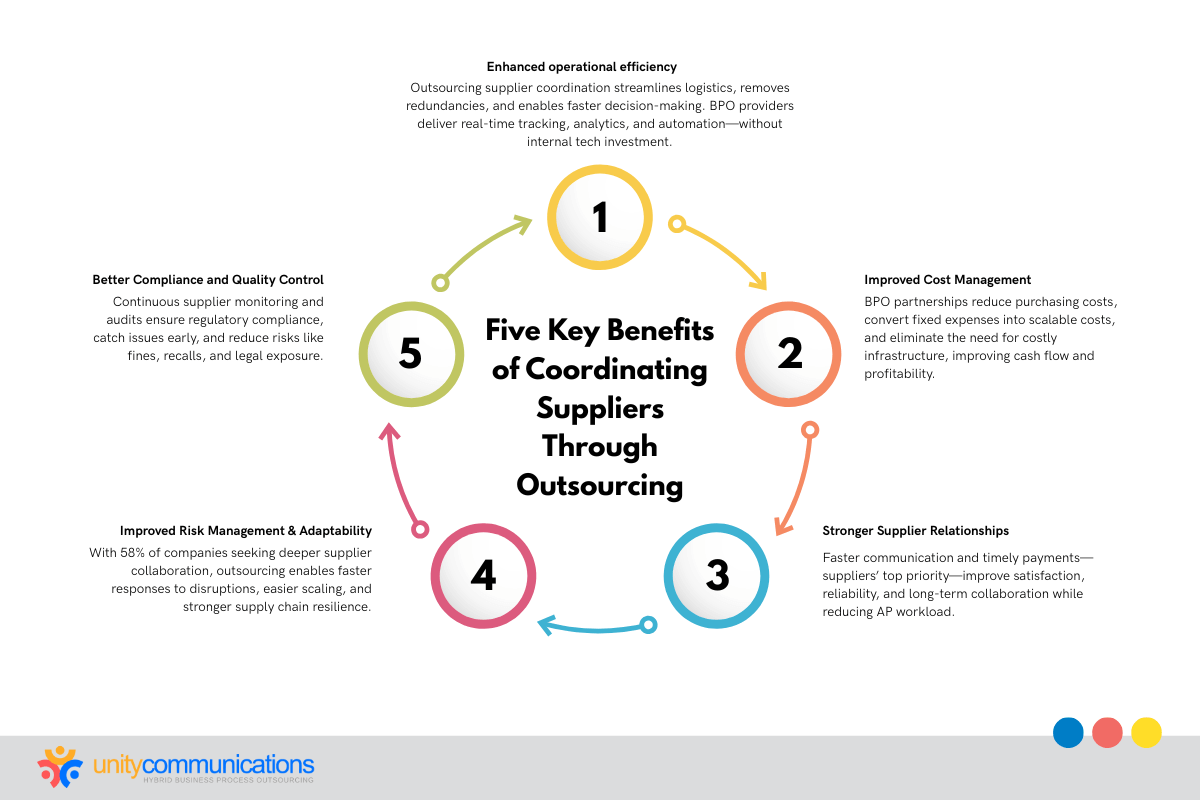
Let’s detail the five primary benefits:
1. Enhanced operational efficiency
A pivotal benefit of outsourced supply chain management is that it helps improve efficiency across daily operations. Delegating coordination tasks to a third-party BPO provider reduces process bottlenecks, eliminates redundancies, and improves overall workflow performance, leading to more effective inventory management. This strategic alignment allows for swift decision-making and rapid market responses.
As today’s business landscape embraces innovation and data-driven strategies, advanced tools and analytics become crucial. Outsourcing allows access to cutting-edge technologies, such as sophisticated analytics platforms, that are otherwise expensive to purchase and maintain internally.
Your BPO partner can offer enterprise resource planning (ERP) platforms, transportation management systems (TMS), Internet of Things (IoT) devices, and AI- or ML-driven algorithms. These tools enable real-time visibility, performance monitoring, and predictive analytics that support better planning.
Furthermore, BPO firms bring expertise that enhances procurement strategies and secures better terms with vendors, improving operational reliability and cost control. This level of expert oversight accelerates processes and aligns them more closely with strategic objectives.
Thus, your company can focus on innovation and growth, confident that your operations are optimized, efficient, and prepared for future demands.
2. Improved cost management and financial outcomes
Outsourcing supplier coordination is a cost-effective way to grow your business. By streamlining your operations through BPO, you can scale more smoothly. This process allows many companies to move from enormous fixed costs into flexible expenses, so you only pay for what you need when you need it.
This setup takes the pressure off your main operations, helping you eliminate inefficiencies that can slow you down and allowing you to focus on your in-house business needs. BPO providers are excellent at getting better deals from suppliers because of their vast market experience and buying power, which help lower purchasing costs.
Consider a bicycle manufacturer that worked with a BPO provider. It used the provider’s extensive network and purchasing power to secure high-quality bike parts at lower rates. This partnership markedly decreased purchasing costs, boosting the manufacturer’s profitability.
Lastly, outsourcing minimizes spending on the latest technology or infrastructure. Instead, you gain access to your BPO partner’s tools and systems, saving money on both upfront investments and ongoing maintenance. This financial flexibility allows you to focus on expanding your business and improving other important areas.
3. Strengthened supplier relationships
Vendor relationships significantly affect supply chain operations. A poor relationship might harm supply reliability, quality, and timeliness.
According to a survey from MineralTree, suppliers value fast payment more than anything else. This makes timely payments a critical factor in maintaining healthy supplier relationships, placing a heavy burden on accounts payable (AP) teams.
Outsourcing supplier coordination eases this pressure by enhancing communication and freeing up internal resources. Better communication quickly resolves supply issues. It streamlines the payment process, meets vendors’ expectations, and fortifies relationships.
Additionally, outsourcing prevents AP teams from being overwhelmed by the demands of supplier interactions. Hence, they can focus more on speeding up payment processing.
Consider a clothing retailer that outsourced its supplier coordination. Enhanced communication quickly addressed a delay in fabric supply. Faster issue resolution sped up payments, satisfying the fabric supplier. Meanwhile, the retailer’s AP team can focus on optimizing budget allocations, relieved from managing daily supplier interactions.
This approach also creates a more collaborative and responsive relationship with suppliers, ensuring smoother operations and enhanced reliability within the supply chain.
4. Sharpened compliance and quality assurance
Ensuring your supply chain follows standards and regulations is critical if your business is in a tightly regulated industry, such as food, healthcare, or finance. Outsourcing supplier coordination can help maintain high levels of compliance and quality.
Specialized BPO providers know how to navigate the complicated rules and laws that apply to different industries. They help guarantee that every part of the supply chain adheres to rules, keeping businesses out of legal trouble and preventing fines, which is vital when outsourcing logistics.
Outsourcing also contributes to quality control efforts. BPO firms regularly review supplier performance to determine whether everything meets international quality standards. The process helps catch and fix any issues early and keeps the whole supply chain reliable and trustworthy.
Moreover, BPO providers constantly monitor suppliers. They’re quick to spot slip-ups and correct them, which means they prioritize quality and compliance.
For instance, a cosmetics company outsourced its supplier management. The BPO provider conducted regular quality audits and ensured compliance with Food and Drug Administration (FDA) regulations. This proactive oversight caught a potential labeling discrepancy before shipment, avoiding a costly recall or lawsuit.
Working with a reliable BPO provider eases the task of staying compliant and keeping up with standards. The outsourcing provider lets you focus on your main goals and increases your confidence in your supply chain. This approach protects your business and elevates its overall performance.
5. Thorough risk management and market adaptability
The 2023 Global Supply Chain report revealed that around 58% of businesses want to enhance supply chain management through deeper collaboration with suppliers.
Companies that outsource supplier coordination get a dedicated team focused only on strengthening supplier relationships. This setup enhances communication and quickly addresses problems. Such a response is necessary when facing uncertainties, such as market fluctuations or supply disruptions.
Effective collaboration through outsourcing also aligns parties’ strategies and goals, enhancing the supply chain’s overall resilience and adaptability.
Further, outsourcing introduces a level of flexibility that might be difficult to match with internal resources alone. It allows companies to scale operations and respond adeptly to economic changes or new regulations without significant internal strain. This adaptability is essential for maintaining a competitive edge in fast-paced markets.
When a critical component faced a supply bottleneck, the third-party BPO provider collaborated closely with alternative suppliers, quickly integrating them to maintain production schedules and reduce costs. This seamless coordination helped the firm address supply challenges without missing market deadlines.
How to get started with outsourcing supplier coordination
Transitioning to outsourced coordination doesn’t have to be complicated. What matters is taking a structured approach that prioritizes clarity, alignment, and long-term value. Here’s how you can begin:
1. Assess your current coordination challenges
Start by identifying the pain points in your existing operations. Look at delays, communication gaps, payment backlogs, or quality inconsistencies. Understanding these issues helps you determine which activities are best handled by a BPO partner and where outsourcing can deliver the highest impact.
2. Define your goals and success metrics
Next, clarify what you want to achieve. Whether you aim for efficiency, achieve cost savings, improve vendor communication, or strengthen compliance, establishing clear targets allows you to measure the value of outsourcing. Consider setting KPIs such as turnaround times, error rates, cost reductions, and service levels to measure the effectiveness of your outsourcing services.
3. Choose the right outsourcing provider
Not all BPO partners offer the same expertise. Look for a provider with:
- Proven experience in procurement and coordination
- Access to advanced technologies (ERP, TMS, analytics tools)
- Strong governance and compliance capabilities are essential for ensuring that the five key benefits of outsourcing are realized.
- Flexible pricing models
- Clear communication processes
Evaluating these criteria helps ensure the partnership aligns with your operational needs and industry requirements.
4. Establish a smooth onboarding and communication plan
A structured onboarding process sets the tone for long-term success. Work with your BPO partner to define:
- Task responsibilities
- Escalation procedures
- Reporting frequency
- Performance tracking methods
Setting expectations early prevents confusion and builds a seamless working relationship, which is essential in any outsourcing strategy.
5. Monitor performance and refine the partnership
Outsourcing is not a “set it and forget it” strategy. Regularly review results, identify opportunities for improvement, and collaborate on adjustments. Strong alignment between both teams ensures your operations remain efficient and adaptable as your business grows.
The bottom line

With technologies rapidly advancing and markets fluctuating, your supply chain’s agility and resilience can define your success.
Can your current supplier coordination strategy handle sudden market changes, or would outsourcing your supply chain management provide a more effective solution? Are your partnerships optimized to encourage mutual growth and resilience? Answering these questions is crucial as your company strives to thrive amid the constant flux of economies.
Working with a seasoned BPO provider such as Unity Communications might be the key to making your supply chain more responsive and efficient. With expertise in streamlining operations, we can turn your supply chain logistics from a potential liability into a strategic asset.
Let’s connect and discuss how your business can benefit from outsourcing tailored supplier coordination solutions.
Frequently asked questions (FAQs)
Coordinating suppliers through outsourcing—especially through reliable 3PL providers and logistics companies—offers measurable benefits: reduced costs, better supply chain management, access to specialized expertise, scalable operations, and the ability to focus on core competencies. Whether your business chooses to outsource specific tasks or keep functions in-house, carefully weighing types of outsourcing and the strengths of third-party partners is key to gaining a competitive advantage.
What are the top benefits of outsourcing supplier coordination to a 3PL provider?
The top benefits include minimizing costs, improving order processing accuracy, and gaining access to specialized expertise. 3PL offers scalable solutions that can adapt to changing demand, enabling businesses to scale easily without incurring heavy capital investment. This helps improve supply chain reliability and increases profitability by reducing operational overhead.
How does outsourcing procurement and logistics help my company focus on core activities?
By outsourcing procurement, purchase order management, and logistical tasks to third-party logistics or specialized procurement teams, internal staff can focus on their core functions like product innovation and customer engagement. Choosing to outsource routine or complex processes allows companies to focus on other aspects that drive growth while external partners handle execution.
Can outsourcing reduce costs and improve customer satisfaction at the same time?
Yes. Outsourcing means leveraging the scale and expertise of logistics companies and 3pl providers to minimize costs through better routing, carrier negotiations, and efficient order processing. These improvements reduce lead times and errors, which directly contribute to improved customer satisfaction and retention.
What types of outsourcing should I consider for better supply chain management?
Consider transactional outsourcing for order processing and returns, tactical outsourcing for carrier management and warehousing, and strategic outsourcing for end-to-end supply chain redesign. Assess whether outsourcing certain functions, such as procurement or third-party logistics, will offer the most impact relative to in-house capabilities.
How do I choose the right 3PL provider to gain a competitive advantage?
Evaluate potential 3PL providers on their experience with your industry, ability to offer scalable services, technology for visibility and purchase order tracking, and proven record of improving logistics performance. Selecting partners that provide specialized expertise and additional resources will help you improve supply chain outcomes and gain a competitive advantage.