

The phone rings after your team has already gone home for the night. Nobody picks up, so the caller either leaves a voicemail or hangs up and dials a competitor instead. If that scenario sounds familiar, then this is a problem that out of hours call handling can solve.
An after-hours answering service uses human agents, AI, or a combination of both to help business owners avoid losing revenue from missed calls, especially those that come after closing time.
This beginner’s guide explains how this answering service can handle after-hours calls and what growing small businesses should look for before choosing a provider.
What is out-of-hours call handling?

Out-of-hours call handling is the process of managing incoming calls that arrive after a business’s normal operating hours close.
It covers everything from a simple after-hours voicemail greeting to a full answering service that talks to callers in real time.
In practice, out-of-hours call handling bridges the gap between when customers call and when your team is available to answer. Instead of every call outside working hours going straight to a dead-end voicemail box, a proper system routes the caller to a live agent, an AI answering service, an on-call staff member, or a scheduled callback. Regardless of the approach, the goal is the same: to improve customer satisfaction and prevent revenue leakage by capturing leads or boosting retention.
An after-hours call-answering service usually includes the following:
- Automated greetings that switch on the moment your business hours end
- Live agents or an AI answering service that talks with callers in real time
- Call recordings or transcripts sent to staff for next-day follow-up
- Callback or appointment scheduling options for non-urgent requests
- Immediate escalation for any emergency call
Out-of-hours call handling differs from traditional voicemail or a basic IVR menu. Voicemail simply stores a message for someone to hear later. An IVR menu routes a caller through numbered options without holding an actual conversation. Neither one gathers caller details nor screens for an emergency in real time.
Out-of-hours call handling replaces that gap with genuine after-hours coverage. A live agent or an AI system answers directly and captures the reason for the call. It then decides whether the situation needs immediate escalation or a next-day follow-up.
Why after-hours call handling matters for business
A single missed call from a new customer or a returning client can mean a lost sale or a frustrated caller who does not try again.
Customer patience has also changed. People expect a business to answer calls, or at least respond quickly, regardless of the clock. When your business is closed and the phone just rings, callers assume no one is paying attention.
According to Salesforce’s State of the Connected Customer research, the vast majority of customers now say the experience a company provides matters just as much as its products or services. Out-of-hours call handling is one of the simplest ways to protect that customer experience without extending your team’s working hours.
Missed calls add up fast
A missed call rarely feels urgent in the moment, but multiply it by every night and weekend your business is closed, and the pattern becomes expensive. Repeat callers who cannot reach anyone tend to assume the business is unreliable, and new leads often move straight to whichever company answers first.
A 24-hour call line does not need to sit idle outside business hours to still cost you leads. Every unanswered ring is a data point the caller uses to judge whether your business is worth calling back. An after-hours call-answering service closes that gap by picking up on the first ring, whether at 2 p.m. or 2 a.m.
Customer experience doesn’t clock out
Your operating hours are internal information. Your customers only know whether the call connected. A calm, professional after-hours greeting, even from an AI virtual receptionist, indicates that the business is organized and still worth trusting outside business hours.
High-quality service does not pause when the lights go off. A business that can handle your calls consistently, day or night, builds the same trust a well-run front desk builds during business hours. Consistent call management overnight also gives your team a clean record to work from each morning. Your staff will know who called and why.
How does an after-hours answering service work?
An after-hours answering service uses live agents or AI to answer calls, capture caller details, and escalate emergencies until business hours.
When a call comes in after your office hours, the system recognizes that your business is closed and automatically switches to after-hours mode. From there, it can greet the caller, ask a few structured questions, and log the reason for the call. It can also book an appointment, take a detailed message, or immediately alert an on-call staff member if the caller describes an emergency.
Everything is recorded and passed along, so your team starts the next business day fully informed rather than guessing what happened overnight.
In the morning, your team can access or receive the following:
- A full call recording or transcript for every after-hours call
- A summary of the caller’s name, reason for calling, and urgency level
- Any appointments already booked and synced to the calendar
- A record of which calls were escalated overnight and to whom
Traditional answering services vs. AI, human, or hybrid answering services
To illustrate its ability, let’s compare the process with that of traditional answering services.
Traditional answering services rely on live agents who follow a fixed script, often operating from a shared call center that also handles other clients. This model delivers professional service for straightforward requests. But the service costs of staffing live agents around the clock add up quickly, and quality can vary between shifts and providers, especially during high call volumes.
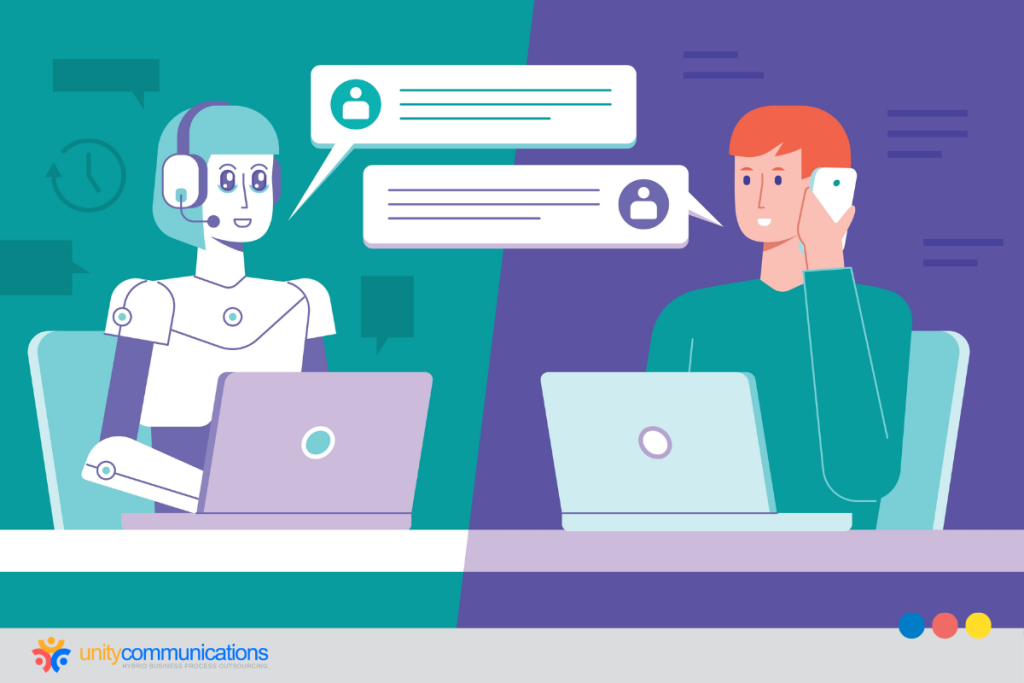
An AI-driven approach to out-of-hours call handling answers every call instantly, without wait times or sick days. A well-built system stays on script, gathers the right details, and hands off to a human agent whenever a call needs one. A hybrid model blends both. An AI after-hours answering service manages the routine calls, and live agents step in for anything urgent or sensitive.
The right choice depends on how your business operations run after regular business hours, how much call volume you handle overnight, and how much of that volume genuinely requires a human voice.
Core features of a reliable call-handling service

A typical setup of out-of-hours call handling often features the following:
Call routing and call forwarding
Good call routing automatically sends each caller to the right place, whether that is an AI agent, a voicemail queue, or on-call staff. Call forwarding then ensures urgent calls still reach a real person, even when the office is closed.
Emergency call escalation
A reliable service can distinguish between a routine question and a genuine emergency call, then notify the appropriate responder immediately via phone, text, or app alert. This matters most for healthcare, property management, and other fields where handling sensitive, time-critical issues cannot wait until morning.
Appointment scheduling and call recordings
Appointment scheduling lets callers book a time directly, keeping your calendar full without a single manual entry. Call recordings and transcripts give your team a searchable record of every conversation, which is useful for training and compliance.
System Integration
Good integration connects answering service solutions directly to your CRM or practice management system, syncing caller details and bookings in near real time. Professional handling means every call updates the same records your team already works from, rather than someone having to re-enter information the next morning.
Reporting and analytics
A dependable provider tracks call volume, escalation logs, and resolution rates over time. That record lets you confirm that the service performs as promised. Regular reporting also flags patterns worth acting on, such as a spike in after-hours calls about a single issue, before it becomes a problem during business hours.
What are the best practices to manage after-hours calls?
Set clear scripts and escalation rules, review call data monthly, test the system regularly, and keep your team informed.
Set clear call scripts and escalation rules
Map out your most common call types and how each should be handled. Define exactly what counts as an emergency call for your business. Then, list who gets notified first, second, and third if a call escalates. Update scripts whenever your hours, staff, or services change.
Check call data and service reviews regularly
Analyze call volume trends to spot recurring after-hours patterns and track how many calls turned into booked appointments or resolved issues. Listen to a sample of call recordings each month for quality control. Read recent service reviews before renewing or switching providers.
Test the system before using it
Call your own after-hours line to hear exactly what customers hear, or try a mock emergency call to confirm escalation actually works. Confirm call recordings and summaries are reaching the right staff. Ask your provider how quickly they update call flows when you request changes.
Keep the team in the loop
Share a simple daily or weekly summary of after-hours call activity with staff. Assign clear ownership for following up on missed appointments or callbacks. Revisit your on-call rotation regularly to keep escalation contacts up to date.
How Unity supports out-of-hours call handling
According to McKinsey’s State of AI, contact-center and customer service automation ranks among the most common ways organizations put AI to work, right alongside processing and delivering information through a conversational interface.
Unity applies that same approach to after-hours answering needs. It builds AI-powered solutions, such as AI customer service agents, with built-in call scripting, emergency escalation, and full CRM syncing. Then it pairs your system with trained, qualified human agents to handle more sensitive calls.