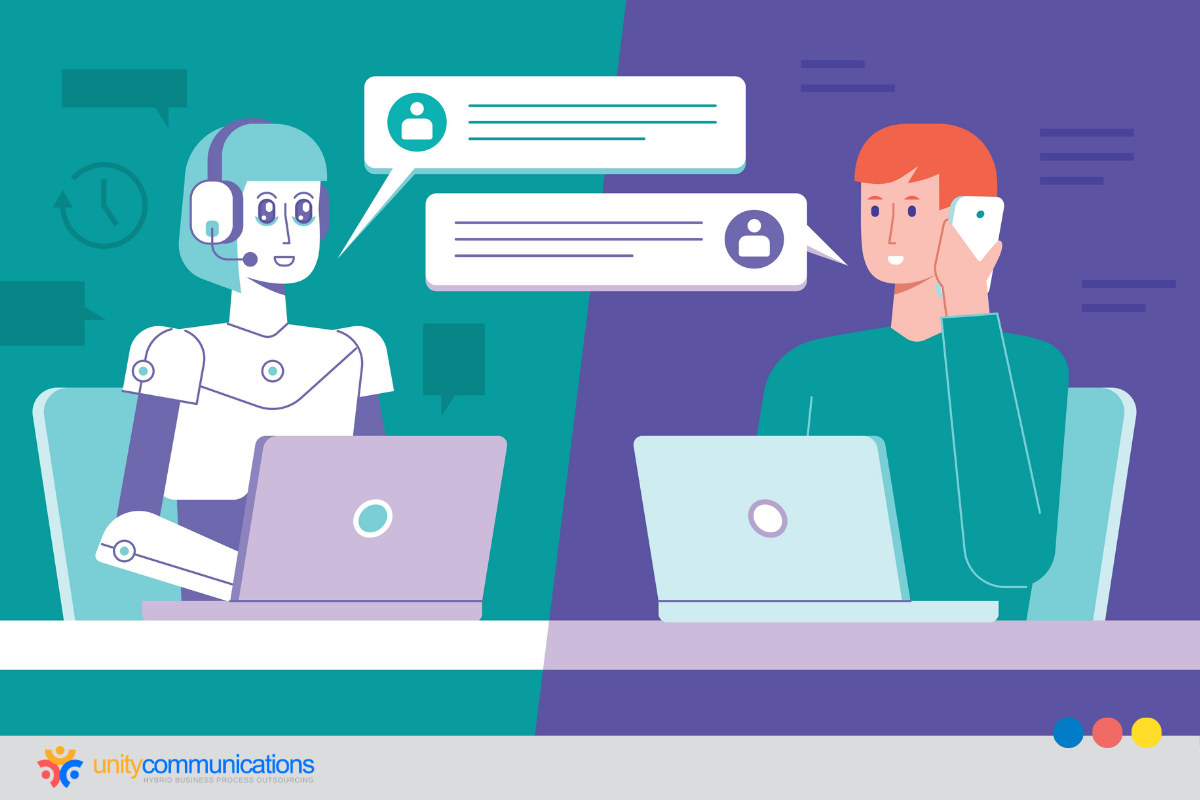


If you run a call center, you have probably already deployed some form of automation. Maybe it is a touch-tone menu. Maybe it is a chatbot on your website.
What most operators have not yet deployed is conversational AI for call centers, and that gap is where the real opportunity sits. Unlike a scripted system, conversational AI understands what the customer means, maintains that context throughout the interaction, and responds as a competent live agent would.
This guide pairs with our AI customer service agents overview and walks you through conversational AI, including what it means, how it changes the customer experience, where it earns its cost, and how to tell if your operation is ready for it.
What is conversational AI for call centers?
Conversational AI for call centers understands intent, maintains context, and responds naturally rather than following a rigid script.
Instead of matching a caller’s words to a fixed list of accepted phrases, conversational AI works differently in three specific ways.
Understands intent
It applies natural language understanding (NLU), the foundation of natural language AI customer service, to figure out what the person actually wants, even if they phrase it in an unexpected way, trail off mid-sentence, mispronounce a word, or bundle two separate requests into one sentence.
A scripted system needs the caller to say the expected phrase. Conversational AI works from meaning instead of exact wording, which is what lets it handle the messy, real way people actually talk on the phone.
Keeps context
It remembers what was said earlier in the same call, so a customer does not have to repeat their account number, order details, or the issue itself two or three times as the conversation moves along. That memory carries across topic changes within the call too. A customer who mentions a second issue partway through does not lose the thread of the first.
Responds naturally
It generates responses in real time rather than reading from a pre-written script, so the exchange feels more natural. The system adjusts its wording to the situation instead of forcing the caller into a fixed set of expected answers.
This is the layer that sits above traditional IVR and the scripted chatbots that most companies already have. Traditional systems automate what the business expects to hear. Conversational AI automates what customers actually say. That is a harder problem, and it is why so many call centers are stuck at an earlier stage of automation without realizing it.
It is also the core of the conversational AI vs scripted chatbots distinction. One system matches, while the other understands. For the broader picture of where this fits into a call center’s overall AI strategy, see “AI in Call Centers: The Role It Plays.”
The three tiers of call center automation
Most call center operations fall into one of three tiers of automation. Knowing which tier your existing call center belongs to is the fastest way to identify the gap. It also shapes which AI capabilities are worth adding first in any serious AI for call center modernization effort.
Tier 1: Touch-tone IVR
This is the original press-1-for-billing menu. It routes calls based on button presses and cannot interpret anything a caller says. It is cheap, it is everywhere, and it is also the biggest source of caller frustration in the entire call center stack.
Anyone who has shouted “representative” at a phone tree has lived through the limits of tier 1, and it explains why so many businesses eventually look to replace call center menus that only route rather than resolve.
Tier 2: Scripted chatbots
Tier 2 replaced buttons with typed or spoken words, but the underlying logic remained largely unchanged. A scripted chatbot matches what the customer says against a list of expected phrases and triggers a pre-written response. The bot can stall or loop if the caller steps outside that list, asks a follow-up question, or phrases an uncommon request.
Most standard IVR upgrades plateau at tier 2. If your team has already invested in smart IVR solutions and still runs into the same wall, scripted logic is usually the reason.
Tier 3: Conversational AI for call centers
Conversational AI for call centers is the tier where the system understands intent rather than matching keywords. It can handle a caller who says “I got double-charged last month, and I need that fixed” in one sentence, pull the right account context, and either resolve it or route it correctly, without a rigid menu in between.
Most SMB and mid-market call centers have not made this jump, largely because implementing AI has historically required an internal technical team to build and maintain.
That is changing as providers such as Unity Communications offer modern AI through a managed conversational AI contact center model instead of a platform you configure yourself. This also drives the demand for an outsourced conversational AI call center approach that skips the internal technical team altogether.
Gartner’s research on customer service AI puts the scale of this shift in context. The firm expects that by 2028, at least 70% of customers will use a conversational AI interface to start their customer service journey. This means operations still relying on tier 1 and tier 2 automation are falling behind what callers now expect from AI virtual agents for call centers built for full conversations, not just menu selections.
Genesys, one of the major contact center platform vendors, frames the same shift in practical terms in its overview of conversational IVR. The technology lets callers speak naturally instead of navigating a touch-tone menu, and the system either resolves the request or routes it based on the intent it understood rather than the button the caller pressed.
How conversational AI changes the customer experience
The difference between tiers is easiest to see in a single customer interaction handled in two ways.
The scripted bot call
A customer calls to ask about a late package that also arrived damaged. The scripted bot recognizes “package” and routes the user to the shipping menu. It asks for an order number, then replies, “Is your package late or damaged?” as if only one problem could exist at a time.
The customer picks one, gets a partial answer, and has to call back or ask for a live agent to resolve the second issue. The bot did not fail because it is broken. It failed because it was never built to resolve two related problems simultaneously.
The conversational AI call
The same call handled by conversational AI starts differently. The customer explains both issues in one sentence. The system extracts the order number from context, recognizes two distinct problems, and either resolves both in the same call or hands off to a human agent with both issues already logged and summarized. The customer says everything once. Nothing gets dropped.
That single difference, saying it once and being understood, is the entire value proposition of conversational AI in call centers. It is why improving customer experience is usually the first business case operators bring to leadership.
Top use cases and ROI for conversational AI in call centers
Not every customer interaction benefits equally from conversational AI. Understanding where to use AI first is what separates a strong rollout from a wasted one. The return is clearest in a handful of specific use cases within a modern conversational AI contact center.
High-volume customer interactions
Order status, appointment confirmations, balance checks, and password resets are high frequency and low complexity, making them the easiest wins and usually the first ones deployed. AI chatbots and voice AI agents both excel here because the range of customer needs is narrow and well documented, which is exactly the workload AI virtual agents for call centers can absorb.
E-commerce operators see this pattern at scale, since order status, returns, and shipping updates make up most of their call volume. “The Transformative Impact of Artificial Intelligence on E-commerce Call Centers” covers how these same high-volume, low-complexity interactions play out specifically in retail and direct-to-consumer support queues.
Voice AI for after-hours coverage
A conversational AI system does not go home at 6 p.m. For SMBs that cannot staff a 24-hour desk, voice AI closes a coverage gap without adding headcount. It keeps call quality consistent whether a customer calls at noon or at midnight. This is where NLP customer service automation does its clearest work for a conversational AI SMB call center that cannot justify a round-the-clock payroll.
Overflow management for contact center operations
During call spikes, whether seasonal, post-outage, or post-marketing campaign, conversational AI absorbs the volume that would otherwise lead to long hold times or abandoned calls. In this scenario, AI supports human agents directly. It protects agent satisfaction by keeping queues manageable instead of letting humans get buried during a surge.
Intelligent call routing and front-of-queue triage
Understanding why a customer is calling before they reach a human agent means faster, more accurate call routing. Intelligent call routing is one of the AI call center features that pays off almost immediately, since it cuts misroutes and repeat transfers. This is the same function covered in “AI Virtual Receptionist: Automate Tasks with AI Agents,” where the AI agent’s job is to sort and direct rather than resolve.
AI agent performance assist
Even on calls that end up with a human agent, conversational AI can listen in real time and pull up relevant account details or policy information, cutting the time an agent spends searching mid-call. As AI analyzes the live conversation, this kind of assistance consistently improves agent performance and call resolution rates.
The cost case behind these use cases has real numbers attached. IBM’s research on call center modernization found that AI-powered virtual agents can contain up to 70% of calls without any human interaction, saving an estimated $5.50 per contained call. Those figures assume a properly scoped deployment that measures actual containment rather than raw call volume handled by the bot.
Beyond containment, AI provides value in less obvious places. Automated call summaries cut after-call work, and searchable call recordings make quality audits and coaching far faster than manual call reviews.
How does conversational AI know when to transfer to a human agent?
Conversational AI transfers a call to a human agent when it detects frustration, a complex request, or a direct request for a person.
The system is built to recognize its own limits rather than push through them. It watches for three specific triggers:
Frustration signals
Sentiment cues in word choice, tone, or repeated corrections signal that a customer is becoming frustrated. Instead of continuing to attempt a resolution and risking a worse outcome, the system routes the call to a person.
Requests outside its scope
Issues that fall outside documented intents, or that combine several unrelated problems in one call, trigger a handoff instead of a forced, likely wrong answer. This is a deliberate design choice. A system that guesses on unfamiliar requests creates more repeat calls than one that hands off early.
A direct ask for a person
Any explicit request to speak with someone is honored immediately, without another automated prompt standing in the way. Customers who want to speak to a human should be able to reach one without having to repeat the request.
What makes this work operationally is the AI call center human handoff. A well-built system passes the full conversation context, including what the customer asked, what was already tried, and what the AI understood the issue to be, to the human agent before the call connects.
The best deployments treat this handoff design as an ongoing responsibility. The business refines the triggers and the context passed along as real call patterns reveal where the system is guessing instead of knowing.
The human layer: Why conversational AI and human agents work best together
Conversational AI is not designed to replace call center staff. Instead, it should recognize its own limits and hand off before it pushes past them.
Contact center AI software and agent performance
Good contact center AI software integrates with the systems agents already use, so it supports agent performance instead of working around it. It integrates most cleanly when it shares the same customer record, call history, and knowledge base that the human team relies on. It should never run as a disconnected side tool.
This is also the layer where ongoing human oversight matters most. Someone has to monitor how often and why handoffs happen, then adjust the system when the pattern reveals a gap. That continuous tuning keeps conversational AI in call centers accurate as call patterns shift. It also differentiates between a modern contact center that improves over time and one that drifts unnoticed.
Every modern call center eventually faces the same decision: build these capabilities in-house or access them through a partner such as Unity Communications, which delivers conversational AI through a contact center as a service model.
Advanced AI platforms and an AI-powered call center can help improve customer service without adding headcount, but only if someone owns the ongoing tuning. Unity treats this as a managed conversational AI contact center deployment, with clear ownership and regular review, the way it treats any other operational system.
Is conversational AI the right upgrade for your call center?
The honest answer depends on where your operation stands today. Answer these questions before you decide:
- Where does your current automation actually sit: touch-tone IVR, scripted chatbot, or something closer to conversational AI?
- What share of your call volume is high-volume and low-complexity versus escalated, novel, or judgment-heavy?
- Do you have after-hours or overflow periods that go unstaffed today?
- Do you have the internal budget and technical capacity to build and maintain AI in-house, or does an outsourced conversational AI call center model fit better?
- Who inside your organization will own ongoing tuning and review the handoff patterns once the system is live?
- Can your current CRM and knowledge base actually integrate with a conversational AI layer, or would that require a separate project first?
If most of those answers point toward gaps rather than readiness, that is not a reason to avoid the upgrade. It is a reason to avoid deploying it alone.
Unity Communications delivers conversational AI as a managed conversational AI contact center model, putting a team behind the technology. AI handles routine volume, after-hours coverage is built in from day one, and a human layer monitors quality and absorbs the exceptions your staff should not have to.