

Every growing company faces the same challenge. Customer calls pile up faster than in-house teams can handle. Support tickets stall, sales calls go unanswered, and costs climb.
A call center business solves this bottleneck by handling customer service, sales, and technical support, so you keep moving. The right partner helps optimize operations and reduce costs. They also outsource tasks that pull focus from your core business through business process outsourcing (BPO). Keep reading to see how BPO call centers can help your business scale without added strain.
What is a BPO call center business?
A BPO call center business is a third-party service provider that handles phone-based, customer-facing processes for businesses. The most common functions include customer service, sales, and technical support.
A call center is a centralized hub where BPO agents assist customers by phone, chat, or messaging apps. Many now pair live agents with AI tools that handle routine requests and route complex issues to a human.
To better understand what BPO is, consider hiring an external vendor to manage your call center rather than building a department in-house. Working with a service provider is a viable solution if you lack staffing or resources. A reliable partner can improve your service efficiency, quality, and customer experience.
Types of BPO call centers
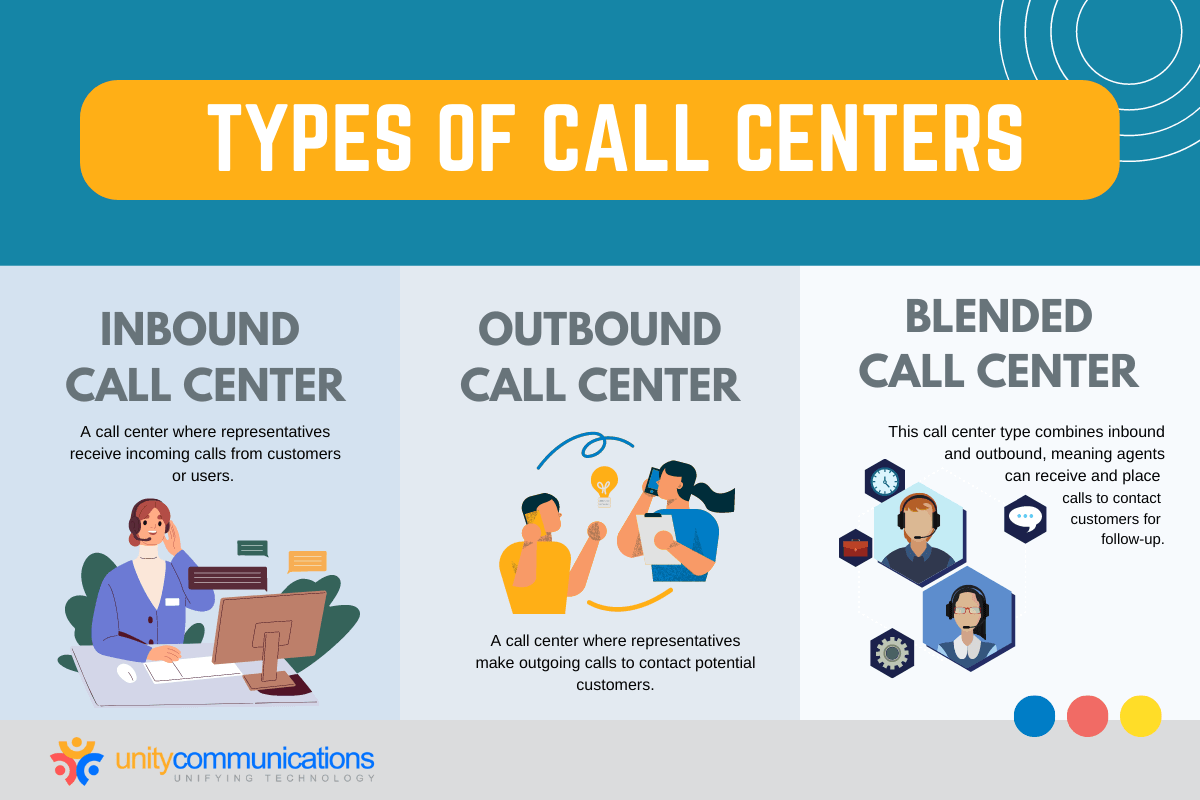
The three types of BPO call centers are inbound, outbound, and blended. They differ based on how calls get routed, whether from customers to agents or vice versa.
Understand what a BPO call center is by exploring the three types below.
- Inbound call center. In this call center, representatives receive incoming calls from customers or users.
- In customer service, agents answer customer inquiries, process orders, provide updates, handle complaints, and resolve issues.
- In tech support, BPO agents provide technical assistance to end users of technology products, such as computer devices and mobile phones.
- Outbound call center. In this type of call center, agents make outgoing calls to contact potential customers.
- In sales or telemarketing, BPO agents contact leads to sell products and services.
- In billing and collections, call center agents contact customers to discuss bills and collect payments.
- Blended call center. This BPO call center business combines inbound and outbound, meaning agents receive and place calls.
- In customer support, BPO agents receive calls from customers to assist them. They also contact customers to provide updates.
- In billing and collections, call center representatives answer customer inquiries about their invoices. They also contact customers to request payment.
Note: Most BPO call centers now run these three types across phone, chat, and messaging in one unified operation, with AI handling routine contacts and agents stepping in for complex ones.
The three types of BPO call centers can help your business grow. For this reason, outsourcing your customer-facing processes to a BPO call center is wise.
How can outsourcing call center work benefit your business?
Outsourcing call center operations offers several potential benefits, including access to talent, tools, and technology, as well as the ability to scale operations and grow a business. The proof is in the numbers. According to Research and Markets, the global call center market could reach $500.1 billion by 2030.
The following further explains the benefit of working with a BPO call center business:
1. Access talent and technology
Outsourcing to a call center business gives you trained agents and current technology without building either in-house. BPO call centers hire and train specialists for customer service, sales, and technical support roles. Training programs cover product knowledge, communication standards, and compliance requirements specific to each client account.
These call centers also invest in AI-powered tools and cloud-based systems. Voice AI now handles routine inquiries such as order status and account updates, while agents manage complex or emotional interactions. This split lets a call center scale support without proportional headcount growth.
2. Efficient and quality services
BPO call centers succeed by delivering consistent value to clients. Agents follow standard operating procedures (SOPs) that keep service quality steady across shifts and locations.
AI and automation now handle routine work, from call routing to sentiment analysis. This frees agents to focus on judgment-heavy interactions, while the combination shortens handle times and raises first-call resolution. Clients track both metrics closely when evaluating a call center business.
3. Enhanced buyer satisfaction
Call centers manage front-office operations to drive business growth. Their main job is to strengthen customer interactions and increase customer satisfaction (CSAT).
For most BPO call centers, CSAT is the top key performance indicator (KPI) because it measures the outcome that actually keeps customers coming back, not just how the call was handled. Average handling time (AHT) and quality assurance (QA) still matter, since they track speed and script adherence. But a fast, compliant call can still leave a customer unhappy. For this reason, these metrics rank below CSAT rather than alongside it.
AI-driven QA tools now automatically score calls, which gives managers real-time visibility into where satisfaction is slipping before it shows up in survey results.
4. Reduced costs and increased profitability
Building an in-house call center costs money upfront. You pay for infrastructure, technology, and recruiting and training staff. None of this spending promises results, and profit margins can still take a hit.
A BPO service changes that math. Choosing a call center business with the right expertise lets you optimize your operations while cutting costs. This partnership can reduce costs and grow profits at the same time.
5. Scalability and business growth support
A call center business helps meet your business objectives by adjusting staff and workflows as demand changes. It streamlines operations, refines processes, and boosts performance.
Many companies look for scalable solutions as they expand. BPO companies offer this kind of flexibility through:
- Staffing that adjusts up or down as call volume shifts
- Support for new markets without a hiring delay
- Process changes that keep pace as the business grows
- Service quality maintained without the need for constant restructuring
What is the impact of a BPO contact center on customer service?
A BPO contact center improves customer service by reducing wait times, covering time zones, and scaling support as demand shifts.
Modern companies face rising pressure to deliver fast, consistent, and personalized support. One answer is turning customer service operations over to a specialized third-party provider. BPO involves outsourcing essential support tasks to a call center business, giving companies flexibility to adapt as needs change.
A key impact is how well businesses handle fluctuating call volume, support inbound and outbound communication, and maintain global coverage. This shows up in a few concrete ways:
- Partnering with a BPO call center keeps customer calls managed promptly, cutting wait times and preventing bottlenecks during peak periods.
- Call center solutions let organizations maintain continuous engagement, whether that means addressing concerns or following up on requests.
- Businesses can proactively address issues before they escalate, protecting overall customer perception and strengthening relationships.
- Many centers come with teams spread across multiple time zones, so a call center business built this way delivers assistance around the clock.
Customers can get help whenever they need it, regardless of location. For industries such as e-commerce or any telecommunications company, this level of availability is important for meeting service expectations.
Lastly, transferring business functions such as contact centers to external experts enables your internal team to focus on your core business activities. This alignment keeps customer support tied directly to broader business goals.
What are the drawbacks of BPO call center services?

BPO call center services have drawbacks, including reduced control, communication gaps, cultural differences, security risks, and potential disruptions.
Understanding these challenges helps you make informed decisions before outsourcing your call center operations:
- Loss of business control. Outsourcing means giving up some control over your call center operations. You get minimal to zero say in training, processes, production, and overall BPO management.
- Communication barriers. Offshore outsourcing means working with a BPO provider on the other side. Miscommunication can come from language barriers and communication styles.
- Cultural differences. Call centers that serve businesses that outsource operations aren’t always in the same country. This brings different cultural norms and business practices.
- Privacy and security issues. BPO means entrusting business and customer information to a third party. Data can leak when a contracted partner lacks strong privacy policies and network security.
- Potential disruptions. BPO call center businesses sometimes face disruptions such as power outages, labor issues, and natural disasters. These events can affect service availability and satisfaction.
Is a BPO call center worth it?
With these drawbacks, you might ask: Is a call center business worth it? The answer is yes, but you must address the challenges with these best practices:
- Hire the BPO call center best suited for your business.
- Develop a service-level agreement (SLA) that includes KPIs.
- Offer strong culture, communication, and product training programs for your BPO team.
- Set data privacy policies and network security protocols.
- Establish constant communication with your BPO service provider.
- Promote a customer-centric culture among your BPO teams.
Businesses that use BPO strategies effectively gain superior customer outcomes. Specialized expertise, streamlined processes, and flexible support models improve service delivery while keeping efficiency high. Done well, this approach can empower your business with a service model that fits current industry trends.
Call center technology to improve customer service
Many companies transfer operations to a BPO to gain access to advanced communication systems and improve efficiency. For organizations outsourcing customer support tasks, digital platforms simplify collaboration and streamline workflows.
Cloud-based systems enable teams to work remotely while maintaining consistent service quality. These tools connect phone, email, and chat into one process. An omnichannel contact center will help businesses respond faster and communicate more consistently across platforms.
AI now plays a direct role here. Gartner reports that by 2028, at least 70% of customers will use a conversational AI interface to start their service journey. Common AI use cases in call centers include:
- Case summarization, giving agents a quick overview of a customer’s issue
- Agent assist tools that surface relevant information in real time
- Real-time translation, letting agents serve customers across languages
A call center’s reporting tools track trends and monitor response times. Automated features deliver customer service without long wait times by resolving simple concerns quickly.
As businesses thrive and demand grows, scalable technology becomes increasingly important. Many software company platforms adapt to changing needs while maintaining consistent service. Many providers use call management systems built directly into their client operations, a model that underpins Unity’s contact center-as-a-service (CCaS) offering.
These digital solutions show how BPO call centers can provide dependable support while ensuring their centers give customers timely, efficient help.
How to find the right BPO call center
The process of choosing a BPO call center requires careful evaluation, as not all providers align with every organization’s goals, processes, or customer expectations.
Here’s how to work with a good BPO call center business:
- Clearly define your business needs. Identify which tasks you want a company to handle, whether it involves general inquiries, order processing, or specialized functions such as knowledge process outsourcing. Understanding the scope ensures that any potential BPO partner can match your requirements and support your long-term strategy as your business is growing.
- Assess the range of services that BPO call centers offer. Some providers focus on specific industries, while others deliver broader BPO solutions tailored to different sectors. Look for flexibility in service models, especially if your organization requires an omnichannel contact center approach. This ensures your customers can reach you across multiple platforms, creating a more seamless experience.
- Check the provider’s tech stack. A BPO call center that uses modern systems and AI tools can significantly enhance efficiency and accuracy. Access to real-time reporting, intelligent routing, and automation improves performance monitoring and speeds resolution times. This access to advanced capabilities promotes consistency and reliability across all touchpoints.
- Evaluate performance standards. Review how providers measure and maintain their service level commitments. Reliable partners establish clear benchmarks and accountability measures to achieve quality outcomes. This directly supports goals related to improving customer satisfaction and maintaining consistent service delivery.
- Weigh cost, but don’t let it drive the decision alone. While call center outsourcing can lead to cost savings, the lowest price should not be the sole factor. Instead, focus on overall value, including expertise, scalability, and efficiency. A well-matched provider can help reduce overhead costs while maintaining high service standards.
- Look for a provider that aligns with your company culture and goals. Effective collaboration goes beyond service delivery. It involves shared values and a clear understanding of expectations. When you begin using a BPO, strong communication and alignment will determine how effectively they integrate with your business operations.
- Consider scalability. As your business evolves, your chosen partner should be able to adapt. Many BPO companies can scale alongside your operations. They can handle increased demand or changes in strategy. This flexibility allows your organization to remain agile and competitive in a fast-changing environment.
Understanding the pros and cons of BPO is equally important. While the benefits are clear, you should also be aware of potential challenges and cons of BPO call centers, such as communication gaps or alignment issues. Addressing these early in the selection process facilitates smoother collaboration and long-term success.
The right partner does more than handle tasks. The BPO can manage critical processes while enabling your organization to focus on growth. By carefully evaluating capabilities, technology, and alignment, you can find a solution that meets your needs and gives you a competitive edge.