Business growth often leads to a sprawling list of third-party relationships. While leadership teams usually focus on monthly invoices, the sticker price of a new service is only a small fraction of the total investment.
Manual oversight of dozens of partners creates a massive internal workload. From the moment you begin a vendor assessment, you are consuming your most valuable resource: your team’s collective focus and time.
This article explores the hidden personnel costs, operational delays, and financial risks that define the true cost of managing your vendor network.
What is vendor assessment?
Vendor assessment is the structured process of evaluating suppliers against a defined set of criteria. This evaluation happens at three points in a vendor relationship:
- Before you begin a partnership
- Throughout the duration of the work
- Contract renewal
It combines due diligence, performance management, and risk mitigation in a single discipline.
The scale of vendor assessment has grown significantly over the years. In a 2025 survey by Whistic, an AI-first third-party risk management platform, the average company works with 286 vendors, a 21% increase from the previous year. At that volume, manual tracking becomes unmanageable.
At its core, vendor assessment answers three fundamental questions:
- Can this vendor do what they claim?
- Are they performing at the required standard?
- Is the relationship worth maintaining?
When executed well, vendor assessment protects your supply chain. It aligns vendor performance with business outcomes and surfaces problems before they become expensive. Neglecting it exposes your business to quality failures, compliance gaps, and dependency risks.
What are the types of vendor assessment?
Vendor assessment falls into four types. Each serves a different stage of the vendor relationship.
| Type of Vendor Assessment | When It Happens | What It Checks | Why It Matters |
| Pre-qualification assessment | Before a contract is signed | Credentials, financial stability, compliance certifications, production capacity, and references | Helps determine whether a vendor is qualified before the relationship begins. This is usually the most intensive assessment because the company is starting from scratch. |
| Performance assessment | Throughout the active vendor relationship | Delivery timelines, quality rates, responsiveness, and agreed SLA metrics | Keeps the vendor accountable and creates a record for future reviews or contract changes. |
| Risk assessment | Before and during the vendor relationship | Financial, operational, reputational, and regulatory exposure | Shows what could happen if the vendor fails and how dependent the company is on that provider. |
| Strategic or relationship assessment | Usually, for long-term or high-value partnerships | Values, sustainability practices, business direction, and long-term roadmap | Helps determine whether the vendor is a good fit beyond price and service delivery. |
Risk assessment deserves particular attention. According to KPMG’s 2023 Global Procurement Survey, 77% of senior procurement professionals cite supply disruption risk as a critical external challenge. For organizations with complex supply chains, risk-based assessment is a baseline requirement.
Applying the right type at the right stage keeps assessments focused. It also prevents teams from over-investing oversight in low-risk relationships.
What does vendor assessment actually cost?
Most organizations treat vendor assessment as a basic compliance step—it is not. Vendor assessment spans six cost categories. Each has a compounding effect on team capacity and budget. The costs are real whether or not they appear in a line item.
1. Time costs
Time is the highest hidden cost. A single pre-qualification assessment can take anywhere from a few hours to several weeks. It depends on the supplier’s category and complexity. When multiplied across dozens or hundreds of vendors, these hours compound rapidly.
Example
Consider a global logistics firm vetting a new regional warehouse partner. The procurement lead spends 10 hours reviewing documents, while the legal team devotes 5 hours to contract deviations. The IT security team uses 8 hours auditing the vendor’s data encryption protocols. Before the company can move a single package, 23 hours of internal labor have been consumed.
2. Labor and staffing costs
Labor costs reflect not just total hours but the seniority of the staff involved. A director-level review of a high-risk supplier costs significantly more per hour than an analyst pulling data. When senior staff are routinely pulled into review cycles, the opportunity cost is high. That time is diverted from strategy and relationship-building.
Example
A CTO might spend four hours a month reviewing SOC 2 reports and performance logs for a primary cloud provider. The cost goes beyond their hourly rate. It also includes the higher-value work they could have done during that time.
It is the loss of four hours of high-level architectural planning or investor relations that only the CTO can perform.
3. Technology and tool costs
Vendor management systems, supplier portals, and risk data platforms all carry licensing fees. The total cost of this infrastructure includes implementation, training, integration, and ongoing maintenance. It often brings additional setup and support costs.
Example
A company purchases a $50,000 annual license for a vendor risk management (VRM) platform. They also pay $20,000 to a consultant to integrate it with their enterprise resource planning (ERP) system. Training 15 department heads on the portal requires another 40 staff hours.
4. Travel and site visit costs
Not every assessment requires an on-site visit. However, site visits are often necessary in manufacturing, food and beverage, and other sectors where facility conditions affect compliance.
Travel expenses, auditor time, and post-visit reporting add a layer of cost that can surprise teams operating on tight procurement budgets.
Example
Assessing a textile factory in Southeast Asia requires flying two auditors from Europe. The cost includes $3,000 in airfare and lodging, plus five days of their professional time. If the factory fails the initial audit, a second follow-up trip might be required, doubling the initial travel budget.
5. Opportunity costs
Every hour spent on assessment is an hour not spent elsewhere. Growing companies feel this acutely. Teams stretched thin often choose between rigorously assessing new vendors and managing the existing supplier base. A rushed assessment increases the probability of a bad selection, which is almost always more expensive than the assessment itself would have been.
Example
A marketing team spends six weeks meticulously vetting a new ad agency. During this period, they delay the launch of a new campaign because they lack the bandwidth to manage both the assessment and the creative rollout. The “cost” is the lost revenue from the delayed campaign.
6. Rework and remediation costs
When a vendor assessment misses a compliance gap or a quality issue, the remediation cost often exceeds the upfront investment. Supplier failures and contract disputes are downstream costs of weak assessments. So is the last-minute scramble to find a backup vendor.
Example
A company skips a financial health check on a sole-source component supplier to save time. Six months later, the supplier goes bankrupt and halts production. The company pays expedited fees at 300% above standard market rates to keep production running.
These situations are more common when organizations lack a structured approach to managing multiple vendors. A consistent framework reduces the likelihood of missing critical signals before they escalate.
How do you reduce the cost of vendor assessment?
Two tools reduce vendor assessment costs without sacrificing oversight quality: continuous vendor monitoring and a standardized vendor checklist. Each addresses a different source of the overhead problem.
The role of continuous vendor monitoring
Continuous vendor monitoring replaces the expensive periodic deep-dive with an ongoing, lower-cost process. Instead of an exhaustive assessment every two years, you maintain a consistent view of vendor health between formal reviews.
This shift responds to a real operational problem. When assessments happen once a year, a vendor’s financial health or delivery performance can deteriorate significantly between cycles. No mechanism can catch it until the next scheduled review or when a breach occurs.
Continuous vendor monitoring spreads the labor cost over time. It also prevents rework costs that arise when a vendor’s status changes between audit cycles. For a closer look at what those performance issues look like in practice, see BPO vendor performance issues and how to address them.
For example, teams no longer need to manually check a vendor’s insurance certificate once a year. An automated monitoring system can flag the policy before it expires, so legal or procurement only steps in when action is needed.
Using a vendor checklist to standardize labor
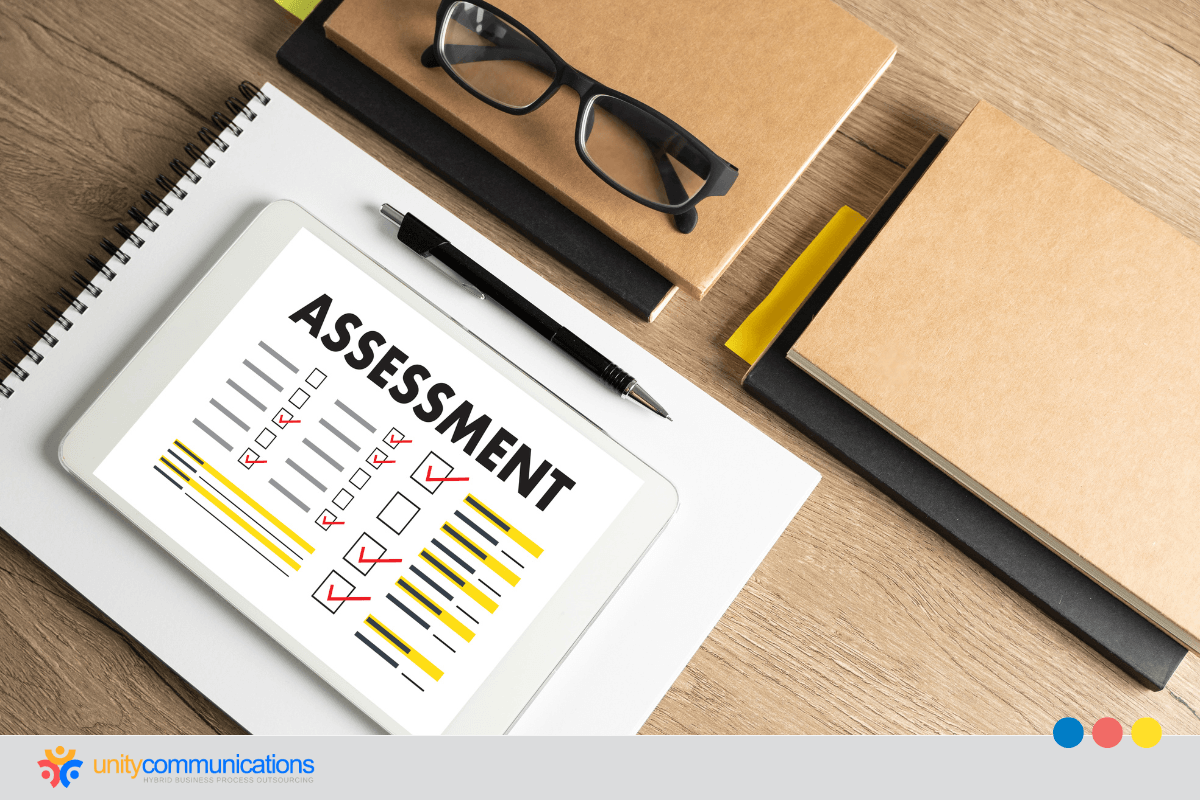
A standardized checklist lets your team filter out unqualified leads before they consume expensive leadership time. Below is an example of how a SaaS-focused checklist might be structured to protect your internal resources.
| Category | Assessment Criteria | Action Level |
| Financial health | Does the vendor provide three years of audited financial statements? | Analyst review |
| Data security | Does the vendor hold a current SOC 2 Type II or ISO 27001 certification? | Analyst review |
| Service level | Is the guaranteed uptime at least 99.9% in the draft SLA? | Analyst review |
| Red flag | Are there any significant limitations of liability that exceed contract value? | Escalate to Legal |
| Red flag | Does the vendor’s disaster recovery plan have a recovery time objective (RTO) over 24 hours? | Escalate to CTO |
Here’s how you can use it: A junior analyst uses this checklist to vet five different cloud storage providers. Suppose four of the providers fail the financial health or data security check immediately.
Instead of the CTO sitting through five separate sales presentations and security briefings, they only receive a single, high-quality dossier for the one vendor that passed the initial checklist. This saves the organization thousands of dollars in executive labor and staffing costs.
Standardizing your assessment through these tools does more than just save time. It creates a repeatable paper trail that helps teams show auditors the review history and approval records behind each vendor decision.
When your process is predictable, your technology and tool costs provide a higher return on investment because you are maximizing the software’s capability to automate routine checks.