Businesses are falling behind in customer service speed, personalization, and cost efficiency. To close this gap, many are turning to chatbots and artificial intelligence (AI) virtual receptionists, often through business process outsourcing (BPO) partnerships.
While both aim to improve service efficiency, they take very different paths. Understanding those distinctions helps you choose the right one—and use it to elevate your customer experience.
This guide breaks down 10 key differences between chatbots and AI receptionists so you can make an informed, strategic decision for your business.
What are chatbots and AI virtual receptionists?
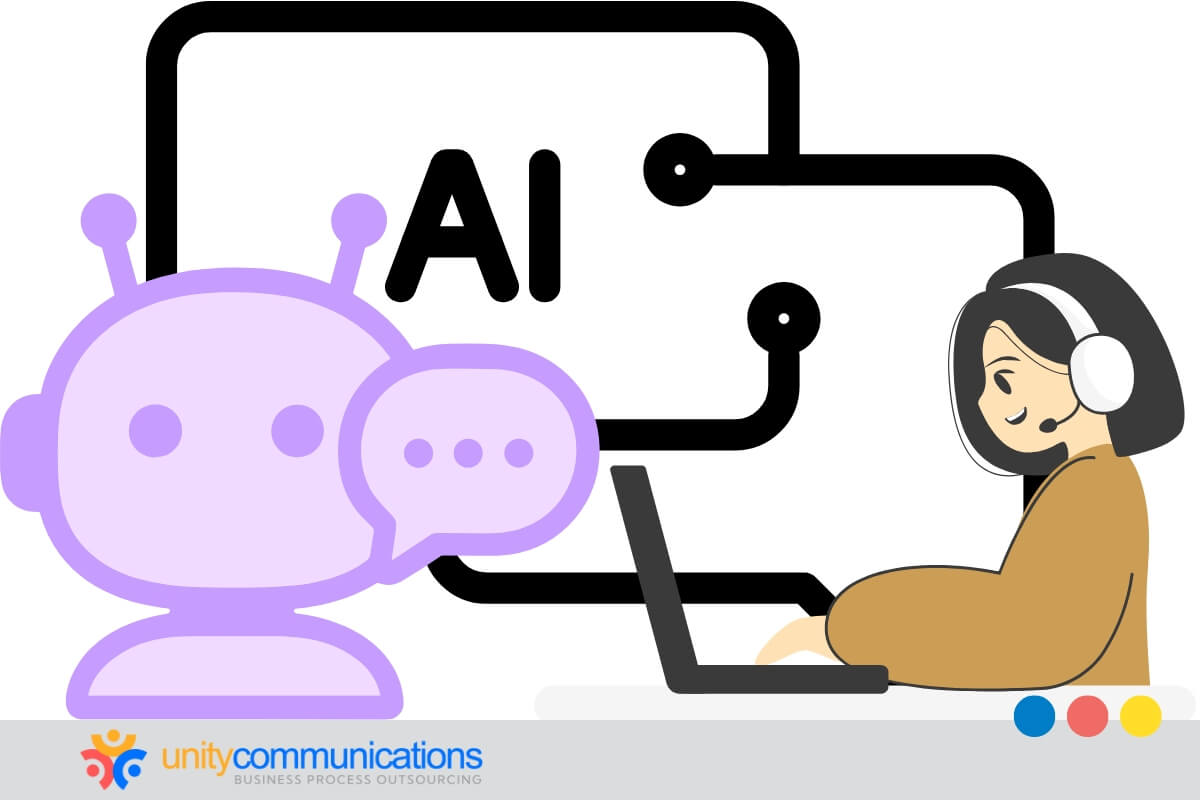
Chatbots and AI virtual receptionists are customer engagement solutions often used in BPO. Over 60% of customer experience leaders say they still lack fast, efficient, and personalized services, making automation an urgent priority.
How outsourcing works is that it involves delegating non-core business activities to specialized third-party providers. For decades, organizations have relied on outsourcing partners to manage IT support, HR, back-office functions, and most prominently, customer service.
Within the customer experience domain, BPO has always revolved around people-powered solutions. That includes live agents handling phone calls, support staff managing emails, or receptionists welcoming clients.
However, with the rise of digital transformation, BPO has expanded to include technology-driven options such as chatbots and virtual receptionists.
What exactly do these tools do? Here’s a rundown:
Chatbots
Chatbots are software applications that simulate conversation with users. They work on websites, apps, and messaging platforms. Chatbots often rely on scripts, natural language processing (NLP), or AI models to respond to customer inquiries.
Thus, they excel at providing instant, automated support for repetitive tasks such as frequently asked questions (FAQs), scheduling, or order tracking. This allows businesses to reduce wait times, thus increasing customer satisfaction scores (CSATs). In fact, a study found that 80% of over 1,000 consumers report a positive chatbot experience.
AI virtual receptionists
What is an AI virtual receptionist? Unlike AI agents, this is an AI–powered system that replicates many of the tasks a human receptionist would perform. They answer calls, route inquiries, schedule appointments, and manage greetings while operating remotely through advanced voice recognition and NLP.
In many BPO models, AI virtual receptionists complement human teams, handling repetitive or predictable tasks while live agents handle sensitive, nuanced, or high-value conversations.
Chatbots and AI receptionists: Critical differences
While chatbots and AI virtual receptionists share the common goal of improving customer engagement, they approach it in very different ways. Chatbots are designed for efficiency and scale across digital platforms, while AI virtual receptionists bring a human-like presence to voice interactions.
To help you understand when to use each, let’s break down the 10 key areas where these solutions differ:
1. Primary engagement channels
The way customers first connect with your business sets the tone for the entire experience. This is where the choice between a chatbot and an AI virtual receptionist becomes especially clear.
Engagement channels are not just technical pathways. They’re the stage where brands either meet customers’ expectations or fall short entirely. Some customers prefer the instant convenience of digital messaging, while others rely heavily on the familiar comfort of a phone call.
Understanding which channel dominates your customer base is critical to deciding whether a chatbot or a virtual receptionist will deliver the most value.
Chatbots excel at digital engagement, which can:
- Operate on websites, mobile apps, and messaging platforms, such as Facebook Messenger and WhatsApp.
- Provide instant answers without requiring customers to call or email.
- Integrate into voice-enabled platforms, such as smart assistants or interactive voice response (IVR) systems.
Meanwhile, AI virtual receptionists focus on voice-first channels, which are:
- Built to answer calls, route them to the right department, and manage greetings.
- Use advanced speech recognition and NLP to sound natural and responsive.
- Extend into SMS and live chat, but their biggest strength lies in phone-based communication.
But why does this matter? If your business model revolves around a digital storefront, such as an e-commerce company, chatbots might provide the fastest return. If you operate in a phone-driven industry, such as healthcare or law, an AI virtual receptionist offers the warm, human presence customers expect.
2. Core responsibilities
Every tool or service in customer engagement has its sweet spot—specific tasks it was designed to handle most effectively. When comparing a chatbot and an AI virtual receptionist, the contrast in responsibilities is striking.
One thrives on predictability and scale, managing thousands of interactions at once. Meanwhile, the other shines in context-rich conversations, adapting in real time to what the customer needs.
Chatbots are best suited for:
- Managing frequently asked questions, such as operating hours or return policies
- Handling simple transactions such as order updates or password resets
- Assisting with basic scheduling, integrated directly with online calendars
- Managing large volumes of inquiries simultaneously at a consistent speed
However, chatbots struggle with complex, emotional, or multi-step conversations.
AI virtual receptionists are best suited for:
- Answering and routing calls, ensuring customers reach the right department
- Scheduling and rescheduling appointments in real time
- Performing client intake tasks, like capturing names, emails, and reasons for calling
- Delivering tone-aware responses, adjusting based on urgency or frustration detected in voice
One limitation of AI virtual receptionists is that they might still require human escalation for high-stakes or nuanced issues.
3. Integration depth
Customer engagement doesn’t exist in isolation. It must plug into the broader operational ecosystem of customer relationship management (CRM), enterprise resource planning (ERP), and scheduling tools. The depth of integration often determines whether these solutions are seen as gimmicks or as game-changers.
How well a solution ties into your existing systems determines its effectiveness. Chatbots generally offer deep digital integration, while AI virtual receptionists concentrate on voice system connectivity with growing digital overlap.
Here’s how chatbots and AI virtual receptionists differ in terms of integration depth.
Chatbots can do the following:
- Connect seamlessly with CRMs, ERPs, and e-commerce systems.
- Automate workflows such as order processing or lead capture.
- Pull real-time customer data to personalize interactions.
Meanwhile, AI virtual receptionists can do the following:
- Integrate with telephony systems, calendars, and ticketing tools.
- Increasingly tied into CRMs for call logging and recording updates.
- Bridge the gap between voice-based inquiries and digital records.
To better describe their difference in integration depth, consider the following example: A banking chatbot integrates account systems to display balances instantly, while an AI receptionist logs a law firm’s intake call directly into Salesforce.
4. Human escalation
No matter how advanced, no system can anticipate every possible customer question or situation. What happens when an interaction moves beyond standard scripts?
This is where human escalation comes in, a crucial aspect that can make or break the customer’s trust. Here’s how chatbots and AI virtual assistants compare.
For chatbots, they can:
- Escalate when queries exceed scripted logic or AI understanding.
- Poorly designed bots risk frustrating users with looping responses.
- Require clear pathways to live support.
For AI virtual receptionists, they:
- Already act as an escalated contact for many interactions.
- Seamlessly transfer calls to live agents when beyond their scope.
- Provide better continuity since customers feel they were already speaking to a “receptionist.”
In real-world applications, a customer stuck in a returns process while conversing with a chatbot can eventually request a human agent or an AI receptionist at an IT firm to route a complex issue to a senior technician.
How does this affect customers? Escalation is often where businesses lose or gain customer trust. Virtual receptionists provide immediate reassurance, while chatbots require well-planned handoffs to avoid friction.
5. Compliance and identity verification
In industries where sensitive data is exchanged, compliance and security are not just background considerations. They’re front and center in every interaction. For instance, healthcare, finance, and law all depend on trust and accuracy.
Thus, compliance is an essential lens through which to compare chatbots and AI virtual receptionists. One relies on encryption, algorithms, and programmed protocols; the other leans on verbal scripts, intuition, and human discretion.
Both approaches have strengths and vulnerabilities, and understanding them helps businesses choose the safer, more reliable option for their regulatory environment.
Here’s a breakdown of how chatbots work around compliance:
- How it works: Depends on encryption, secure APIs, and user authentication flows to protect sensitive information.
- Strengths: Fast, automated verification for simple credentials such as account numbers or login details.
- Weaknesses: Require frequent updates to remain aligned with evolving laws (e.g., the General Data Protection Regulation (GDPR), the Health Insurance Portability and Accountability Act of 1996 (HIPAA)), and some customers feel uneasy about typing personal data into a text box.
- Example: A banking chatbot verifies a customer’s identity by sending a one-time passcode before sharing account details.
How do AI virtual receptionists work in this context? Here’s a rundown:
- How it works: Use voice authentication and scripted compliance checks to confirm identities during calls.
- Strengths: Feel more natural for customers sharing sensitive information verbally and can detect anomalies during live interactions.
- Weaknesses: Still need escalation to human staff for highly sensitive or legally complex data exchanges.
- Example: A patient provides their insurance ID over the phone to an AI receptionist, who verifies it before scheduling an appointment.
6. Personalization and context
Today’s customers don’t just want answers; they want interactions that feel tailored, relevant, and human. Personalization is no longer a nice-to-have; it’s a competitive differentiator. In fact, according to Zendesk’s benchmark data, personalization is a high priority for 76% of customers.
This is where the fundamental difference between chatbots and AI virtual receptionists becomes clear. Chatbots rely on data-driven personalization, while AI virtual receptionists use contextual, voice-aware personalization to adapt in real time.
Chatbots can:
- Personalize via data: name recognition, purchase history, or recommendations.
- Use AI to anticipate common follow-up questions.
AI virtual receptionists:
- Personalize through tone and sentiment analysis.
- Adjust responses based on urgency or frustration detected in voice.
- Provide natural conversation flow closer to human receptionists.
This matters because personalization directly shapes brand loyalty. Businesses that rely heavily on empathy-driven trust (e.g., healthcare, real estate, law) benefit more from receptionists than chatbots.
7. Brand experience
A brand isn’t just logos and marketing. It’s the emotional residue left after every customer interaction. This is where the difference between a chatbot and an AI virtual receptionist becomes clear.
Chatbots can signal modernity, efficiency, and 24/7 availability, but if the responses feel too robotic, they risk making the experience impersonal.
An AI virtual receptionist, by contrast, brings professionalism and trust to voice interactions, offering a natural, human-like tone that reinforces brand values.
Choosing between the two reveals a technological preference and the type of customer experience and brand identity you want to deliver. They differ in terms of tone of voice, customer perception, first impressions, consistency, emotional branding, alignment, and risks.
Here’s a more detailed breakdown.
| Dimension | Chatbots | AI virtual receptionists |
| Tone of voice | Neutral, efficient, and data-driven—reinforces a brand as modern and tech-forward but can feel flat or robotic if not well-designed. | Natural, conversational, and human-like—projects professionalism and warmth, giving brands a more approachable, trustworthy image. |
| Customer perception | Suggest innovation and speed, appealing to digitally savvy customers who value convenience. Risk of making the brand feel impersonal if interactions lack empathy. | Suggest care, reliability, and attention to detail, which resonates in industries where trust and relationship-building drive loyalty (e.g., healthcare, law, finance). |
| First impression | Quick and functional — customers get answers fast, but the interaction might feel transactional. | Mimic a human receptionist —callers feel they’re engaging with a professional extension of the business, strengthening credibility. |
| Consistency in experience | Extremely consistent in tone and response, reinforcing a brand’s reliability in digital spaces. Can come across as rigid. | Consistency is balanced with adaptability; they maintain professionalism while flexing tone and pacing to match caller sentiment, creating a more human-like brand experience. |
| Emotional branding | Focus on utility and efficiency, making them better for brands that want to highlight innovation and speed. | Focus on empathy and reassurance, ideal for brands that prioritize relationship-driven loyalty and trust-building. |
| Brand identity alignment | Works well for companies that want to be perceived as tech-savvy, cost-efficient, and scalable (e.g., SaaS platforms, e-commerce). | Works well for companies that want to be seen as professional, approachable, and people-focused (e.g., healthcare, hospitality, legal services). |
| Risk to brand image | Poorly designed bots can damage brand reputation, making a business appear out of touch or dismissive of customer needs. | If voice technology is poorly tuned, it risks sounding artificial, which can undermine credibility — though less so than an impersonal chatbot. |
What’s the case in point? In hospitality, a chatbot can confirm a reservation instantly, but a receptionist who remembers a returning guest’s preferences creates loyalty beyond convenience.
8. Coverage model
Availability is one of the most practical yet overlooked aspects of customer engagement. Businesses that serve global audiences or operate around the clock must evaluate whether to lean on chatbots or AI virtual receptionists.
Chatbots guarantee uninterrupted service across time zones, while AI virtual receptionists provide professional, human-like support for after-hours and weekend calls.
Coverage models for chatbots and AI virtual receptionists reveal how scalable each solution truly is. It also reveals where your customers place the most value. Are they instant, automated responses anytime or personalized, voice-driven conversations that mirror live receptionists, even outside regular business hours?
Here are some things you should know about chatbots:
- Availability: Operate 24/7/365 without downtime.
- Strengths: Scale globally across time zones, ensuring instant responses anytime.
- Limitations: Might provide impersonal or mechanical interactions during sensitive inquiries.
- Example: An airline chatbot delivers flight status updates to customers worldwide at any time.
For AI virtual receptionists, you should consider the following coverage factors:
- Availability: Increasingly available 24/7, depending on the platform. Traditionally aligned with business hours but now extended with AI-driven coverage.
- Strengths: Offer natural, voice-based conversations that feel like speaking to a real receptionist, even after hours.
- Limitations: Require careful tuning to avoid sounding artificial; might escalate to human staff for complex issues.
- Example: A law firm uses an AI receptionist for after-hours client intake, capturing leads and scheduling consultations when live staff are unavailable.
9. Implementation andmaintenance
Launching a customer engagement solution isn’t as simple as turning it on. It’s an ongoing commitment of time, resources, and oversight. Both chatbots and AI virtual receptionists require continuous maintenance to remain effective, but the type of upkeep differs dramatically.
Chatbots depend on technical development and regular updates, while AI virtual receptionists require voice-model refinement and compliance tuning. In other words, both solutions need active management to deliver long-term value.
Here’s what you should know about chatbots:
- Require conversation design, integration, and AI training.
- Need continuous updates to remain accurate.
- Risk customer frustration if upkeep is neglected.
Meanwhile, here’s what you should know about AI virtual receptionists:
- Require setup of voice models, compliance scripts, and call routing rules.
- Ongoing tuning for industry-specific vocabulary.
- Supported upkeep is often handled by BPO providers, reducing in-house burden.
10. KPIsand costs
No business decision is complete without weighing performance metrics and financial impact. Chatbots and AI virtual receptionists each come with distinct key performance indicators (KPIs) that reflect their unique strengths.
The same goes for their cost models. When viewed side by side, KPIs and costs show that the choice between chatbots and AI virtual receptionists is not just about technology. It’s an investment strategy that directly impacts customer experience.
Chatbots:
- KPIs: response times, resolution rates, containment rate, CSAT.
- Costs: typically, subscription-based with predictable monthly fees.
- ROI is strongest for high-volume, low-complexity interactions.
AI virtual receptionists:
- KPIs: call handling time, first-contact resolution (FCR), satisfaction scores.
- Costs: usage-based or bundled within outsourcing contracts.
- ROI is strongest for voice-driven, high-value interactions.
For high-volume inquiries, chatbots are cheaper per interaction. For high-value calls, such as lead intake in real estate, receptionists often deliver a better return on experience (RoX).
The bottom line

The choice between a chatbot and an AI virtual receptionist isn’t about which is better overall; it’s about what fits your business needs. Chatbots excel in speed, scalability, and cost predictability, while AI virtual receptionists shine in professionalism, empathy, and brand trust.
For many businesses, the strongest approach is hybrid. Chatbots manage high-volume, low-complexity inquiries, while AI virtual receptionists handle higher-value interactions that require context and warmth.
Are you considering integrating one or both of these technologies into your business? Let’s connect and find the best solution that meets your needs.