

Customer expectations are higher than ever. People want fast, accurate help on whichever channel they choose—and they don’t want to wait.
Meanwhile, support teams are under constant pressure: more tickets, more channels, tighter service-level agreements (SLAs), and limited budgets. That’s why more organizations, including those working with business process outsourcing (BPO) partners, are turning to artificial intelligence (AI) to boost speed and service quality.
This article walks through the benefits of AI agents in customer service, which go beyond automation. Used well, they free up your people, personalize interactions, and help you run a more resilient, data‑driven operation.
How do AI agents enable 24/7 customer support and instant responses?
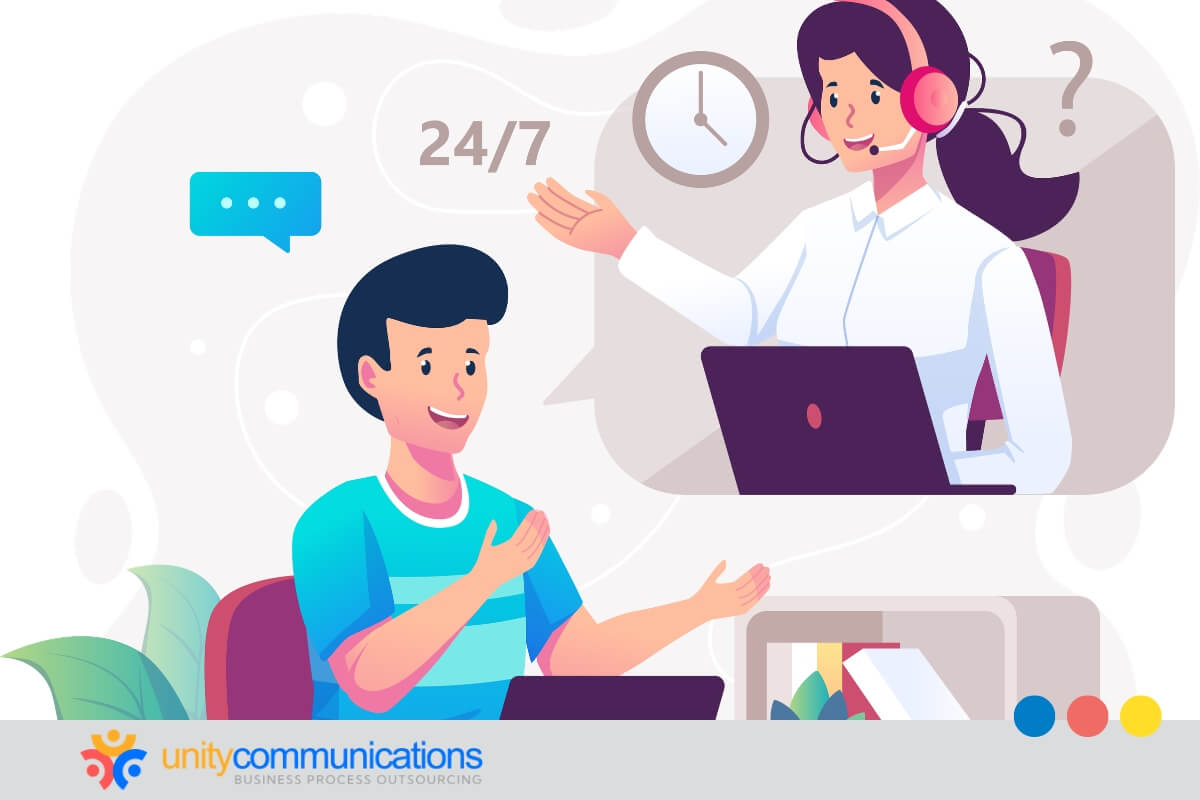
AI agents give you continuous coverage. They can appear wherever your customers are, from the web to social media, and handle many conversations at once.
McKinsey’s 2025 State of AI research shows that many organizations deploying generative AI are already redesigning parts of their workflows. Customer service is one of the first areas to change. Customers no longer see “business hours” as an excuse; they expect help any time.
Here’s where AI agents help:
- They provide near-instant responses across channels, significantly reducing wait times and maintaining high availability.
- They deliver round-the-clock support that builds trust and sustains customer satisfaction, even when human agents are offline.
- AI systems can stay active across chat, email, and social platforms simultaneously, helping maintain speed and accuracy even during peak traffic.
- When issues exceed an AI agent’s scope, the system can route the conversation to the right human agent with full context, so customers don’t have to repeat themselves.
AI also tracks interactions and identifies patterns across conversations to improve service quality and anticipate customer needs. By integrating with customer relationship management (CRM) and other systems, AI can pull in past interactions and customer data to tailor responses and provide more human-like, personalized connections.
How do AI agents reduce wait times and quickly resolve issues?
AI agents reduce wait times and speed up issue resolutions by automatically handling routine inquiries, intelligently routing tickets, and deflecting requests away from queues.
Consider a telecommunications company where customers frequently call to ask about their current bill or payment due dates. Before AI, each of these calls required a live agent to log in to the account and relay basic information. The entire process could take three to five minutes per call.
AI agents can recognize the nature of the inquiry within seconds, retrieve the relevant account data, and deliver an accurate response without routing the call to a live agent. Customers receive their answers more quickly, while human agents can focus their attention on more complex cases, such as disputes.
As AI learns from these interactions, it refines its routing logic to reduce misroutes and improve first-contact resolution rates.
How does AI help free up agents for complex issues?
One of the benefits of AI agents in customer service is automating repetitive tasks, allowing agents to focus on more complex, sensitive, or urgent issues. These include the following:
- Automatic ticket categorization. AI tags and sorts issues immediately, reducing manual workload.
- Data entry automation. The AI agent captures key customer information and logs it directly into the CRM.
- Conversation summarization. It generates post-interaction notes for accurate reporting, especially for calls that require handoffs or callbacks.
- Follow-up management. AI schedules callbacks, sends surveys, and automatically tracks closure.
- Knowledge base updates. AI extracts recurring topics and suggests content improvements to speed up future resolutions.
- Workflow orchestration. Routine backend actions, such as password resets or order status checks, run automatically without agent involvement.
By handling these behind-the-scenes tasks, AI can reduce the administrative burden on agents. Humans can provide more time and attention to conversations that genuinely require human judgment.
How do AI agents maintain consistent, policy-aligned responses every time?
AI agents support consistent, policy-aligned responses by referencing approved knowledge bases, frequently asked questions (FAQs), and policy documents in real time.
Maintaining consistency across every customer interaction can be difficult, especially in large teams. AI innovation helps reduce discrepancies by referencing your most current data sources. They also apply a standardized communication tone that reflects your brand’s preferred language and style guidelines.
When procedures change, AI can reflect those adjustments more quickly across responses. In the process, customers receive dependable, brand-consistent information regardless of which channel they use.
How do AI agents improve cost efficiency and enable scalability?

One of the benefits of AI agents in customer service is the ability to handle thousands of interactions simultaneously, expanding capacity without increasing headcount.
- Lower cost per interaction. AI can handle routine cases at a lower cost per interaction compared to full human handling.
- Elastic scalability. You can expand or contract support capacity quickly based on call volume.
- Optimized resource allocation. Human agents focus on high-value tasks while AI manages the rest.
- Faster onboarding time. New human agents can ramp up more efficiently when AI handles simpler workloads.
- Predictable operating expenses. With automation managing most questions, support costs can stay consistent even as demand fluctuates.
- Improved return on investment (ROI) tracking. Built-in analytics help quantify cost savings and performance gains from AI deployment.
With AI, you can expand coverage and control costs while maintaining service quality and even oversight.
How do AI agents deliver personalized interactions?
AI agents can support more personalized interactions by leveraging CRM data, past interactions, and behavioral insights to tailor responses.
Customers want to feel recognized and understood, not treated as ticket numbers. According to a 2024 Deloitte study on retail personalization, 80% of consumers surveyed prefer brands that offer personalized experiences and report spending 50% more with them.
One of the benefits of AI agents in customer service is enhanced personalization. They can suggest products and solutions based on demographic and user behavior. In addition, they can identify opportunities to check in or re-engage customers before issues arise.
For example, when a repeat customer calls, AI surfaces customer preferences, purchase history, and previous touchpoints. It modifies responses dynamically based on tone, intent, and conversation history. After a call or purchase, the AI updates the CRM and notes to maintain continuity across agents and channels.
With AI’s integrated omnichannel memory, customers can experience more engaging and satisfying conversations.
How do AI agents provide proactive support?
AI agents enable proactive support by detecting customer sentiment and triggering preventive outreach before issues escalate.
In 2024, Microsoft’s Work Trend Index found that 75% of global knowledge workers used generative AI at work, a sign of how deeply AI has become embedded in modern workflows.
This growing adoption empowers support teams by:
- Detecting frustration, churn signals, or negative sentiment early
- Enabling timely interventions to help reduce the risk of problems escalating
- Triggering alerts, sending preemptive messages, or automatically offering solutions to routine problems
- Interpreting tone and emotion to detect dissatisfaction or urgency, helping surface at-risk customers earlier for targeted outreach
In addition, the AI system can initiate check-ins based on patterns or unresolved issues and identify irregular trends or system issues before they worsen. When intervention is needed, AI routes cases to the right agent with relevant emotional and historical context.
Proactive, AI-driven support can help prevent issues and strengthen customer loyalty by showing care before it is asked for.
How do AI agents use analytics to improve performance and detect trends?
AI agents can improve performance and surface trends by capturing and analyzing customer interactions at scale.
In customer service, every conversation holds data that would otherwise go unexamined. One benefit of AI agents in customer service is that they automate the analysis of customer interactions. With these insights, teams can refine processes and help leaders make faster, better-informed decisions.
AI agents can conduct the following analytics tasks:
- Root-cause analysis. AI identifies underlying issues driving frequent inquiries.
- Performance metrics. It tracks handle time, resolution speed, and satisfaction rates in real time.
- Customer trend insights. AI detects emerging topics or problems before they escalate.
- Agent coaching support. Insights help managers tailor training and feedback.
- Feedback loops. AI continuously improves based on conversation outcomes and data patterns.
- Data visualization dashboards. Intuitive reports transform complex analytics into clear, actionable insights.
- Cross-channel correlation. AI links data from multiple touchpoints to provide a unified picture of customer experience.
AI-driven analytics give teams greater visibility into service quality and performance over time.
How do AI agents support teams and boost productivity?

AI agents enable support teams and boost productivity by improving real-time assistance, automating workflows, and reducing manual effort.
A 2025 Harvard Business School working paper found that individuals using AI matched the performance of teams working without it. While the study focused on product innovation at Procter & Gamble, the productivity dynamic it describes has parallels in customer support: AI can help agents and customers work smarter.
For example, during a conversation with a client or customer, AI:
- Recommends phrasing and solutions
- Automatically surfaces relevant policies and articles based on context
- Instantly summarizes calls and chats
- Identifies areas where agents might need coaching
- Suggests tailored learning materials
By empowering your team with real-time intelligence, AI can help agents respond more quickly and with greater confidence.
AI can also help manage scaling more efficiently. Understanding how outsourcing works in a hybrid model helps illustrate the advantage. AI expands capacity without proportional increases in labor costs, while human agents remain available for complex, high-value interactions. The potential result is higher productivity and reduced operational strain, even during peak demand.