
Help desk support services ensure businesses maintain seamless operations by providing timely assistance for technical issues from employees and customers. Their efficiency and responsiveness can significantly enhance productivity and customer satisfaction.
As companies strive to enhance their information technology (IT) infrastructure and service delivery, the demand for robust and effective help desk support has never been higher. One strategic approach that many organizations adopt is IT support outsourcing.
Outsourcing help desk support optimizes operational efficiency and allows businesses to focus on their core competencies while benefiting from specialized expertise. Read on to learn more about how outsourcing help desk support might improve business operations.
Understanding help desk support services
Help desk support encompasses the processes and systems designed to assist users in resolving technical issues. Central to these services is the help desk ticketing system, which allows for systematically tracking and managing user requests to address every problem promptly.
The scope of help desk support extends from troubleshooting technical problems to guiding software usage, aiming to enhance user experience and operational continuity.
Key components of help desk support
Effective help desk support relies on several essential components that promote smooth and efficient service delivery:
- Ticketing. The ticketing system logs and tracks user requests, recording each issue and assigning the appropriate support personnel for resolution.
- Troubleshooting. It determines the root cause of the technical problem to help support staff address the issue effectively.
- Issue resolution. After identifying the problem, the support team fixes it, restoring functionality and minimizing user disruption.
- User guidance. Help desk support provides users with instructions and best practices for preventing issues and improving their system experience.
- Knowledge management. This database of solutions and troubleshooting guides for support staff and users resolves common issues more quickly.
- Escalation management. When a team cannot resolve the problem at the initial support level, they escalate it to higher-level experts with the specialized knowledge to handle more complex issues.
Differentiating help desk support from an IT service desk
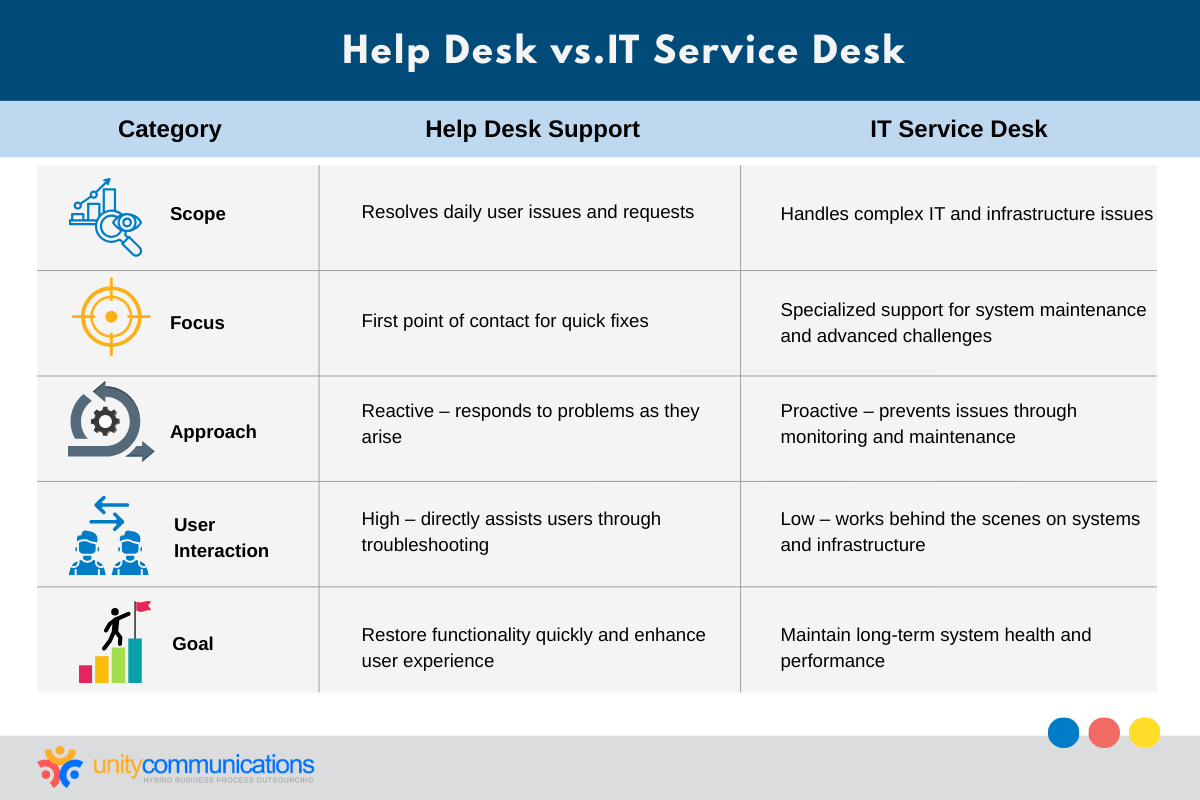
Businesses often use “help desk” and “technical support” interchangeably. Although both provide essential IT assistance, they differ in scope, focus, responsiveness, and level of user interaction.
Learn more about help desk vs. technical support below:
Scope
- A help desk primarily handles user issues and requests, often focused on troubleshooting and resolving day-to-day technical problems.
- Technical support involves more in-depth technical assistance, often addressing complex IT issues and infrastructure management.
Focus
- A help desk is the first point of contact for users who need quick solutions to immediate problems.
- Technical support might provide specialized support for system maintenance, updates, and advanced technical challenges.
Proactive vs. reactive
- A help desk typically operates reactively, addressing issues as they arise and providing support to end-users when needed.
- Technical support often includes proactive measures such as monitoring systems, performing regular maintenance, and preventing issues before they affect users.
User interaction vs. system management
- A help desk focuses on direct interaction with users, guiding them through troubleshooting steps and resolving their immediate concerns.
- Technical support involves more behind-the-scenes work, such as managing and maintaining IT infrastructure and ensuring systems run smoothly and efficiently.
Understanding these differences helps organizations allocate resources and better meet their immediate and long-term IT needs.
The role of help desk support in business operations

Help desk support services are vital in business operations. They are the first contact point for employees and customers experiencing technical issues. The help desk’s primary functions include troubleshooting, resolving common IT problems, and guiding users to ensure smooth day-to-day operations.
Unlike IT service desk services, which often focus on broader tech management and more complex issues, help desk support addresses immediate user needs and resolves problems quickly. This distinction underscores the help desk’s essential role in maintaining productivity and minimizing organizational downtime.
Help desk support and improving business operations
An efficient internal help desk is essential for maintaining smooth business operations. By promptly addressing and resolving technical issues for employees, the help desk minimizes downtime and ensures that employees can focus on their core tasks. Thus, help desk support services contribute significantly to productivity.
- Rapid response to technical problems. The help desk addresses technical issues quickly to reduce work disruptions.
- Proactive monitoring to prevent issues. By continuously monitoring systems, the help desk can identify and address problems before they escalate and prevent disruptions in business operations.
- Streamlined communication for faster resolutions. The help desk facilitates clear and efficient communication between users and IT support, leading to quicker resolutions and less downtime.
- Continuous user support and guidance. The help desk provides ongoing assistance and advice, helping users navigate technical challenges and preventing recurring issues.
Help desk support in maintaining employee productivity and user satisfaction
Effective help desk support is essential for maintaining high employee productivity and user satisfaction. By promptly addressing technical issues, the help desk ensures that employees can continue their duties with minimal disruption, leading to a more positive and efficient work environment.
- Consistent support. The help desk offers reliable support to address user concerns, enhancing overall satisfaction and confidence in IT services.
- Preventative measures. They might also identify and address issues before they affect users for a smoother operational flow.
- User education. They guide employees in best practices and troubleshooting, reducing the frequency of recurring problems.
Help desk support and the broader IT support processes
Help desk support is a crucial component of the broader IT support processes, focusing specifically on addressing and resolving user issues. While it plays a vital role in maintaining operational efficiency, it only covers part of the scope of IT services, which includes more comprehensive strategies and infrastructure management.
Help desk support contributes to broader IT support by providing the following:
- Focused user support. They handle day-to-day technical problems and user inquiries without considering broader IT infrastructure concerns.
- Issue tracking and resolution. They manage the immediate troubleshooting and resolution of user issues, distinct from larger-scale IT service management tasks.
- Integration with IT services. Help desk support works alongside IT service management processes to address user issues promptly while IT teams handle system-wide strategies.
- User communication. They provide direct support and guidance to users, whereas IT service management focuses on service delivery and performance metrics.
Advantages of outsourcing help desk support services

Outsourcing help desk support services offers several advantages, especially when utilizing help desk software for a mid-size business. This approach helps streamline operations and brings numerous benefits that improve service quality.
- Cost savings. Outsourcing help desk support services helps businesses avoid the expenses of managing an extensive team, allowing for a more efficient budget allocation.
- Access to skilled professionals and the latest technology. It offers specialized resources for high-quality support and up-to-date solutions.
- 24/7 availability and faster response times. Outsourcing ensures round-the-clock support and quicker resolutions for end users, improving service efficiency.
- Scalability and flexibility. It allows for easy adjustment of resources based on demand, ensuring that the help desk can scale when needed.
Selecting a help desk outsourcing provider
Below are tips on how to find help desk services that align with the company’s operational goals and offer reliable support:
- Define requirements. Assess the business needs to determine the scope of support required, including technical expertise and service levels.
- Research potential providers. Look for reputable companies with a track record of delivering quality help desk services and positive customer feedback.
- Evaluate service offerings. Compare the features and capabilities of different providers, such as support hours, ticketing systems, and response times.
- Consider scalability and flexibility. Choose a provider that can adapt to the business’s growth and changing requirements.
- Review cost structures. Ensure that the pricing model aligns with the budget and provides good value for the services offered.
The bottom line

Help desk support services are essential for resolving technical issues efficiently and maintaining smooth business operations. Outsourcing these services can offer significant benefits, including cost savings, access to skilled professionals, and 24/7 availability.
By leveraging external expertise, businesses can enhance their support capabilities while focusing on core activities. Consider outsourcing your help desk support to improve efficiency and reduce costs. Let’s connect to discuss your options.