

Healthcare providers cannot afford to miss a call. A voicemail left after business hours might come from a patient in distress, a family member awaiting an update, or a referral source deciding whether to trust your medical office. Yet staffing a compliant call center around the clock is out of reach for most medical practices, home health agencies, and long-term care facilities.
That gap is exactly what a HIPAA-compliant answering service is built to close. These providers combine secure technology with trained receptionists to schedule appointments, handle patient calls, route emergencies, and protect patient data at every step, without adding to your payroll.
This guide ranks the best medical answering service providers on the market, explains what HIPAA compliance actually requires, and gives medical practices a framework for choosing a HIPAA-compliant answering service that fits their practice.
What is a HIPAA-compliant answering service for a healthcare practice?

A HIPAA-compliant call center meets the security, privacy, and documentation standards HIPAA requires for healthcare practices.
HIPAA stands for the Health Insurance Portability and Accountability Act of 1996. This federal law governs how healthcare providers, insurers, and their vendors handle medical information. It sets rules for:
- Who can access medical records
- How to store and transmit data
- What happens when a breach occurs
Patients gain the right to see and correct their own records under the law. Businesses that handle health data on behalf of a provider, including call centers and IT vendors, sign agreements committing them to these same standards. Violations of HIPAA regulations carry fines and can trigger a federal investigation.
Unlike standard answering services, top HIPAA-compliant medical answering services handle protected health information (PHI) without exposing patients or medical practices to compliance risks.
At a minimum, these services encrypt calls and messages, restrict access to PHI, and provide documented staff training and a signed business associate agreement (BAA).
Many providers also add features on top of that baseline, including a virtual receptionist for daytime overflow, appointment scheduling, multilingual support, and direct integration with electronic health record (EHR) systems, as Unity Communications explains in How AI After-Hours Answering Services Transform Medical Office Operations.
Choosing a provider that only claims HIPAA compliance in marketing, without the safeguards to back it up, can leave a health system legally exposed. OCR made this clear on February 20, 2025, according to HIPAA Journal. It fined Warby Parker $1.5 million after credential-stuffing attacks exposed customer data between September and November 2018. The exposed data included names, addresses, payment card details, and prescription information for nearly 198,000 customers.
OCR cited three HIPAA violations. Warby Parker had never conducted a risk analysis. Its security measures fell short of what the rule requires. It also had no process to regularly review system activity logs. Warby Parker did not contest the penalty and waived its right to a hearing.
What makes an answering service HIPAA compliant?
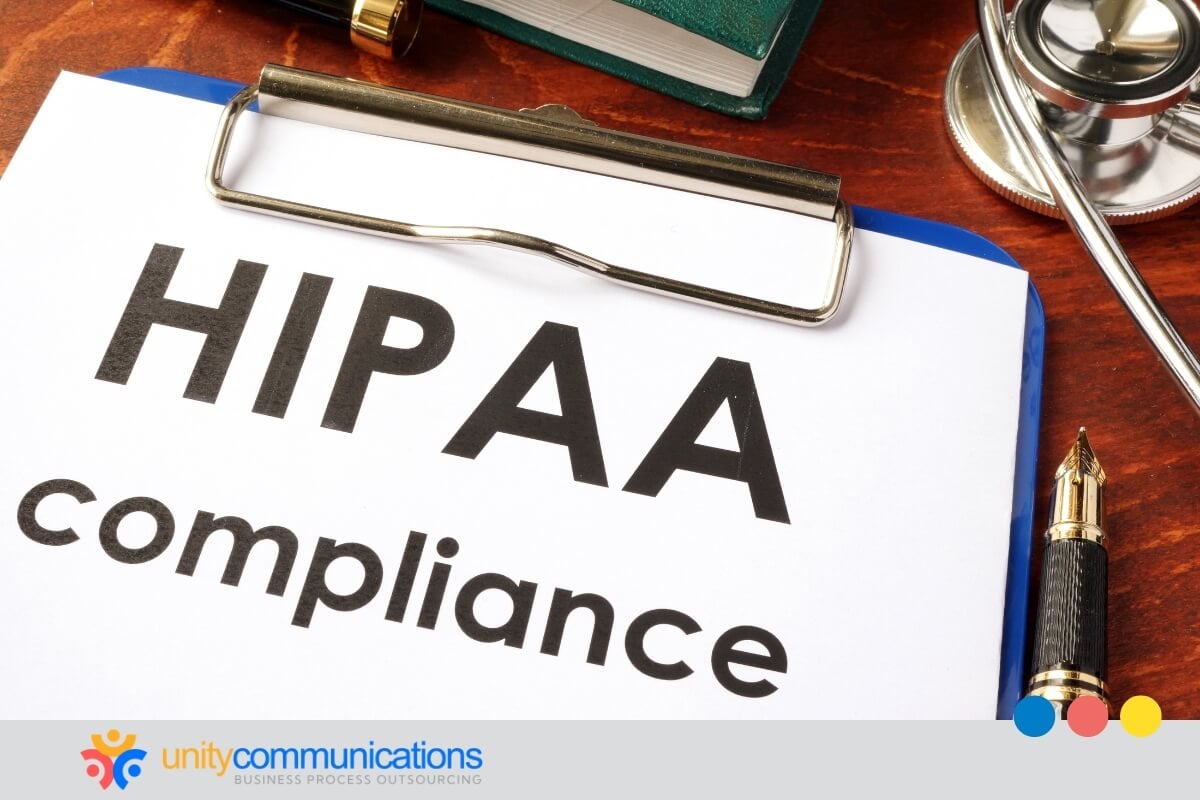
A HIPAA-compliant answering service protects data using encryption, access controls, staff training, and a signed BAA.
A vendor that is missing even one of them cannot honestly claim HIPAA compliance, regardless of how well the rest of its technology performs.
Encryption protects data in transit and at rest
Encryption protects patient information whether it is being transmitted during a call or stored afterward in a message or recording.
- Call recordings and voicemail are encrypted so they cannot be intercepted or accessed without authorization.
- Messages and call summaries are encrypted before they are stored or forwarded to staff.
- Data remains protected whether it is moving between systems or sitting in storage.
Access controls limit who can view PHI
Access controls determine who within the receptionist service can see PHI, based on role and need.
- Only staff assigned to a specific account can view that account’s PHI.
- Role-based permissions prevent unnecessary exposure of sensitive patient information.
- Access can be revoked immediately when staff change roles or leave the organization.
Staff training prepares receptionists for sensitive calls
Ongoing staff training ensures that every receptionist is comfortable answering questions and knows what they can and cannot disclose to callers.
- Receptionists are trained on what information can be shared and with whom.
- Training covers how to handle patient calls involving distress, confusion, or urgency.
- Refresher training keeps staff up to date as HIPAA guidance and vendor protocols evolve.
A signed BAA holds the vendor accountable for PHI
A BAA is a signed contract between the practice and the answering service that spells out how the vendor will protect PHI.
- The BAA specifies how the vendor stores, transmits, and disposes of PHI.
- It requires the vendor to report any breach to the practice without delay.
- A signed BAA gives the practice peace of mind that the vendor carries real, contractual accountability for PHI.
- Without a signed BAA, the practice remains at risk of HIPAA violations. It can become liable for how the vendor handles PHI, regardless of the vendor’s own security practices.
9 best HIPAA-compliant medical answering services for healthcare providers

When comparing the best medical answering service for your organization, security should be weighed as heavily as call-handling quality.
An industry report on medical call centers found that only about half of patients are satisfied with their provider’s phone experience, largely due to long holds and unresolved first calls. Choosing the right HIPAA-compliant answering service can directly improve patient satisfaction and reduce that friction.
The entries below are ordered with those differences in mind, moving from the most complete, technology-forward option down to more specialized or narrower providers. This way, you can match a vendor to your organization’s size, call volume, and clinical workflows before requesting a quote.
1. Unity Communications: Best overall HIPAA-compliant answering service
Best for: Medical practices that need AI triage and a live virtual receptionist in one hybrid model
Unity Communications combines AI-driven call triage with trained receptionists, encrypted data handling, role-based access controls, and a signed BAA for every client. Rather than forcing a healthcare organization to choose between automation and a human touch, the platform routes routine questions to AI and hands off anything urgent, emotional, or clinically complex to a live agent trained on the organization’s own escalation protocols. Unity outlines this approach in How to Choose the Right AI-Powered Outsourced Answering Service.
- Integrates with EHR and scheduling systems so appointment requests and updates stay accurate
- Supports multilingual, sentiment-aware patient interactions for diverse populations
- Scales from single-location medical practices to multi-site health system networks
- Routes emergencies and urgent calls directly to on-call clinicians or supervisors
- Provides audit trails and documentation to support ongoing HIPAA compliance reviews
Because it is built as a hybrid BPO service rather than a pure software tool, Unity Communications can adjust staffing, scripts, and escalation rules as a healthcare organization grows, which is why it ranks first on this list.
2. MedConnectUSA
Best for: Physician practices and home health agencies wanting a healthcare answering specialist
MedConnectUSA builds its plans specifically around medical clients, with standard HIPAA safeguards and receptionists available for after-hours coverage. Its positioning as a medical-only provider means agents are generally already familiar with common intake questions, insurance terminology, and the tone families expect when calling about a loved one’s care.
- Live receptionist coverage for physician practices and home health
- Customizable call scripts across medical terminology and specialties
- After-hours and on-call message relay for on-call clinicians
- EHR integration varies by plan, so confirm details directly
Organizations considering MedConnectUSA should ask specifically how its plans handle EHR integration and multilingual support, since these vary more by tier than with some competitors.
3. Ambs Call Center
Best for: Smaller medical practices that prioritize a personal touch
Ambs Call Center combines decades of medical answering experience with AI-assisted triage and live 24/7 agents to handle patient interactions and EMR scheduling. AnswerConnect provides HIPAA-compliant, multi-channel general business support with bilingual agents, though organizations should review their call scripts for complex clinical workflows.
- Long-standing presence in the medical industry
- Customizable call scripts and greetings
- Live agents available for routine and after-hours calls
- Limited AI triage compared to technology-forward providers
Ambs Call Center is a reasonable fit for a single-location practice, but larger organizations might find its feature set thinner than that of more automation-forward competitors on this list.
4. AnswerConnect
Best for: Organizations that want general call-handling flexibility and broad customer support across departments
AnswerConnect serves a broad range of industries, including medical practices, and advertises HIPAA-compliant plans for medical clients. Because it was built to serve many industries rather than healthcare alone, its strength lies in flexible call handling and general customer support, not in deep clinical workflow features.
- Flexible call handling built for multiple industries
- HIPAA-compliant plans available for medical clients
- Bilingual support options for diverse caller bases
- Practice-specific features may be less developed than dedicated medical answering services
Healthcare organizations evaluating AnswerConnect should confirm which HIPAA safeguards apply to the medical plan. Coverage might differ from its general business offering.
5. TeleDirect
Best for: Organizations that also need outbound patient outreach
TeleDirect pairs encrypted, medical-focused call handling with appointment scheduling support for medical clients. It stands out among general call center services for offering outbound capabilities alongside standard inbound coverage, which suits practices running reminder campaigns or patient satisfaction surveys.
According to a guide on no-show statistics and reminder effectiveness, multi-channel reminder systems that combine phone, text, and email can cut missed appointments by 30% to 60%, the kind of outbound touchpoint TeleDirect supports.
- Encrypted call handling for medical accounts
- Helps schedule appointments and confirms visits as part of routine patient communication
- Outbound outreach and survey capabilities available alongside inbound coverage
- Appointment reminders that reduce missed-visit rates
For a practice that only needs after-hours inbound coverage, TeleDirect’s outbound features might be more than necessary, so it is worth carefully comparing pricing tiers.
6. Sound Telecom
Best for: Organizations prioritizing fast response over deep automation
Sound Telecom emphasizes rapid response times for urgent calls and maintains standard compliance safeguards for medical accounts. Its model favors quick human pickup over layered AI triage. This can appeal to organizations that want a straightforward, low-friction answering experience.
- Fast response times for urgent calls and voicemail follow-up
- Standard HIPAA safeguards for medical accounts
- Live agents trained to recognize urgent versus routine calls
- Less AI triage and EHR integration than more technology-forward providers
Sound Telecom works well as a dependable baseline service, though organizations with complex routing needs might outgrow its more limited technology stack.
7. VoiceNation
Best for: Solo practitioners and small medical businesses
VoiceNation is known primarily for small-business answering services and has expanded into HIPAA-compliant medical plans. Its pricing and onboarding are generally simpler than those of enterprise-focused competitors, making it accessible to a single provider adding after-hours coverage for the first time.
- Entry-level pricing suited to small medical practices
- HIPAA-compliant plans available on request
- Simple setup for practices without dedicated IT staff
- The feature set might be outgrown by larger medical practices
VoiceNation is a sensible starting point for a solo practitioner, but growing practices should revisit the vendor as call volume and compliance needs increase.
8. MAP Communications
Best for: Mid-market practices that want dependable, no-frills coverage 24 hours a day
MAP Communications offers medical answering with standard compliance safeguards and bilingual receptionist support. It sits comfortably between the bare-bones small-business plans and the more technology-heavy enterprise options, making it a common choice for mid-sized clinics and multi-provider practices.
- Around-the-clock coverage with bilingual agents
- Standard HIPAA safeguards
- Consistent live agent availability for routine and after-hours calls
- Limited customization compared to hybrid AI and receptionist models
Practices that want dependable coverage without extensive customization are often satisfied with MAP Communications, though it is not the most feature-rich option on this list.
9. Apello
Best for: Internal clinical coordination rather than patient-facing calls.
Apello is a medical answering service specializing in front-end patient interactions, appointment scheduling, and live operator triage using clinical protocols. The platform emphasizes HIPAA-compliant communication and patient-facing customer service, making it well-suited for clinics that require dedicated after-hours call management and virtual receptionist support.
- Secure messaging built for care team coordination
- Strong fit for on-call scheduling workflows
- Useful for hospital departments coordinating handoffs
- Not designed for high-volume, patient-facing call answering
Health systems already using Apello for internal coordination might still need a separate, dedicated answering service to handle external patient calls.
Providers frequently change their offerings and pricing, so confirm current features, BAA terms, and integration capabilities directly with each vendor before signing a contract. This holds true for answering services for medical professionals in solo or small-group practice. Plans and pricing tiers change more often than enterprise health system contracts do.
How much does a HIPAA-compliant answering service cost?
Most HIPAA-compliant answering services cost between $2 and $4 per call, or a flat monthly fee based on call volume and features.
That range covers the baseline cost of live or AI-assisted call handling with standard HIPAA safeguards in place. Where a specific provider lands within it depends on call volume, the level of automation involved, and how many extras are bundled into the plan.
Per-call and flat monthly pricing fit different call volumes
Per-call pricing fits practices with unpredictable or seasonal volume. Flat monthly plans work better for practices with steady, predictable call patterns. Hybrid tiers combine a base rate with overage charges once volume passes a set threshold. Many HIPAA-compliant answering service providers offer all three structures.
AI features and integrations raise the price
AI-assisted triage carries a premium over live-agent-only plans. EHR integration and custom escalation workflows often come as add-ons. A longer onboarding period can offset a lower per-call rate. The vendor spends more time on setup before that discount pays off.
The lowest price is not the best value
A cheaper service that misroutes urgent calls poses a real risk to patients and the practice. Missing a documented BAA exposes a medical practice to compliance risk no matter how low the rate looks. Every HIPAA compliant call carries the same legal weight, whether the vendor charges premium or discounted pricing.
Compare virtual receptionist services and HIPAA compliant medical answering services on total value. Price alone will not show the difference between a compliant vendor and a shortcut.
Choosing a HIPAA-compliant answering service for your practice
Selecting among the providers above depends on your medical practice’s size, call volume, and clinical workflows. A few factors should guide healthcare providers regardless of which vendor they consider.
Use a HIPAA-compliant receptionist service that protects PHI
Ask every provider to confirm they will sign a BAA and to describe their encryption, access control, and audit trail practices in writing. A reliable answering service should be able to produce this documentation without hesitation and explain in plain terms how it will protect patient data across channels.
Confirm your health system understands what HIPAA requires
Organizations with high after-hours call volume or complex triage needs benefit from AI-assisted routing paired with a live virtual receptionist. Smaller medical practices with simpler needs might do well with a more straightforward receptionist model, but every health system should confirm that its vendor understands HIPAA requirements before calls go live.
Verify integration with existing systems
According to guidance from the U.S. Department of Health and Human Services on business associate responsibilities, covered entities remain accountable for how vendors handle PHI, which makes system integration worth scrutinizing before signing a contract.
Confirm that any answering service can connect with your EHR or scheduling software to avoid manual data entry and duplicate records and can schedule appointments and follow-up reminders directly from an incoming call.
Pair a virtual receptionist with on-call human support
AI automation brings speed and consistency, but conversations involving distressing news or complex medical questions often call for a human agent. A hybrid business process outsourcing (BPO) approach that pairs a virtual receptionist with on-call staff is generally the safer choice for medical practices handling sensitive patient calls.