You’ve defined your back-office tasks (step 1) and secured your global talent footprint (step 2). Now comes the game-changer: integrating the right technology.
This guide, based on step 3 called the hybrid automation strategy of our back-office outsourcing system, shows you where to apply automation, how to combine artificial intelligence (AI) with human expertise, and how this model can drive 10x ROI for your business.
This tactic doesn’t replace humans with robots. Instead, it bridges traditional business process outsourcing (BPO) and the future of work. Specialized agents use tools that deliver Fortune 500–level speed, accuracy, and compliance (based on typical automation benchmarks).
The power of blended tech: Doing more with less
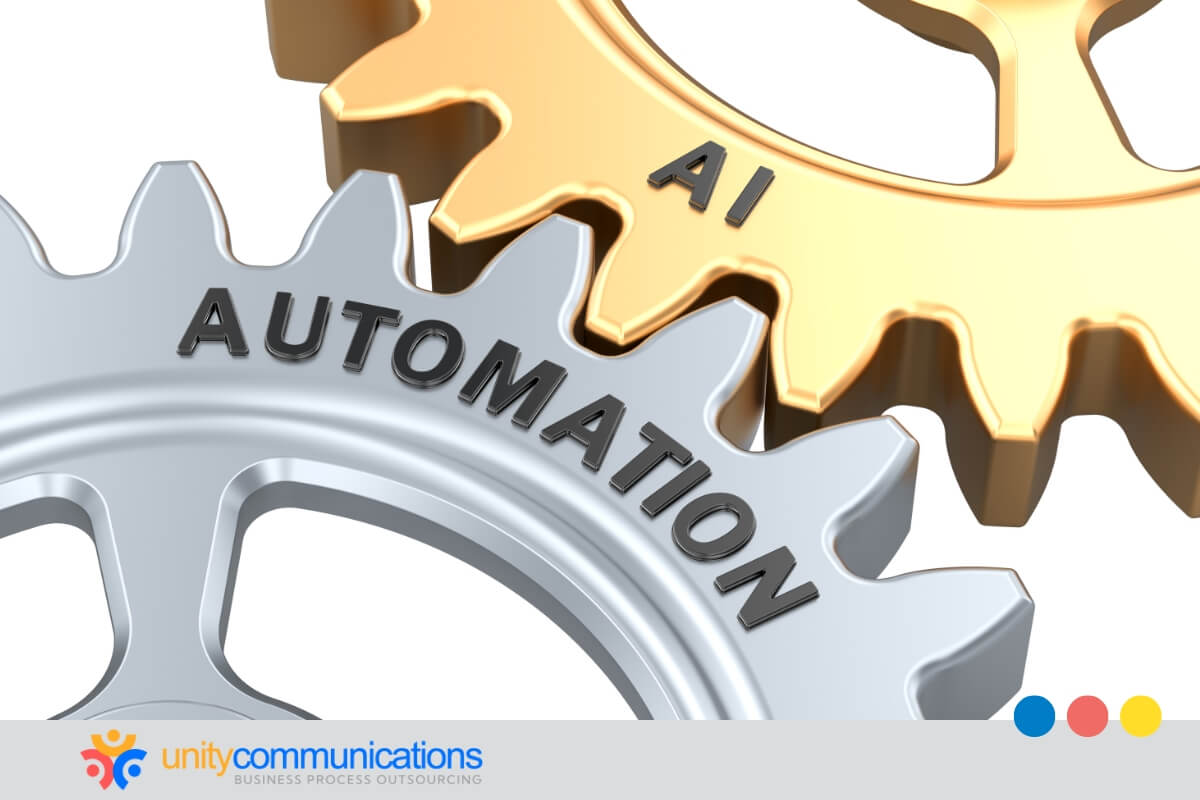
The key to the hybrid model lies in understanding the strengths of each component, knowing which tasks are best suited for machines and which ones require a human touch to truly excel.
- AI/automation (RPA/IDP) tackles speed, scale, data processing, and repetitive, rule-based tasks with perfect consistency.
- A human agent brings empathy, judgment, complex problem-solving, quality assurance (QA), and communication to the table. They can handle tricky “edge cases” that AI can’t.
By combining the two, an AI-powered BPO partner delivers the efficiency of machines with the quality assurance of human expertise. At Unity, our core strategy involves blending human and tech solutions to help clients “do more with less,” not just save costs.
The automation playbook: 4 tasks you must delegate and automate
Approximately 80% of companies utilize AI for efficiency, but you experience its real value when it drives growth and innovation. The smartest way to get there? Automating high-volume, repetitive tasks.
Here are five back-office functions that SBOs should outsource to a BPO partner with advanced automation capabilities.
4 back-office tasks you didn’t know AI can automate (but should)
For a deeper technical dive into the platforms and implementation of these automations, read our detailed blog post.
1. Financial reconciliation and expense management
Let AI do the heavy lifting, such as processing digital receipts, cross-checking bank statements, and automatically categorizing expenses. The result? Lower labor costs and almost zero errors in your financial data.
Why it matters for you: You can make faster, smarter financial decisions without worrying about mistakes eating into your bottom line.
2. Automated data entry and digitization
Forget slow, manual keying. Intelligent document processing (IDP) reads forms, receipts, and invoices, turning them into clean digital records with near-perfect accuracy.
Why it matters for you: Your team spends less time on tedious tasks and more time on work that drives your business forward.
3. Fraud monitoring and prevention
AI continuously monitors millions of transactions, identifying unusual activity before it becomes a costly problem.
Why it matters for you: You reduce financial risk and gain peace of mind by catching suspicious activities early.
4. RPA in HR and payroll
Robotic process automation (RPA) automates repetitive HR tasks, including onboarding, payroll setup, and compliance reporting. This tool ensures consistency and accuracy, allowing your team to focus on high-value activities.
Why it matters for you: Your HR processes run smoothly, freeing your team to focus on strategic initiatives and employee experience.
The future-proof back office: AI-human collaboration trends

The business world is changing rapidly, and staying competitive requires staying informed and smart. Outsourcing back-office operations enables you to stay ahead of these key trends while giving your team the freedom to focus on growth and strategy.
1. The new role of the human agent (empathy and oversight)
Today, the BPO agent is no longer just a data-entry clerk. They’ve become a quality manager and strategic problem-solver. Their focus includes:
- Strategic decisions: Tackling complex customer issues and exceptions that AI can’t handle
- Quality oversight: Reviewing automated processes to ensure accuracy and compliance
- Empathy and judgment: Bringing the human touch to customer interactions and team leadership, which machines cannot replicate
As automation expands, human agents provide the judgment, empathy, and oversight that keep back-office operations accurate, compliant, and customer-focused.
For a complete look at the market changes and what this means for your future hiring strategy, read our analysis of 2026 industry trends.
(Sub-Integration Point: Video Link – 2026 in 60 seconds summary) Watch this quick video summary of the top three essential trends shaping back-office efficiency.
2. Data readiness: The pre-automation checklist
About 53% of businesses believe AI will optimize workflows across their organization, but it starts with getting the basics right. To make AI-human collaboration effective, your data must be in order.
Your BPO partner can guide the process, while you prepare the data to expedite a smooth handoff using this checklist:
- Process documentation. Are all your standard operating procedures (SOPs) properly documented and easy to follow?
- Data structure. Is your data clean, organized, and digitized so it’s easy to transfer and use?
- Legacy system access. Can the BPO partner access the data needed to train the AI tools?
Getting these basics right upfront saves time, prevents errors, and ensures your automation works as intended. With clean, well-structured data and proper access in place, your AI tools can deliver results more quickly and reliably.
(Internal Link/Integration Point: Top AI tools used by BPO teams Infographic) See our infographic detailing the most effective AI and automation tools deployed by leading BPO teams.
SBO spotlight: Guaranteed quality and compliance
For SBOs in regulated industries, non-compliance results in steep fines and damaged reputation. The hybrid automation strategy enhances security and quality for peace of mind.
Case study: Compliance and billing transformation in healthcare
A growing clinic struggled with complex medical coding and patient billing compliance while maintaining control over costs.
The founder was spending 20+ hours a week double-checking its compliance with the Health Insurance Portability and Accountability Act of 1996 (HIPAA). Even with that effort, the clinic remained exposed to costly fines, leaving little time to focus on patient care.
The solution
The clinic partnered with a BPO for specialized knowledge process outsourcing (KPO), utilizing virtual medical assistants (VMAs) and IDP tools. These tools automatically flagged coding errors and ensured every form met strict compliance standards before processing. The BPO partner guaranteed full adherence to compliance.
The result
Claims rejection rates dropped by 15%, directly increasing revenue capture, while maintaining strict compliance standards. The founder regained 100% of their time for patient care, delegating all regulatory burden and risk to the expert team.
The bottom line

The hybrid automation strategy is an investment in long-term resilience. It provides the efficiency of a large corporation while maintaining the flexibility and agility that small businesses thrive on.
By partnering with an AI-powered BPO to handle automation, you reduce costs, maintain top-notch quality, and keep your back office fully compliant and ready for the next wave of technology.
Ready to see how this strategy can transform your operations? Take the next step and start building a back office that works smarter, not harder. Let’s connect.
Download the complete definitive guide, The Small Business Owner’s System for Back-Office Outsourcing, to access the complete 5-step system, including the 50-question Full Back-Office Readiness Audit and all KPI templates.
Step 3 FAQs
1. What is a hybrid automation strategy?
A hybrid automation strategy combines AI tools (such as RPA and IDP) with human agents to create a faster, more accurate, and more scalable back office. AI handles the high-volume, rule-based tasks, while humans focus on exceptions, decision-making, and quality oversight. This blended model offers small businesses enterprise-level capabilities without the associated costs.
2. How does human-AI collaboration improve back office performance?
AI increases speed, reduces errors, and automates repetitive tasks. Humans bring empathy, judgment, and the ability to solve complex problems. Together, they create a workflow that is:
- More accurate
- Faster
- More compliant
- More scalable
- Less dependent on founder oversight
This is why hybrid back-office operations consistently outperform manual- or AI-only setups.
3. What are the best back-office tasks to automate first?
The highest-impact automation opportunities include:
- Data entry and digitization
- Financial reconciliation
- Expense categorization
- Invoice processing
- Compliance verification
- Payroll and HR onboarding
- Fraud detection and anomaly monitoring
These tasks drain time from your internal team and are perfect for automation because they follow consistent, rule-based workflows.
4. Do I need to buy AI tools before outsourcing?
No. One of the most significant advantages of partnering with an AI-powered BPO is that the tools, automation platforms, and infrastructure are already in place.
This saves you:
- Upfront software costs
- Expensive implementation cycles
- Training and configuration time
Your BPO partner provides the technology and the talent.
5. How does hybrid automation reduce back-office costs?
Hybrid automation reduces operating costs through:
- Lower labor hours for manual tasks
- Fewer errors and less rework
- Faster processing times
- Standardized workflows
- Predictable, fixed-fee pricing models
- Reduced compliance risks
Many small businesses experience a measurable return on investment within 60–90 days after implementation.
6. Is hybrid automation secure for sensitive data?
Yes. AI-powered BPO providers use the same enterprise-grade security tools and compliance frameworks that large corporations rely on. This includes:
- Encryption
- Role-based access controls
- Automated audit trails
- HIPAA/PCI/ISO 27001 compliance
- 24/7 monitoring
In many cases, outsourcing improves security because workflows are more standardized and less dependent on individual employees.
7. Do I need clean data before implementing AI automation?
Clean data helps, but it’s not required. Your BPO partner can assist with:
- Data cleanup
- Standardization
- Digitization
- Legacy system extraction
Once your data is structured and documented, AI tools work much faster and more accurately.
8. What results can small businesses realistically expect?
Most SBOs experience:
- 30–60% faster back office processing
- 10–20% cost savings in the first 90 days
- 98–99.9% data accuracy
- 15%+ fewer compliance errors
- Higher customer satisfaction
- Founder time reclaimed for strategy and growth
Hybrid automation empowers small businesses to operate with the same efficiency as large companies.
9. How do I know if my business is ready for hybrid automation?
You’re ready if you:
- Have recurring, high-volume tasks
- Spend too much time on admin
- Can’t scale with your current team
- Are drowning in manual data work
- Need more accuracy or compliance
- Want 24/7 capability without hiring more staff
If one or more of these apply, hybrid automation can create immediate leverage.
10. How do I get started with an AI-powered BPO?
The simplest path is to:
- Identify high-time-drain tasks.
- Document your workflows.
- Meet with a BPO partner to map automation opportunities.
- Start with a low-risk pilot process.
- Scale once you see results.
A BPO partner such as Unity Communications can handle the heavy lifting, from process mapping to full automation, to get you operational quickly.