


Headcount used to decide outsourcing capacity. More work meant more hires, and the cost climbed with it. That math no longer holds.
AI agents now handle routine tasks in daily operations, and people manage what automation cannot: judgment, exceptions, and accountability.
AI-enabled BPO ties results to workflow design and delivery speed. Staff count no longer decides the outcome. A handful of providers already run their entire delivery this way, pairing automation with real teams on the ground. Here is what that means for your operations.
What is an AI-enabled BPO, and how is it different from traditional BPO?
AI-enabled BPO combines intelligent technology with people. It is unlike traditional BPO, which adds employees to handle more work.
This outsourcing model combines AI with human expertise throughout service delivery. AI completes defined tasks. People check results and address unusual cases. They also make business decisions and remain accountable for the outcome. The model changes how work moves through operations rather than adding software to processes.
Outsourced work follows a different operating approach. Instead of expanding teams for every new demand, AI becomes part of the delivery process. Employees remain responsible for work requiring context, communication, and experience. A processing team, for example, receives the AI output on complex insurance claims. They review them first before approval.
By comparison, traditional BPO expands capacity by adding employees to finish assigned tasks. This operating model assigns routine work to automation and smart systems. Service capacity grows through workflow design rather than solely through workforce size. That shift moves the focus from workforce size to design and performance.
This distinction matters because many providers advertise AI without changing how services operate. Think about two customer support teams. One uses AI to draft replies. The other integrates AI into customer service operations. Human team members also evaluate results and handle complex cases. Both use AI, but only one changes how the service operates.
This difference explains why the term “AI-enabled” means more than adding AI to existing services. It describes a different way of delivering outsourced work.
Why is outsourcing shifting beyond headcount-based delivery?
Outsourcing is moving beyond headcount, as buyers now weigh providers on speed, accuracy, and results, not team size.
For years, outsourcing value rested on one number: headcount. More staff meant more output. That math worked when tasks stayed repetitive and predictable, and when clients cared more about volume than result quality.
That standard no longer holds. Leaders measure providers on speed, accuracy under pressure, and capacity that scales without a long hiring cycle. A bigger team does not settle any of that. Clients see the gap between headcount and actual performance.
Providers built around seat count alone feel that strain first. Clients track turnaround time, error rates, and consistency during peak periods, not the number of names on a roster. Extra staff cannot fix a process built on outdated steps or manual review at every stage.
AI-enabled BPO closes that gap. It brings AI in business process outsourcing into everyday workflows. Output then scales with client demand, without adding a new hire for every request or stretching existing teams thin.
The data backs this up. Market.us projects that the global AI in BPO market will grow from $2.6 billion in 2023 to $49.6 billion by 2033 at a 34.3% annual growth rate. That trajectory rewards providers who are building around AI now, not those still pricing by headcount.
How is AI changing the way BPO services are delivered?
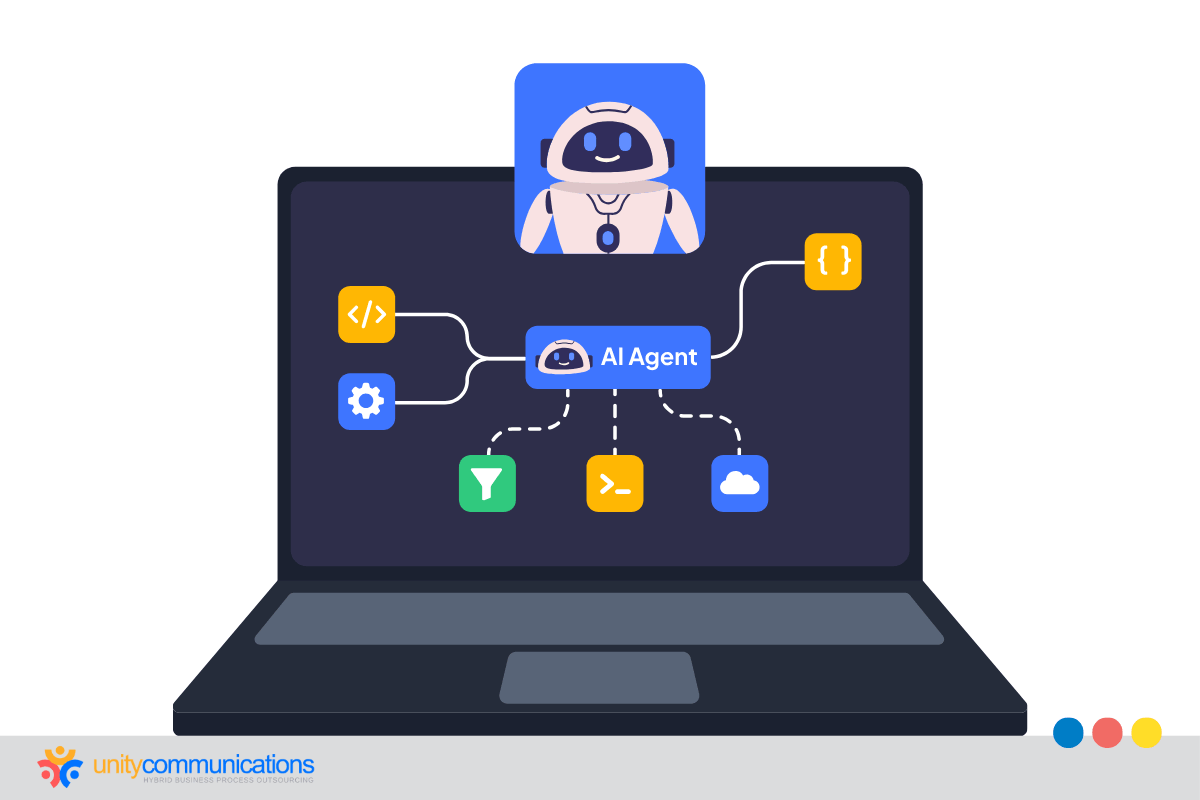
AI changes BPO delivery by automating repetitive tasks, guiding human decisions, and shifting focus to measurable outcomes.
Three approaches define modern AI BPO services:
Automation of repetitive tasks
Automation handles the rules-based volume, such as invoice data entry, document sorting, and standard email replies. It runs the same steps every time, which raises speed and consistency. This is BPO automation at its most direct, removing manual repetition from high-volume, low-judgment work.
AI-assisted human workflows
Here, AI supports the person doing the work instead of replacing them. An agent handling a support ticket gets a drafted reply and a case summary pulled from prior interactions before responding. eGain reports that one telecommunications client cut inbound call volume by 70% and reduced case handling time by 25% after adding AI-guided knowledge tools.
Outcome-based delivery
This model ties AI to a tracked result, not headcount. A provider follows the first contact resolution rate or error rate per batch. Automation and human review work toward that number, tied to the outcome rather than hours logged.
A claims team shows this in practice. Automation sorts incoming documents by claim type. AI-assisted review flags amount mismatches for a person to check. The tracked result is turnaround time in hours, not staff count. This shows outcome-based BPO pricing applied to delivery and explains why AI-driven BPO now outranks headcount as the real measure of performance.
Why is outcome-based pricing changing BPO expectations?
Outcome-based pricing is changing expectations because AI helps providers achieve measurable results without relying on labor hours.
Pricing in outsourcing ran on two models for years:
- Headcount pricing. A bigger team meant a bigger invoice, whether the work moved on schedule or not.
- Activity-based pricing. BPO teams tracked cost to completed tasks, whether or not those tasks solved the client’s problem.
Both models charged for effort, but AI is changing the math.
A provider can now handle volume that once needed additional staff. Then it points to accuracy, speed, or consistency as proof of value instead of hours worked. Outcome-based BPO pricing grew out of that shift, as cost tracks to the result that a client actually wants.
Buyer expectations moved with it as well. A client now asks what a provider delivers, not how many people staff the account. A provider that promises a resolution rate or an accuracy threshold has to hit it, and that holds regardless of team size or the tools used.
This model does not replace every contract. Many providers still blend outcome-based terms with seat-based or hour-based pricing, depending on the process involved. For processes with a clear, measurable result, outcome-based pricing rewards performance directly.
Take a data entry account as an example. A provider priced on record accuracy gets paid for clean, error-free output rather than for hours logged at a desk. AI-enabled BPO makes that kind of pricing viable at scale. Automation absorbs the volume, and staff focus on the exceptions that need judgment.
What does a human-AI operating model look like?

A human-AI operating model splits BPO work. AI takes on the repetitive tasks, while people stay responsible for quality, exceptions, and outcomes.
In a human and AI BPO model, AI does not run the account on its own. Instead, it works inside a structure built around specific roles.
- AI processes high-volume, repetitive work such as data entry, routing, and standard responses. It also flags anything outside its rules.
- Frontline employees handle flagged cases, talk with customers, and apply judgment that AI cannot replicate.
- Supervisors review flagged work and coach agents. They also ensure AI output remains accurate.
- Operational leaders set policies, own compliance, and answer for results on the account.
Work moves through this structure in a consequential order. AI completes a task first, then routes anything unusual to a person. Supervisors review patterns in that flagged work, so problems get caught before they repeat or spread. Leaders track the system and adjust it as volume or risk changes.
You can already see this setup taking shape across contact centers. Recent research puts AI adoption at 88%, and 76% of leaders have already paired AI routing with human handling for complex or high-stakes calls, the same split this operating model relies on.
As an AI-enabled BPO provider, Unity Communications also follows the hybrid model. AI agents can take the routine volume, call routing, and appointment scheduling. Trained specialists step in for anything that needs judgment, tone, or a frustrated customer talked down. Both sides stay reviewed against real conversations. To learn more about our processes, read “BPO in Artificial Intelligence Ethics Oversight: AI Practice.”
How can you tell if a BPO is truly AI-enabled?
You confirm a BPO is AI-enabled by checking how it redesigns workflows and owns outcomes, not by the AI tools it names on its website.
Software alone will not tell you much. A provider can license the same AI tools and still run the account the same way as before. What separates a genuine AI-enabled BPO from a label is how deeply the change permeates daily work.
A short AI BPO evaluation gives you that picture. Look for these signs during research, before contract talks start:
- Workflow redesign. Steps change around AI, not AI bolted onto old steps.
- Transparency. The provider explains how AI supports specific tasks.
- Measurable outcomes. Results tie to accuracy or turnaround, not tools alone.
- Human accountability. Named people own quality and exceptions rather than software.
- Governance. Rules determine how AI output is checked and corrected.
- Continuous improvement. The process gets refined against real performance data.
For a closer look at what that looks like in practice, read “Ethical AI in Outsourcing: Fair, Transparent Practices.” It gives you a factual basis for comparing providers before you commit.
What are the warning signs of AI washing in BPO?
The clearest signs of AI washing include vague AI claims, AI limited to one tool, no measurable outcomes, and unchanged headcount pricing.
In AI washing, a BPO provider markets itself as AI-enabled while the real delivery model behind that claim stays unchanged. In other words, AI-enabled BPO gets used, but nothing behind it moves.
Watch for these red flags before you trust the label:
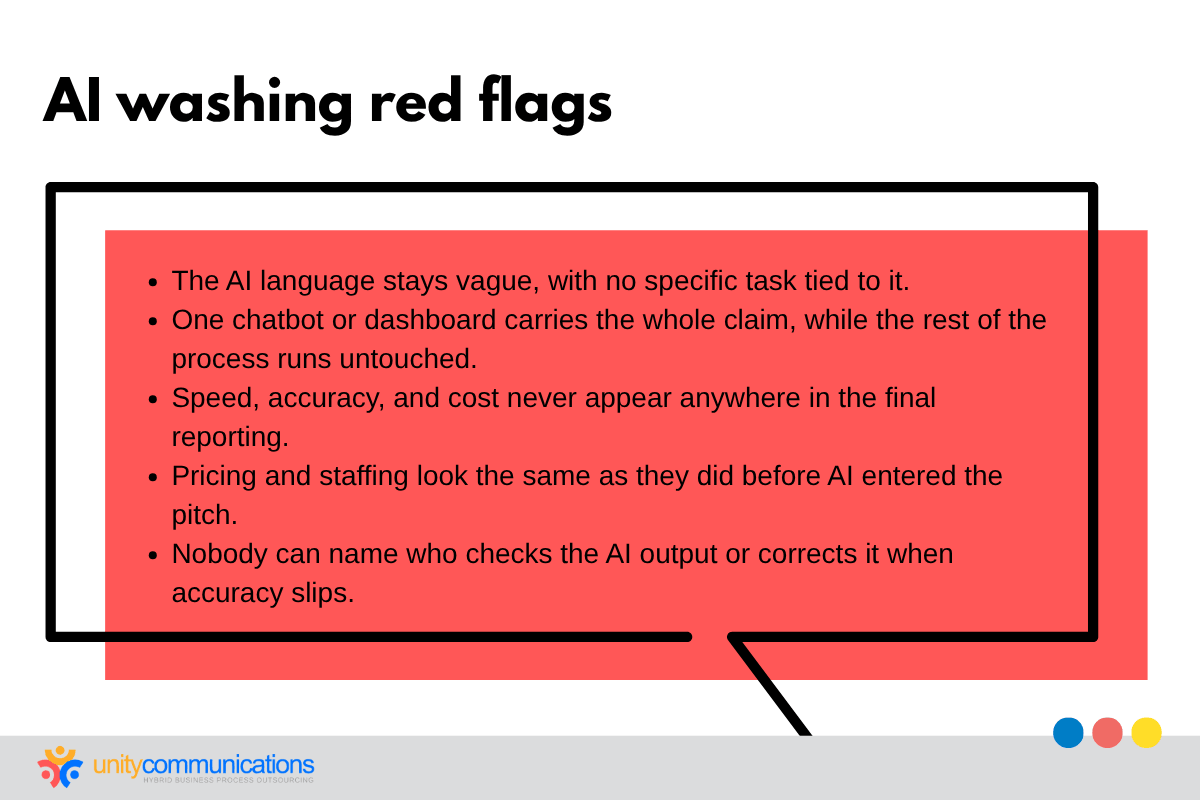
When evaluating an AI-enabled BPO company, ask for evidence of business results.
Which questions should you ask before choosing a provider?
Before you choose a provider, ask how AI gets integrated, overseen, governed, secured, measured, and owned across the account.
A good question pushes a provider to explain their process rather than just naming AI tools. The answers can uncover whether an AI outsourcing partner changes how work gets done.
Provider questions to ask
- Where does AI enter this account, and what does it touch first?
- Who owns the workflow once AI hands off a task to a person?
- Who reviews AI output before it reaches a customer?
- What rules keep AI decisions within security and compliance limits?
- What gets measured and reported, and who sees that report?
- How does the process change once data shows a problem?
- If something breaks, who owns the fix?
A strong answer to one question does not confirm the rest. What matters is whether the provider can walk through a real process behind every question on this list. A genuine AI-enabled BPO holds up under that full scrutiny.
What does moving to AI-driven outsourcing actually involve?
An AI-enabled BPO shift reaches into process design, staffing, and oversight. A software install alone does not get you there.
The move follows a rough sequence:
- Process discovery and onboarding precede workflow redesign.
- A provider studies your process, then tests where AI fits and where a person stays in the loop.
- A pilot runs on a small slice of work before anything scales to the full account, with optimization continuing afterward.
Both sides carry weight here. Your team documents the real process details and remains available during the pilot review. The provider builds the workflow, trains staff on new steps, and establishes governance for how AI output is checked over time.
Employee adoption decides more than the AI itself. Staff need training on new roles and the judgment those roles require. This prevents people from working around the new process.
During this period, pay attention to possible failure points. For example, teams might expect results before processes get documented, or stakeholders might stay uninvolved past kickoff. Governance can also weaken, while human review gets skipped once volume grows. Each gap shows up later as added rework or lost trust.
This kind of transition takes several months. For a closer look at what this shift requires across the industry, see “AI in BPO: Opportunities and Challenges for Business Process.”
How can AI-driven BPO support long-term business growth?
Combining automation, human oversight, and process improvement allows AI-driven BPO to support your business in the long term.
A process running faster this quarter does not mean much on its own. New volume, new regulations, or a new market next year can break that same process. Growth that lasts needs a workflow that can absorb this kind of change without falling apart.
Organizational learning drives long-term outcomes in this shift. Providers that track performance data and adjust workflows sustain results longer.
Durable results depend on three elements working together:
- Automation
- Human oversight
- Governance
Automation without human review misses context. Human oversight without governance drifts as an account grows. Each element depends on the other two.
Consider a support operation expanding from one market to three. Automation absorbs the added ticket volume, while staff manage the cultural and language differences that a rulebook cannot address. Governance maintains consistent quality across all three markets. This combination turns short-term efficiency gains into lasting operational strength.
Why does operational accountability matter for MSPs?
Operational accountability matters for MSPs because AI creates business value when people own governance, oversight, and results behind it.
AI does not replace human accountability. Someone needs to own quality, catch exceptions, and answer for results as workflows shift more weight onto automation than before.
That means real governance and transparent reporting. Governance means little without escalation paths, security controls, compliance checks, and ownership.
Unity Communications pairs AI-enabled workflows with experienced teams and physical infrastructure in the Philippines and Mexico. Staff review flagged work, own compliance, and stay accountable for results.
MSPs comparing outsourcing options should weigh accountability the same way they evaluate the underlying technology. A provider unable to name who owns each outcome is running plain automation and calling it AI-enabled BPO.