


AI agents in 2026 changed how business process outsourcing (BPO) leaders staff, price, and govern delivery. Pilots from 2025 turned into daily production work this year. Agents now handle live client workflows alongside human teams, and outsourcing partners are accountable for the results.
This article outlines five trends shaping AI agent solutions today, such as production-scale deployment, hybrid staffing, outcome-based pricing, tighter governance, and expanded back-office use.
Each section covers what changed, how it affects your operation, and what to do next. Read on to see where your outsourcing partner stands and what to ask before you scale.
What changed in AI agent deployment maturity from 2025 to 2026?
AI agents support daily BPO operations in real client accounts this year. They have moved from limited pilot programs used in 2025.
That shift now matters more than any capability upgrade. AI agents 2026 planning involves scale, oversight, and workforce fit as businesses shift from agent testing.
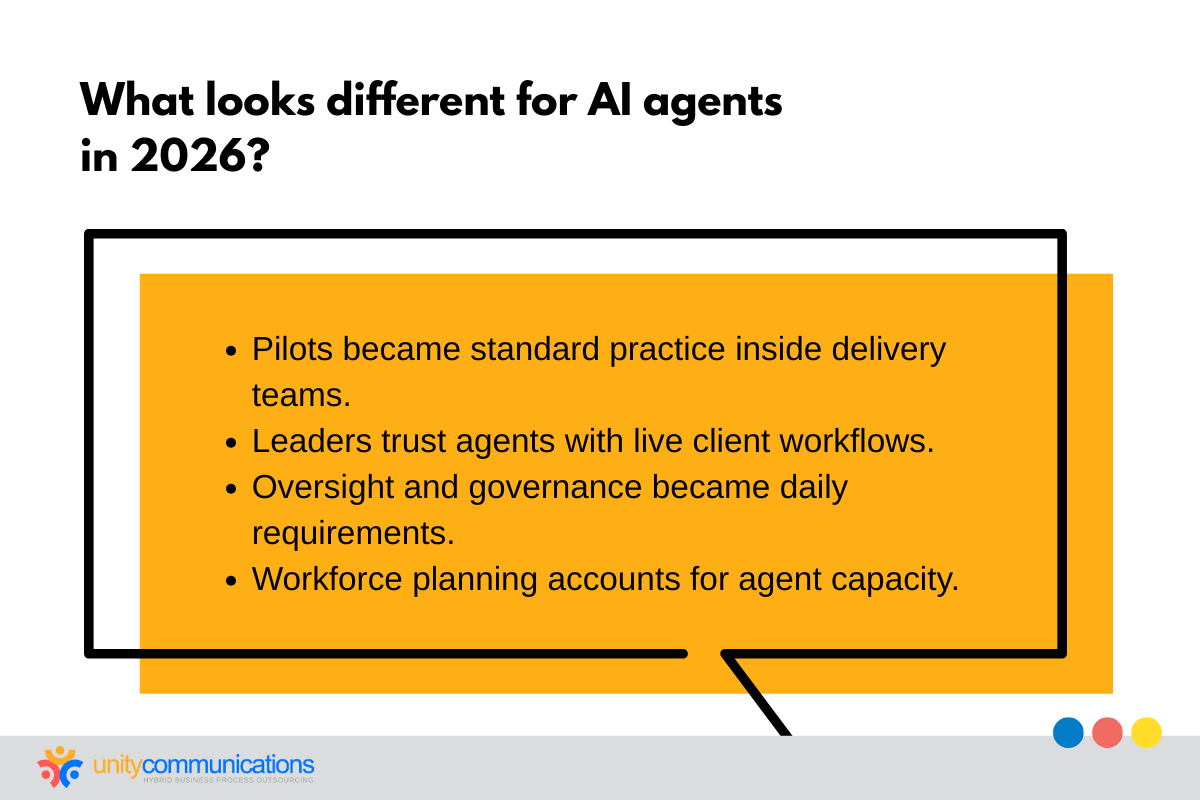
According to Stanford’s AI Index Report 2026, 88% of organizations used AI in 2025, up from 78% in 2024. This wider use of AI gives companies a stronger base for adding agents to existing workflows. For more background on the technology itself, read AI agents explained: What is an AI agent and why it matters for business leaders.
For BPO teams, AI agents for BPO in 2026 mean measurable delivery capacity you can plan around, and that shift sets up five trends worth watching.
5 AI agents 2026 trends to watch
AI agents in 2026 influence core parts of BPO delivery. Production deployment, staffing models, pricing structures, governance requirements, and back-office scope all shifted this year. Leaders now manage change across contracts, teams, and client expectations simultaneously.
The five trends below break down what changed and how to respond.
1. Multi-agent systems move from pilots to BPO production
Multi-agent systems now run live client workflows inside BPO delivery teams in 2026, moving past the isolated pilots that defined agent use in 2025.
Operational implication: For multi-agent systems BPO deployment, leaders assign one agent to intake and another to verification. A third agent handles reporting inside the same claims process. Delivery teams must define handoff rules and escalation paths before agents touch live accounts.
Deloitte found that 26% of organizations were already exploring autonomous agent development at scale in late 2024, with 42% doing so to a lesser degree. That early momentum has since carried into live BPO deployments this year.
This shift pushes BPO leaders to audit where agents already handle live workflows and spot oversight gaps. Our guide to 7 types of AI agents transforming business outsourcing in 2026 explains which categories fit each function.
2. Human-agent hybrid staffing replaces FTE-based planning
Full-time headcount drove staffing plans in 2025. This year, teams pair AI agents with people who handle reviews and exceptions.
Operational implication: AI agent workforce integration starts by assigning work. Leaders decide where agents fit and where people add expertise. Then they build supervision roles, escalation paths, and performance metrics around hybrid output.
A human-agent hybrid model changes workforce planning in several ways:
- Job roles shift toward oversight, coaching, and exception handling.
- Managers take on new duties supervising agent output and quality.
- Performance metrics track blended team results, not headcount alone.
- Hiring plans account for agent capacity alongside people.
Delivery leaders who redesign roles around this change build teams that scale service delivery without adding headcount for every new account. Quality remains steady as agent capacity grows this year.
BPO provider Unity Communications applies this same hybrid approach in outsourcing accounts, pairing agents with delivery teams to keep oversight as capacity grows.
3. Client demand moves toward agent-augmented SLAs and outcome pricing
Clients benchmarked BPO providers by staffing levels and response times in 2025. Now they expect agent-driven delivery and measurable outcomes.
Operational implication: Agent-augmented service performance becomes the basis for SLA discussions, rather than headcount alone. Pricing models tie fees to business outcomes, response speed, quality, and consistency. BPO leaders need transparent reporting to show clients how agents contribute to results without overselling automation’s role.
| Category | Traditional Delivery | Agent-Augmented Delivery |
| Service expectations | Fixed scope | Proactive, consistent results |
| Staffing model | Headcount-driven | Human-agent hybrid |
| SLAs | Time and volume-based | Outcome and quality-based |
| Pricing approach | Per-seat or per-hour | Outcome-based pricing |
| Performance metrics | Volume, uptime | Accuracy, business impact |
| Client value | Cost predictability | Measurable outcomes |
BPO leaders who redesign SLAs and pricing around agent-augmented delivery meet these expectations without adding headcount. Clients gain clear visibility into how agents drive results. That clarity builds trust and gives providers room to price for value instead of hours worked.
4. Governance and oversight become competitive differentiators
BPO providers treated governance as a compliance checkbox in 2025. Now it wins new clients and keeps existing accounts renewing in 2026.
Operational implication: Leaders now track hallucination rates, escalation speed, and audit trails before agents touch live accounts. AI agent governance 2026 planning turns these checks into standard practice for every workflow that agents support.
Governance work this year covers four recurring risks:
- Hallucinations. Verify AI agent outputs against source data before delivery.
- Cascading failures. Set kill switches to stop errors from spreading between agents.
- Oversight gaps. Assign named owners to each agent handling live accounts.
- Inconsistent decisions. Run regular quality audits against defined accuracy thresholds.
Strong governance turns into a trust signal for clients evaluating providers this year. BPO leaders who treat oversight as a daily discipline protect service quality and give clients proof that agents operate within clear limits. That proof wins renewals and expands scope on existing accounts.
5. Agentic AI expands into complex outsourced back-office work
Finance reconciliations, claims reviews, and compliance checks joined routine paperwork as agentic AI took on broader operational work in 2026.
Operational implication: Teams shift procurement workflows and document review to agentic AI business operations. People focus on exception approvals, result validation, and client-facing decisions with legal or financial impact.
Better reasoning and system integration enable agentic systems to handle data-heavy processes without close supervision. AI agents 2026 deployments cover procurement support, records management, and claims processing, which are functions that sat outside automated systems only two years ago. Leaders can now measure through faster turnaround and fewer manual reviews.
Ongoing agentic support also replaces slower one-time data entry outsourcing projects.
To leverage this trend, leaders should map which back-office functions carry the least risk and test agentic AI in those areas first. People stay accountable for exceptions and client decisions.
How BPO leaders prepare for AI agent adoption

Expanding AI agents in 2026 begins with readiness. Workforce capability, delivery alignment, technology readiness, operational processes, and governance deserve review. The same goes for client expectations, performance measurement, and risk management. AI agent trends 2026 reward firms that strengthen operating discipline before expanding deployment.
Use this readiness checklist:
- Have governance owners and review routines been assigned?
- Do pilot processes balance business value with operational risk?
- Can delivery teams support hybrid operations and shared accountability?
- Do performance measures reflect client outcomes and operating capability?
- Are client reporting expectations documented before expansion?
- Is the workflow assigned clear ownership for escalation before agents support live client operations at scale?
Use checklist answers to rank priorities and address capability gaps before expansion. Compare current practices with business goals and client commitments. Our article “AI in BPO: opportunities and challenges for business process” provides useful context when reviewing readiness and planning practical next steps.
Teams that strengthen operating capabilities before wider adoption adapt with fewer disruptions. They can support responsible growth and expand deployment where measurable business results justify continued investment.
How Unity balances agentic AI with human oversight
Unity integrates agentic AI in outsourcing into established BPO operations through defined processes, skilled delivery teams, quality assurance, and clear escalation paths. This approach supports reliable service while people remain accountable for client decisions and business outcomes.
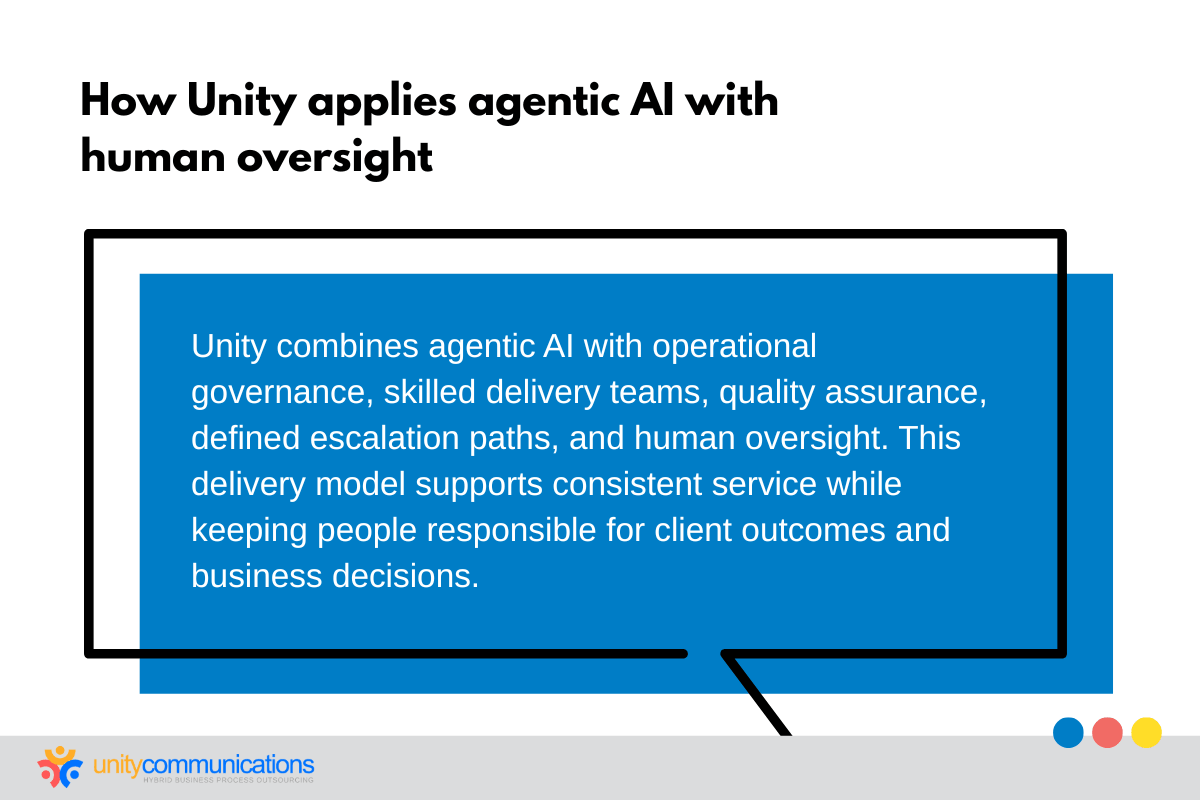
This operating approach supports AI agents outsourcing delivery through disciplined processes, while experienced specialists oversee exceptions, review outputs, maintain accountability, and make business-critical decisions.
For a fuller picture of responsible AI adoption in day-to-day operations, see the evolving AI role in outsourced operations: A strategic guide for modern BPO leaders. That balance reflects the operational maturity many organizations expect as agentic AI becomes part of everyday service delivery.