


Cost, control, and accountability sit at the center of two BPO models: managed services and staff augmentation. Your workload needs BPO services built to fit it. But it also needs a provider whose risk tolerance and AI-enabled delivery match your own.
The managed services vs staff augmentation decision carries real financial weight. The fine print determines what lands on your invoice.
To help you, this guide compares both models side by side. It walks through real scenarios and lays out an ROI framework designed to help you settle this decision for your business.
What is the core difference between these outsourcing models?
Managed services shift full operational ownership to your provider. Staff augmentation adds people you manage inside your own team.
This split shapes who carries the day-to-day load. With managed services, the provider owns delivery, service levels, and results against a signed business process outsourcing agreement. Your team steps back from execution and shifts its attention to strategy, growth, and higher-value priorities.
Staff augmentation works another way. The provider supplies skilled professionals, from developers to support staff, but your business still runs the day. You assign tasks, set priorities, and answer for whatever the work produces.
The managed services vs staff augmentation choice comes down to how much oversight you want to keep and how much risk you want to hand off. One model transfers accountability for results and the risk. The other keeps that weight with you while adding trained specialists to your team.
Framed as managed services vs outsourcing, the real question is what you need the provider to own. Some businesses want a partner who runs the work end-to-end, the way a company hands off its entire help desk operation. Others just need added staff who still take your direction and review.
Making this call starts with clarity about where responsibility lies within your operation. For a breakdown of how these models diverge from broader BPO structures, read “Staff Augmentation vs BPO: Key Differences Explained.”
How does managed services vs staff augmentation compare?

Managed services and staff augmentation vary in cost, control, accountability, and risk. That split determines which model best fits your operation.
While both models promise skilled talent, the ownership behind that talent points in opposite directions. One model transfers outcomes to a provider that owns the work end-to-end. The other keeps outcomes with your team while adding trained hands.
| Comparison Factor | Managed Services | Staff Augmentation |
| Cost structure | Fixed, predictable | Variable, hourly |
| Management responsibility | Provider-led | Client-led |
| Accountability | Provider owns outcomes | Client owns outcomes |
| Control | Lower | Full |
| Scalability | Provider capacity | Added headcount |
| Time to value | Slower ramp-up | Faster start |
| Risk distribution | Shared | Mostly client |
| Governance | Contract-driven | Managed in-house |
| Pricing approach | Outcome-based | Per-resource |
| ROI potential | Ongoing operations | Short-term needs |
The managed services vs staff augmentation comparison shows a clear split. Managed services trade day-to-day control for predictability, shared risk, and a provider that answers for results. Direct oversight and faster access to specialized skills come with staff augmentation, in exchange for predictability.
Before you commit to either model, ask a few questions first.
- Who owns accountability?
- How does pricing work?
- How fast does it scale?
- How much governance and risk stays with your team versus the provider?
None of these factors points to one model as the automatic choice. A provider strong on governance might fall short on scalability, and a staffing partner fast to onboard might leave your team holding more risk than expected.
What does the managed services model look like in practice?
Managed services shift operational delivery to the provider, leaving your team focused on strategy rather than routine execution.
What managed services is comes down to a signed agreement in which the provider commits to measurable outcomes, not just hours worked. Take a mid-size company with an internal support desk. Under managed services, the provider owns ticket resolution, system uptime, and response times.
Once the contract begins, each side has a defined role. The provider supplies the team, manages the workflow, hires and trains its staff, and reports against the agreed service levels. Your team sets the business goals and reviews performance against the agreement, rather than managing the routine grind, hour by hour.
You can expect these elements in a managed services agreement:
- An SLA defining response times and uptime targets
- Governance meetings that track performance against agreed goals
- Regular reporting on outcomes and business results, not just hours logged
- Continuous process improvement built into the contract terms
- Fixed pricing tied to agreed outcomes rather than headcount
- Written operating procedures keep service delivery consistent during staffing changes.
- Documented escalation procedures covering service issues and those requiring client approval decisions
Payroll, IT support, and compliance fit this managed services vs staff augmentation model because business results matter more than direct supervision of the delivery team. Growing companies lean on this model once internal management bandwidth runs thin.
How does staff augmentation work in real-world operations?

Staff augmentation adds external professionals to your existing team while your business keeps full responsibility for daily management and delivery.
Understanding what staff augmentation services is in practice starts with onboarding. You select a professional, set them up in your systems, and assign work within days. They use your tools, follow your workflows, and join your daily standups. The client retains full control over every management decision from start to finish. Reporting stays direct and simple.
External hires report to your managers, not to a separate account management team. This is the core contrast in managed services vs staff augmentation: Under managed services, a provider directs the work. Your augmented professional works inside your ticketing system, follows your escalation process, and reports to your internal lead for every task and deadline.
Staff augmentation works when your staffing needs change faster than permanent hiring can:
- Scale headcount up or down as project needs change.
- Pay for hours worked instead of a fixed salary.
- Bring in specialized skills for a single project.
- Keep quality control and final decisions in-house.
- Add or remove staff without renegotiating a contract.
Say you need a database specialist for a six-month migration. You bring in an augmented professional who plugs into your project team, follows your standards, and hands off documentation when the project ends. You keep the knowledge, and staffing stays flexible for the next project ahead.
How do control and accountability affect business outcomes?
Control and accountability shape business outcomes by determining who directs daily work and who owns final delivery results and performance.
Control means who tells the team what to do each day. Accountability means who answers for the outcome once the work is delivered. In a managed services model vs staff augmentation setup, this line shifts based on who signs off on quality and deadlines.
Here is how each model splits these responsibilities:
- Decision rights. Staff augmentation keeps decisions with your managers, while managed services shifts most decisions to the provider.
- Execution ownership: The provider owns execution and outcomes under managed services, while your team owns execution under staff augmentation.
- Escalation path. Managed service providers route problems through their chain, while staff augmentation routes them through your internal chain.
- Performance ownership. A managed services vs staff augmentation choice decides who answers for missed targets, SLA breaches, or quality gaps.
These splits carry weight beyond daily operations. The SLA and contract specify who responds when service failures occur. If the provider owns accountability, responsibility shifts with it. Keeping control means leaving reporting, oversight, and those obligations to your team.
Responsibility affects more than daily operations. It touches staffing, escalation, and governance inside your business. Those decisions also influence operating costs and long-term returns when comparing both outsourcing models.
How should you measure ROI across both models?
Measure ROI by weighing total cost of ownership, not contract price, against productivity, delivery quality, and long-term business value.
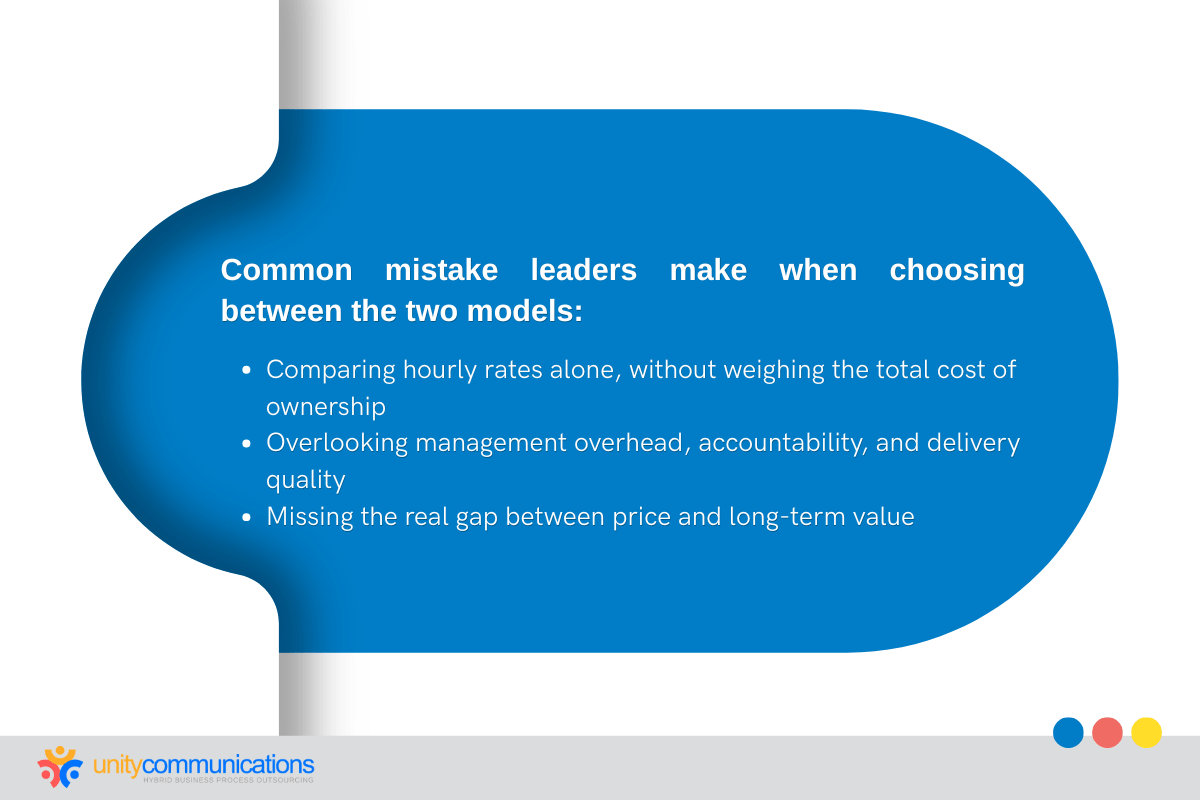
Price per hour tells you almost nothing on its own. A managed services vs staff augmentation decision based solely on hourly rates misses management time, onboarding delays, and the cost of fixing mistakes down the road.
Total cost of ownership analysis is where you start. Add contract price to internal management hours, recruiting costs, onboarding time, and any tools or training needed to get someone productive. This gives you a real starting point for an outsourcing model comparison.
Also account for productivity ramp-up. A new hire or vendor team needs weeks or months to reach full speed. A cheaper option that takes twice as long to reach full productivity can cost you more by the time the work is delivered.
Use this table to track ROI factors.
| ROI Factor | What to Track |
| Total cost of ownership | Contract price, management hours, recruiting, onboarding, and tools |
| Time to productivity | Weeks or months until output hits full speed |
| Delivery quality | Rework rate, error frequency, and client escalations |
| Turnover impact | Replacement frequency, reset onboarding cost |
| Hidden costs | Licensing, training, and transition time between providers |
Delivery quality and turnover factor into your total return as much as the invoice does. Rework from missed quality standards eats into savings fast, and turnover on either side resets your ramp-up clock. Track these factors together, and the real return on either model gets much easier to see. Unity Communications ties its managed services pricing to these same outcomes, not hours logged.
When do managed services deliver better ROI?

Managed services make stronger financial sense for long-term operations with heavy compliance demands and limited management capacity.
Certain business conditions favor this model over direct staffing:
- Recurring business functions with consistent workloads, including IT support and back-office processing
- Regulated work with audit trails, certifications, and reporting requirements tied to financial risk
- Standardized processes that follow the same steps regardless of who performs the task
- Limited internal management capacity, where your team has no bandwidth to supervise daily execution
Take a healthcare billing department running claims processing every month. Volume stays steady, rules change often, and errors trigger penalties. A provider that owns the outcome, not just the labor, absorbs that compliance risk and keeps the process running on schedule.
Predictable costs play a role in this managed services ROI picture too. A fixed monthly fee replaces the swings that come with hiring, replacing, and retraining internal staff. Budgeting becomes simpler when the provider bears the cost of turnover on their side.
Outcome-based delivery changes the incentive structure. The provider gets paid for results, not hours logged, so fixing problems fast becomes their job. This shifts risk away from your internal team and onto a party bound by contract to hit the standard.
Managed services do not win every case. When work varies week to week or needs specialized skills for a single project, a managed services vs staff augmentation decision points elsewhere. But steady, rule-bound operations deliver compounding returns.
When do staff augmentation benefits outweigh managed services?
Specialized skills, temporary capacity, and direct operational control make staff augmentation the stronger choice over managed services.
Specific business conditions point toward this model:
- Temporary capacity gaps, such as a busy season or a workload spike
- Specialized expertise for one project, such as a cloud migration
- Projects expected to finish after a defined period of work
- Fast-changing priorities that need weekly staffing adjustments
- Strong internal management already in place to direct day-to-day work
One project shows how those conditions apply. A software company needs a mobile developer for a four-month product release. A permanent hire adds little value after the release moves into maintenance. Staff augmentation adds the required expertise, and your team controls the code and project schedule.
Your managers already know the standards and priorities, so adding a professional under that structure skips the ramp-up a new vendor relationship requires. Staff augmentation benefits include filling a skills gap in days instead of weeks.
Finding specialized talent through external hiring has become part of workforce planning for many businesses. Deloitte’s 2025 Smart Manufacturing Survey found that 40% of manufacturers use contract or contingent labor to supplement capabilities in the near term. That confirms exactly where staff augmentation earns its keep: short-term, specialized needs, not permanent headcount.
Read “Benefits of Staff Augmentation in BPO: Key Advantages” for more on where this model delivers its strongest return. In the managed services vs staff augmentation comparison, speed and skill decide the winner here, not long-term ownership.
What has changed in 2026 for both outsourcing models?

Managed services and staff augmentation look different in 2026 due to AI-enabled delivery, hybrid work, and higher client expectations.
In particular:
- AI-assisted workflows cover routine work under both models, leaving people to manage exceptions, reviews, and escalations.
- Distributed and hybrid teams have become standard for both delivery structures.
- Buyers evaluate providers on measurable outcomes and governance, not headcount alone.
This changes how the decision to go with managed services vs. staff augmentation is made. Buyers now award contracts to providers with proven productivity, sound governance, and measurable delivery quality rather than to the lowest hourly bidder.
Market spending backs this shift. Business Research Insights values the combined global IT staff augmentation and managed services market at $439.49 billion in 2026, projected to reach $1.58 trillion by 2035. Organizations continue choosing both outsourcing models for different operational needs.
Enterprise buying patterns confirm it, too. DATAINTELO reports that over 72% of large enterprises plan to maintain or grow their managed services footprint within the next 24 months. About 61% of mid-market firms lean on IT staff augmentation 2026 trends to fill cloud architecture, data science, and cybersecurity roles.
Can you combine managed services and staff augmentation?
Yes, many businesses run both models together to balance provider accountability with flexible access to specialized talent and operational control.
A hybrid setup divides work by function. The provider offers ongoing services, such as help desk support, under a managed contract. Meanwhile, augmented staff join your internal team for a specific project that needs additional hands and direct oversight.
This split works well in a few common scenarios:
- Running core operations under a managed contract while adding project staff for a one-time initiative
- Keeping compliance-heavy functions with a provider while your team handles fast-moving internal projects
- Using augmented staff to build a new capability, then shifting it to managed delivery once it stabilizes
Governance becomes more complex when two structures run side by side. Your team needs clear lines on which SLA covers which function, and who signs off when a task spans both groups. For a deeper look and decision-making tips, read our comparative analysis of BPO service delivery models for peak efficiency.
Done right, a hybrid model gives you provider accountability where it matters and direct control where you need speed. For more on structuring this approach, see “The Power of Hybrid Models: Transforming BPO with Staff Augmentation.”
How should you evaluate providers before making a decision?
Evaluate providers by checking governance, security, and expertise. Look next at transparency, scalability, and their record on outcomes.
Score potential partners against a short list:
- Industry expertise and delivery history
- Governance, SLAs, and reporting structure
- Security and compliance, plus business continuity
- Pricing transparency and transition planning
- AI capabilities and customer references
Security and operational readiness deserve close attention here. The Linux Foundation’s 2026 State of Tech Talent Report found that 57% of organizations report a capacity gap in AI security and risk management. Providers that already have strong governance and technical expertise stand out precisely because most of the industry still has this gap.
A few questions deserve answers before you sign:
- How do you measure outcomes?
- What happens if service levels slip?
- How do you handle a security incident?
A managed services vs staff augmentation evaluation shifts focus. Weigh providers on outcome delivery, and weigh staffing firms on talent depth and speed to onboard.
Which model fits your business today?
The right outsourcing model depends on your goals and management capacity. Compliance needs and expected business outcomes matter too.
A decision framework starts with a few honest questions. Look at your operation, your workload, and the oversight your team can carry into the coming year.
- Stable, compliance-heavy workloads with limited management capacity favor managed services in regulated functions such as payroll or claims processing.
- Short-term, specialized, or fast-changing needs favor staff augmentation for single-project technical work.
- Budget predictability, growth stage, and desired control determine which model fits your operation best right now.
Neither model wins outright. Choosing an outsourcing model depends on your operational maturity, workload stability, and long-term business objectives, which might differ by company and department.
Businesses prioritizing outcome-based delivery, accountability, and predictable costs tend to lean toward managed services, the model Unity Communications built its practice around. Those needing fast, flexible headcount tend to lean toward staff augmentation.
Staff augmentation still wins for temporary expertise and fast capacity expansion. It also wins when you need direct day-to-day control over the work. The right choice between managed services and staff augmentation depends on what your operation needs right now, not whatever sounds stronger in a pitch.