

KEY TAKEAWAYS
- It would help if this part doesn’t change much, like just in one line. Because it is confusing. Can I remove one or two bullet points here.
- Cost savings are important, but efficiency and scalability deliver real BPO value.
- Well-defined processes are essential for successful outsourcing outcomes.
- Technology-driven BPO improves accuracy, speed, and consistency.
- djskadjalkdasjdlkasjdkasjdaslkdj
What Is Business Process Outsourcing?
Business process outsourcing is entrusting some of your company’s business operations to an external vendor. You hire a third-party service provider to handle certain business processes, functions, or tasks.
Some people immediately equate BPO to call centers. But BPO – while it includes call centers – encompasses many additional operations.
BPO covers two primary business functions: front office and back office. The front office works directly with customers – a call center is one type of front office operation. On the other hand, the back office provides support services & performs administrative tasks. A BPO can provide back-office support to companies too.
A Brief BPO History
Outsourcing started between the 19th and 20th centuries. Businesses use other companies’ human resources and machinery to ensure continuous operations. Outsourcing then became a primary component of the manufacturing industry in the 1950s. However, key players in the industry coined “outsourcing” only in 1981.
Outsourcing quickly became a growing business strategy in the late 1980s and a crucial part of the global economy in the 1990s. Soon the BPO sector expanded worldwide. BPO companies started offering onshore, offshore, and nearshore services.
Today, the BPO industry has grown by leaps and bounds with no signs of stopping or slowing down. The global BPO market was worth nearly $246 billion in 2021 and could hit $525.2 billion by 2030.
How BPO Works & Why Companies Outsource
For a more in-depth understanding of BPO, look into how outsourcing works. Find out why some companies outsource.

Understanding BPO Processes
How does a company determine its need to use BPO processes? You need to assess and identify business functions to outsource. From there, hire a BPO company to match your needs and let it run some parts of your operation.
Still, BPO, for long-term planning and implementation, requires deliberate action and sound business decisions to be effective.
The steps involved in outsourcing are:
- Identifying business problems
- Determining business functions to outsource
- Setting BPO goals and objectives
- Looking for a BPO service provider
- Screening BPO prospects (based on credentials, resources, reputation, & pricing)
- Hiring a BPO company
- Setting a service-level contract agreement
- Starting BPO operations and executing business strategies
- Monitoring outsourcing progress and development.
Exploring BPO Statistics
Generally, companies outsource to reduce operating costs. However, some companies outsource for other reasons. Below are some BPO industry statistics that can help you make informed decisions.
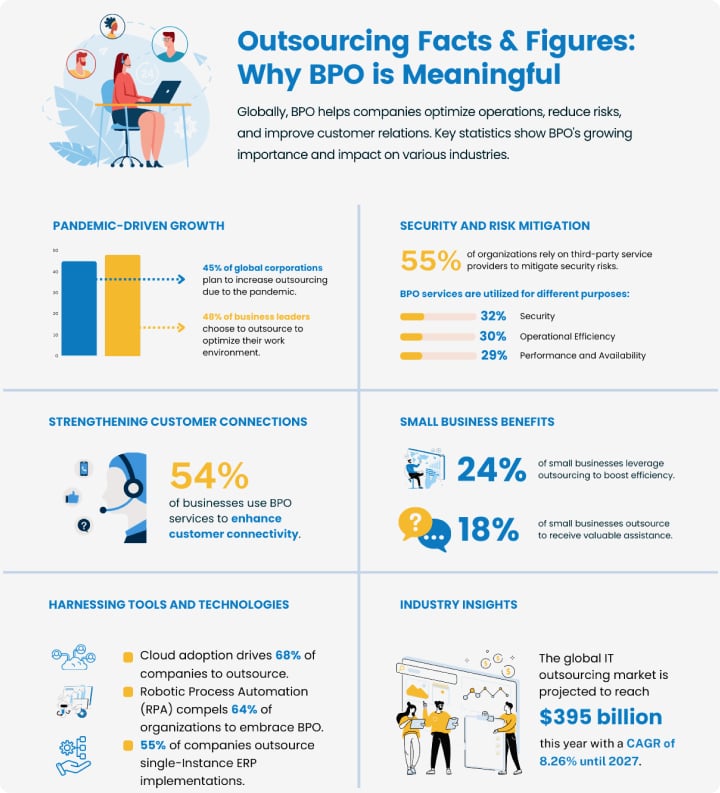
- 45% of global corporations plan to outsource more work due to the pandemic.(NTT)
- 48% of business leaders acknowledge the need to optimize their work environment and choose to outsource. (NTT)
- 55% of organizations rely on third-party service providers to reduce security risks. (NTT)
- 32% of organizations use BPO services to boost security, while 30% do so to improve operational efficiency and 29% to increase performance and availability. (NTT)
- 54% of businesses use BPO services to connect with customers. (Fortunly)
- 24% of small businesses outsource to boost efficiency, and 18% do so to receive assistance. (Clutch)
- Companies outsource to leverage tools and technologies: 68% for cloud, 64% for robotic process automation (RPA), and 55% for single-instance ERP. (Findstack)

General Types of BPO Services
BPO services have four types. Let’s take a brief look at them.
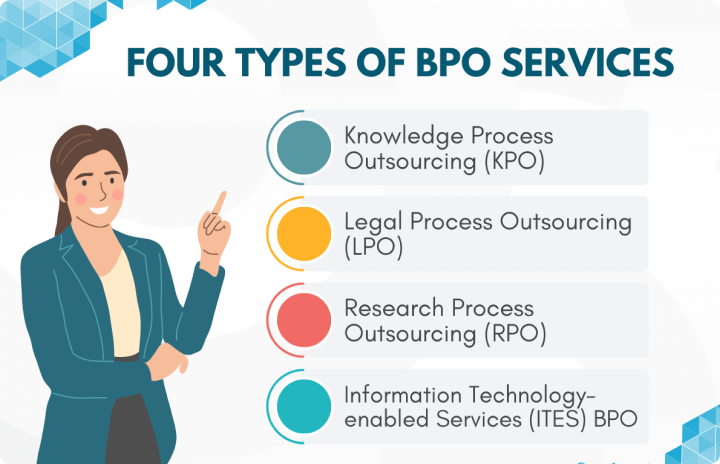
- Knowledge Process Outsourcing (KPO). This BPO service entails providing expertise and leveraging industry knowledge. A BPO company with a team of experts can help scale and grow your business.
- Legal Process Outsourcing (LPO). This service involves outsourcing legal-related matters, including business licensing, contract writing, & legal research and advice. The BPO firm specialists have law-related educational backgrounds, expertise, & specializations
- Research Process Outsourcing (RPO). This service is about research and development (R&D) and applies to biotechnology, financial investment, and digital marketing. Experts will handle your research and analysis to ensure accuracy.
- Information Technology-enabled Services (ITES) BPO. This service centers on IT support functions, covering network management, software updates, hardware installation, troubleshooting, help desk, and more. You are guaranteed experts
to address your IT needs.
Primary Types of Outsourcing
Outsourcing types can also be based on the location of the BPO company. Below are three outsourcing types by location.
- Offshoring. This outsourcing involves overseas BPO companies. For instance, a U.S.-based company hires a BPO service provider in Asia. Cost reduction is usually the top reason for offshoring.
- Onshore Outsourcing. This outsourcing involves a BPO company in the same country of operation as the hiring company. For example, an e-commerce business in the U.S. hires a digital marketing agency also in the U.S. to promote its products. Onshoring is a practical solution if you don’t have the workforce, technology, and resources for continuous and seamless operations.
- Nearshore Outsourcing. This outsourcing is working with a BPO company operating in a nearby country. For instance, a U.S.-based company works with a call center in Mexico for its bilingual customer service. A move to Latin American countries is one of the latest BPO trends.
Potential Benefits and Drawbacks of BPO
Business process outsourcing comes with several benefits. That’s why businesses of all sizes have taken the plunge into outsourcing. Twenty-seven percent of small companies outsourced a business function in 2019, and startups are encouraged to do so this year.
However, some companies and enterprises might work with the wrong BPO service providers. Others might decide to outsource processes inappropriate for their businesses.
Here are the advantages and disadvantages that will help you decide on outsourcing initiatives.

Advantages
Let’s look at the potential benefits of hiring BPO services.
- Focus on Core Competencies. Large companies have various business processes, often mundane and cumbersome but essential nonetheless. Outsourcing lets you leave repetitive, tedious tasks to BPO agents while focusing on your core functions.
Additionally, startups and small companies can entrust major business operations to third-party service providers. These providers can help them grow and expand. - Financial Stability. Informed outsourcing decisions can lead to stable business finances. Outsourcing can reduce labor and production costs, particularly if you turn to offshore.
Also, outsourcing gives you access to a solid workforce. These trained employees – if used for front-office work – can help increase your bottom line by winning new customers and retaining old ones. Working with the right BPO company can translate to financial stability. - Flexibility and Agility. Businesses need to be flexible and agile to survive and thrive in this digital era. Companies of all sizes face an ever-changing landscape, made more complicated by evolving consumer demands and advancing technologies.
BPO service providers are flexible in their business approaches, strategies, and practices. Outsourcing lets you capitalize on their business flexibility and agility. - Service Quality and Efficiency. BPO service providers usually have a robust workforce, the latest technology, and vital resources. BPO companies train employees and hone their skills. They also invest in digital tools such as automation, AI, cloud computing, and progressive web apps.
A solid workforce can optimize your business processes. The latest technology can also streamline your workflows. Ultimately, BPO providers can help boost your service efficiency and quality. - Increased Profitability. Outsourcing gives you access to global talent, technology, & resources. It also improves your service quality, efficiency, & overall productivity.
Improved services can translate into greater customer satisfaction and loyalty and lead to an increase in your bottom line. - Business Scalability and Growth. BPO service providers usually have a team of industry experts and a competent workforce. They also have the latest tools and technologies required for business in this digital era.
Outsourcing allows you to capitalize on the third party’s resources. To that end, a BPO company can help scale and grow your business.
Outsourcing Facts and Figures: Why BPO is Meaningful
Frequently Asked Questions
Hello
This is a test. Wondering how this one would work
GutenKit Block Addon is a powerful WordPress block plugin that enhances the block editor experience. Packed with dynamic and customizable blocks, it offers endless possibilities for building visually stunning pages and posts. From advanced grid layouts to dynamic pricing tables, the GutenKit Block Addon is designed to elevate your website design effortlessly, making it a must-have tool for WordPress developers and designers alike.
Far far away, behind the word mountains, far from the countries Vokalia and Consonantia, there live the blind texts. Separated they live in Bookmarksgrove right at the coast
Far far away, behind the word mountains, far from the countries Vokalia and Consonantia, there live the blind texts. Separated they live in Bookmarksgrove right at the coast
Far far away, behind the word mountains, far from the countries Vokalia and Consonantia, there live the blind texts. Separated they live in Bookmarksgrove right at the coast
Far far away, behind the word mountains, far from the countries Vokalia and Consonantia, there live the blind texts. Separated they live in Bookmarksgrove right at the coast
Far far away, behind the word mountains, far from the countries Vokalia and Consonantia, there live the blind texts. Separated they live in Bookmarksgrove right at the coast
The Bottom Line
Business process outsourcing is a viable solution for reducing operating costs. You can focus on core functions and gain a reliable workforce, technology, & resources through outsourcing. The BPO industry plays a crucial role in business today.
Whether you’re outsourcing for the first time or looking to expand your BPO endeavors, fully understand the meaning of BPO. Perform due diligence before hiring a BPO service provider and think through critically about what you want to outsource and why.
By partnering with the right BPO service provider, you’ll boost your service efficiency, quality, and productivity. You’ll not only improve customer satisfaction, you’ll also improve your business’s operations over time while reducing costs.