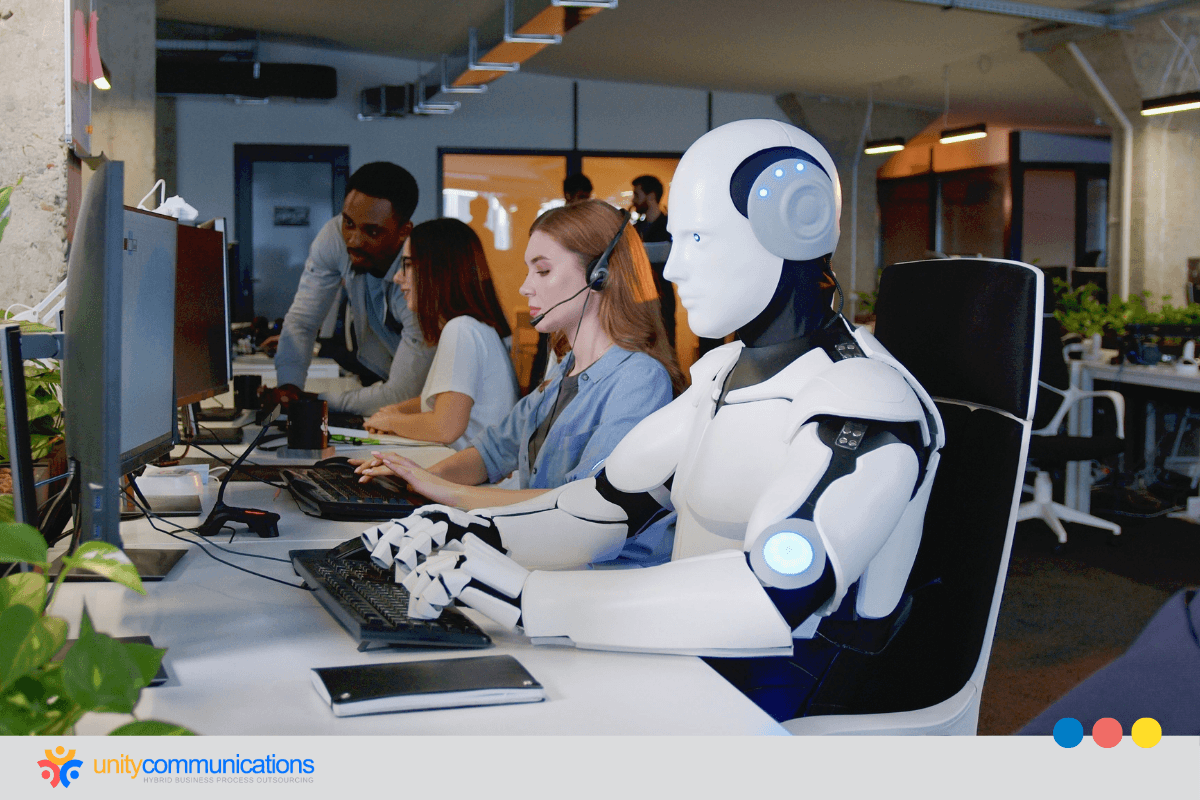


Choosing between an AI contact center and a traditional call center carries consequences that are hard to reverse. Some interaction types need automation’s speed and consistency. Others still need a person’s judgment, and getting that mix wrong costs you either money or customer trust.
This article compares an AI contact center vs a traditional call center. It breaks down what each model actually does, where each one falls short, and how to match the right setup to your specific business—whether that’s full automation, a traditional team, or a hybrid of both.
What does a traditional call center look like?

A traditional call center is a centralized team of live agents who handle customer calls through fixed shift schedules and manual oversight.
The debate over AI vs. customer service agents is largely settled at the level of individual interactions. This article goes one level higher, comparing whole operating models instead.
Traditional call centers are built around people. Every interaction is handled by a live agent, and every operational decision stems from how those agents are staffed and managed.
- Staffing follows fixed shift schedules built around expected call volume and time zone coverage.
- Agents work as a dedicated team, either in-house or outsourced, hired and trained specifically for phone support.
- Channel coverage centers on voice calls, with chat and email typically handled by separate teams or not offered at all.
- Supervisors manage quality and performance through manual call monitoring and reporting.
This structure works well for businesses with predictable call volume and straightforward interactions. It becomes a liability once volume spikes, hours need to be extended, or customers expect support across more than one channel.
The call center vs contact center distinction matters here too. A call center historically means voice-only support, while a contact center covers every channel a customer might use. This baseline is the traditional side of the AI contact center vs traditional call center comparison that this article walks through next.
What an AI contact center actually is
An AI contact center runs customer interactions through automated systems that handle conversations across channels. Human agents only step in for escalations and complex cases.
Most interactions first land with an automated system, built to resolve routine issues without a live agent. The AI contact center vs call center distinction comes down to default routing: One sends work to automation first; the other sends it to a person first.
- AI agents manage conversations across voice, chat, email, and messaging from a single system.
- Automated routing sends interactions to the right resource, whether that’s a bot, a knowledge base, or a live agent.
- Human agents step in for escalations, high-stakes decisions, and cases the AI can’t resolve.
- Performance data flows in real time, giving managers visibility into containment rates and where the AI is falling short.
Many businesses start their AI adoption narrowly, automating a set of repetitive queries first, then expanding scope as containment rates prove out. “What Is an AI Customer Service Agent? A Complete Guide” walks through what that looks like in practice.
What determines success is how well tasks are divided between AI and human agents, and how tightly that division is managed as volume grows.
Where traditional call centers are still limited
Traditional call center limitations show up long before customers notice. The model runs on a fixed headcount, which locks in costs and limits flexibility.
These constraints are exactly what show up in the AI contact center vs traditional call center comparison. One model is bound by staffing math; the other isn’t.
Fixed staffing costs
Every shift needs a scheduled agent regardless of actual call volume. Staffing costs stay flat during slow periods and can’t flex fast enough during spikes, so businesses either overstaff to cover peak demand or understaff and let wait times climb.
Seasonal businesses feel this most acutely, paying for idle headcount most of the year to be ready for a few weeks of high volume. Scaling up for growth means a slow hiring and training cycle.
Agent attrition and training cycles
Replacing a departing agent is costly, and it’s not the only cost. According to SQM, most call centers see 25% or fewer of departing agents move to another role within the same company, meaning the rest leave the organization entirely.
High-turnover environments end up in a constant cycle of recruiting, onboarding, and ramping up new hires, which pulls supervisor time away from coaching experienced agents. New agents also take weeks to reach full proficiency, so quality dips right when a team needs stability most.
After-hours and availability gaps
Coverage depends entirely on who’s scheduled. Support outside standard business hours usually means longer wait times, a smaller overnight team, or no coverage until the next shift starts.
Customers in different time zones or those with urgent issues after hours either wait or look elsewhere. Extending hours to close availability gaps means paying for shifts that might see low volume most nights, raising costs without guaranteeing better outcomes.
Inconsistency across agents
Response quality varies by agent experience, mood, and training. The same question can yield different answers depending on who answers it, which erodes customer trust and makes quality control harder to enforce at scale.
Newer agents might follow scripts rigidly while experienced ones improvise, creating uneven experiences across the same interaction type. This inconsistency also makes it difficult to determine whether a service issue stems from a process problem or an individual performance problem.
Single-channel friction
Most traditional setups are built around voice. Customers who prefer chat or email get routed to a separate process. Other channels come with their own queue, staff, and response times.
This forces customers to switch channels mid-issue if their preferred option is slower, and it prevents a business from seeing a full picture of a customer’s history across channels. Support quality depends on which channel a customer chooses.
Limited real-time analytics
Performance data is typically reviewed after the fact through call logs and supervisor spot checks. Managers find out about a quality problem or a volume spike after it’s already affected customers, rather than catching it as it happens.
This delay limits how quickly a team can adjust staffing, coaching, or process changes. It makes forecasting demand harder since the data driving decisions is already outdated by the time it’s reviewed.
What an AI contact center delivers differently

An AI contact center changes what a traditional call center can staff for and what it can deliver. In this situation, the AI contact center vs traditional call center comparison tips in AI’s favor. AI-powered contact center benefits show up most clearly in day-to-day performance, especially in metrics such as containment rate and CSAT.
24/7 availability
AI agents don’t work shifts. They handle interactions around the clock without rest, overtime pay, night differentials, or shift handoffs. According to Zendesk, 74% of consumers now expect customer service to be available 24/7, making constant availability a baseline expectation. For businesses with customers across time zones, this solves the issue that fixed staffing schedules can’t.
Instant scalability
Call volume spikes don’t require emergency hiring. An AI contact center absorbs a surge in interactions the moment it happens, whether that’s a product launch, a service outage, or a seasonal rush.
No ramp-up period is needed, and no temporary staffing agency gets involved. Capacity adjusts to demand immediately, without a hiring delay.
Omnichannel handling
One system manages voice, chat, email, and messaging together, whereas traditional centers route each channel to a separate team. Customers can start on chat and move to voice without having to repeat themselves, because the AI carries context across the interaction.
Carrying context across channels is one of the clearest differences in AI contact center vs traditional call center. Voice-first models can’t carry a conversation from chat into a phone call. The agent who picks up has no record of the chat, so the customer has to explain the issue again.
Consistent response quality
An AI agent doesn’t have an off day. It won’t skip a step or answer a question differently depending on who’s on shift. The same question gets the same accurate answer every time, based on the same underlying knowledge base.
AI customer service agents show their biggest practical advantage over agent-dependent quality control in this area.
Real-time data and analytics
Every interaction generates data the moment it happens. It doesn’t need a supervisor to review a call log days later. Managers can view containment rates, common issues, and quality signals in real time and adjust routing or escalation rules without waiting for a reporting cycle.
In a 2026 Zendesk CX report, 85% of CX leaders say memory-rich AI agents are key to delivering personalized experiences, which depend on real-time context being available at the moment of interaction.
What AI contact centers still cannot do well
Knowing where AI falls short matters just as much as knowing where it delivers, because deploying it in the wrong places can lead to worse outcomes than sticking with a traditional model.
Emotionally complex conversations
An angry, frustrated, grieving, or scared customer needs to feel heard before they need a resolution. AI can recognize sentiment and adjust tone, but it can’t genuinely read a situation the way a person can.
Complaints tied to a death, a serious illness, or a financial crisis often need a human simply to acknowledge what the customer is going through. Rushing that kind of interaction toward a quick resolution can make the customer feel dismissed, even if the underlying issue is resolved.
High-stakes decisions requiring human authority
Some decisions carry operational, legal, financial, or medical weight that a business isn’t willing to hand to an automated system. Waiving a large fee, approving an exception to policy, or confirming a diagnosis-adjacent detail all require a person who can be held accountable for the call.
AI can gather the relevant information and prepare the case, but the final decision often needs a name attached to it. Businesses in regulated industries feel this limit the most.
Novel or edge-case issues
AI performs well on interactions it has seen before. It struggles with problems that don’t fit existing patterns, such as unusual combinations of account issues or requests that fall outside documented policy.
Without a clear script or knowledge base entry to draw from, AI tends to guess, loop, or hand off the interaction anyway. A human agent can reason through an unfamiliar situation in a way current AI systems still can’t reliably replicate.
Customers who explicitly want a human
Some customers ask for a person outright, regardless of how well the AI is performing. Forcing them through automation first or making it hard to reach a human damages trust even when the AI could have solved the issue correctly.
Respecting that preference matters more than proving the AI works. This is one of the simplest limits to plan around, and one of the most commonly ignored.
AI contact center vs traditional call center: Which fits your business?
When it comes to AI contact centers vs. traditional call centers, the right model depends on interaction volume, complexity, and risk.
Choosing the wrong approach is common enough that half of the companies that cut customer service staff due to AI will end up rehiring, according to Gartner, often under different job titles, as they run into the limits of what AI can handle on its own.
Here’s how that plays out across four common business profiles.
High-volume e-commerce SMB
Order status, returns, shipping updates, and basic troubleshooting make up most of the volume for e-commerce support. These are exactly the interactions AI handles well because they follow predictable patterns and have rule-based answers.
Volume also tends to spike around sales events, holidays, and promotions, which is precisely when fixed staffing struggles most and AI scales without added headcount.
The interactions that still need a person are disputes, fraud concerns, damaged or lost high-value orders, and any customer who explicitly asks for a human.
Our recommendation is an AI contact center that handles the bulk of routine, high-volume interactions, with a clear escalation path for disputes and dissatisfied customers. The main implementation risk is underbuilding the escalation path, since a customer stuck in an automated loop during a dispute will churn faster than one who waits on hold.
Healthcare practice with sensitive patient interactions
Patient interactions carry a different risk profile than retail or service support. A scheduling question is low-stakes. A call about a diagnosis, a medication concern, or a billing dispute tied to a medical bill carries compliance requirements, emotional weight, and decisions that can cause real harm if handled wrong.
HIPAA and other privacy regulations also limit what can be automated without added safeguards around data handling and consent. Full automation isn’t a safe default in this environment, and getting it wrong damages trust in a way that’s hard to rebuild.
We recommend a traditional or lightly augmented model. AI can handle scheduling, appointment reminders, insurance verification, and other administrative tasks that don’t touch clinical judgment or sensitive disclosures.
Every clinical question, symptom-related concern, or emotionally difficult conversation should be routed to a trained person early. The goal here is to draw the line at anything where a wrong or mishandled answer carries clinical or compliance risk.
Professional services firm, low volume, high-touch relationships
Firms in law, accounting, financial advising, and consulting run on relationships. Call and inquiry volume is usually low, so staffing costs don’t face the same pressure as in high-volume environments. That removes the strongest argument for full automation.
Clients also expect a level of personal attention and continuity. They want to speak with someone who knows their history and context, something that AI can’t replicate yet. Routing a high-value client to a bot for a routine question can be perceived as a downgrade in service.
It is best to use a traditional model with targeted AI support underneath it. AI can handle scheduling, intake forms, document collection, and routine follow-ups such as appointment confirmations or status updates, freeing up staff time for the relationship-driven conversations that actually differentiate the firm.
The interactions that matter most here, such as consultations, case updates, and anything requiring judgment or trust, should stay with a person. For this business type, AI’s role is efficiency in the background.
Rapidly scaling startup
Unpredictable growth makes fixed staffing a liability. A startup’s support volume can double in a quarter after a funding round, a product launch, or a viral moment. Hiring can’t keep pace with that kind of swing.
Bringing on a full team of new agents takes weeks of recruiting and training, by which point the volume spike might have already passed or grown further. Budgets are also usually tighter and less predictable than at an established company, making fixed headcount costs harder to justify before revenue catches up.
Starting with an AI contact center makes sense here, built to scale support without a corresponding hiring cycle. This also avoids the sunk cost of building a large support team around a call volume that might look completely different in six months.
Human oversight should be added deliberately as complexity increases. This matters most once the product reaches customers with more varied, higher-stakes support needs than its early base had. Starting with AI here matches the support model to a growth curve that a traditional staffing model can’t follow.
The hybrid model
Most businesses don’t fit neatly into an AI contact center or a traditional call center. They land in a hybrid AI contact center model.
This model splits work by complexity:
- AI handles the routine volume and answers them instantly across whatever channel the customer uses.
- Anything that requires judgment or is flagged by the customer as needing a person is routed to a human agent.
As AI proves itself on a narrow set of interactions, businesses typically expand its scope gradually.
SMBs land here because they don’t have the volume to justify a fully automated build-out, and they don’t have the staffing budget to run a large traditional team either. A hybrid model lets them get AI’s cost and availability advantages on routine work while keeping a person available for anything that actually needs one.
According to Forrester, a third of companies will damage customer trust by deploying AI self-service prematurely. A hybrid approach is a direct hedge against that outcome. Unity Communications manages hybrid delivery with trained people and oversight.
Unity Communications provides access to offshore and nearshore agents already embedded in the support workflow. They’re trained on the client’s processes and ready to handle escalations from day one, with no onboarding delay. As AI takes on more routine volume, these agents monitor performance and catch cases in which automation gives an incomplete or incorrect answer.
The right setup is a managed hybrid. Unity provides this through its contact center as a service, pairing AI with trained agents who handle escalations and maintain consistent quality as automation expands.
How do you transition to AI without losing quality?
Transition safely by auditing your interaction mix, piloting AI on bounded, low-risk cases, and building human escalation before full rollout.
Contact center modernization means deciding where automation belongs and where people still need to own the conversation. Moving from a traditional call center to an AI-enabled model works best as a staged rollout. Skipping steps can cause service quality to drop during the transition.
- Audit your current interaction mix. Break down call and message volume by type to see which categories are repetitive and rule-based versus which require judgment or emotional handling.
- Identify AI-ready interactions. Start with the categories that are high-volume, low-risk, and follow a predictable pattern, such as order status, appointment scheduling, or password resets.
- Pilot with a bounded scope. Launch AI on a narrow set of interaction types first, rather than rolling it out across every channel and category at once.
- Measure before expanding. Track containment rate, CSAT, and escalation frequency on the pilot before adding more interaction types or channels.
- Build the human escalation path before going live. Make sure trained agents are in place to catch failed automation and handle anything AI can’t resolve, from day one of the pilot.
Unity Communications supports this staged rollout by having agents already trained on client workflows, so the escalation layer is in place before the first pilot begins.